

A startup’s IT needs can change quickly. A small team may first need reliable helpdesk support, then require stronger security, cloud services or help for new staff. That’s why IT support packages for UK startups are best compared by what they cover, not by tier names alone. Avoid paying for services you’re not ready to use, while making sure essential support is clearly defined.
This guide explains which services to compare, what to ask about coverage and costs, and how to review an arrangement as your organisation grows. It also looks at what may be useful from the outset and what can wait until your needs change.
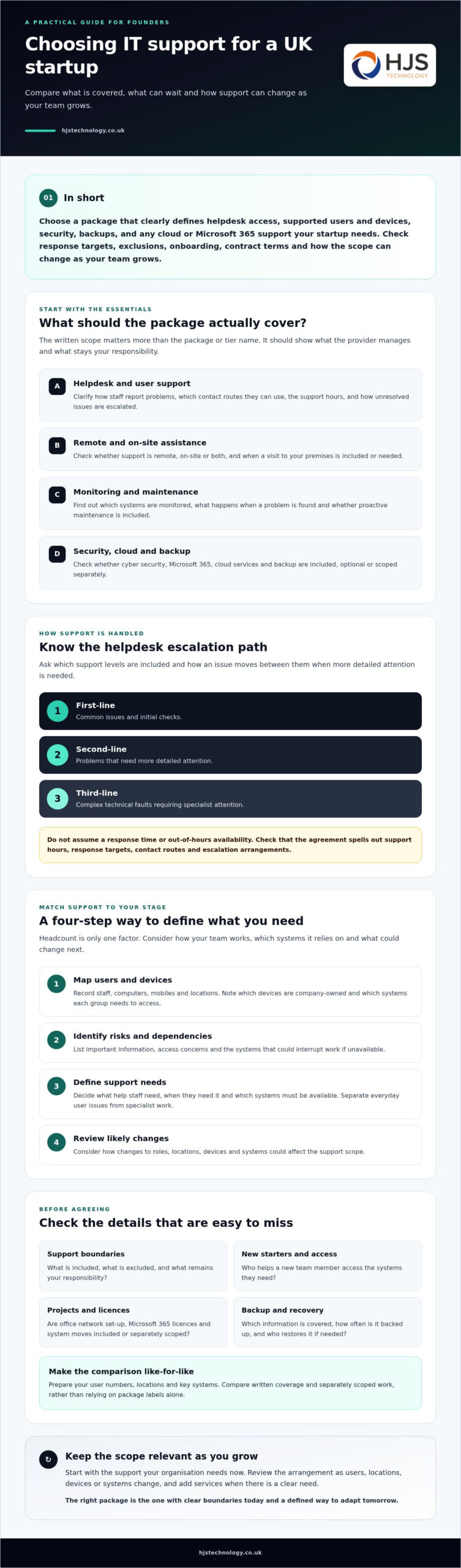
In short: An IT support package for a startup should clearly define helpdesk access, supported users and devices, security, backups, and any cloud or Microsoft 365 support you need. Check response targets, exclusions, onboarding, contract terms and how the arrangement can change as your team grows. Choose based on current needs, with planned review points.
Key Takeaways
- Compare IT support packages for UK startups by their written scope, not just their tier names.
- Map your users, devices, working patterns and reliance on key systems to identify the support your team needs now.
- Clarify which support channels, hours and on-site arrangements are included, and what monitoring and maintenance involve.
- Prepare your user numbers, locations and key systems before comparing providers, then review the agreement as your organisation grows.
What should IT support packages for UK startups include?
An IT support package is an agreed scope of helpdesk support and related services. It should make clear what the provider manages and what remains your responsibility. For startups comparing managed IT support in Southampton, the written scope matters more than the package label.
Core support may include a helpdesk for reporting problems, remote assistance to resolve issues without a visit, and on-site support when a task requires someone at your premises. Monitoring means checking agreed systems for issues. Ask which systems are monitored, what happens when a problem is found and whether proactive maintenance is included.
Separate ongoing support from one-off projects, software licences and infrastructure work. Setting up a new office network, buying Microsoft 365 licences or moving systems may need to be scoped separately. Ask for these items to be listed clearly so you can compare proposals on a like-for-like basis.
Which support tasks should be covered from day one?
First-line helpdesk staff handle common issues and initial checks. Second-line support investigates problems that need more detailed attention, while third-line specialists address complex technical faults. Ask which levels are included and how an unresolved issue is escalated between them.
Before agreeing, confirm support hours, contact routes and escalation arrangements. Check whether staff should contact the helpdesk by phone, email or another method, and what happens when support is needed outside the stated hours. Don’t assume a response time or availability unless the agreement spells it out.
Also ask how routine tasks are handled. For example, confirm who helps when a new starter needs access to a system, or when a member of staff cannot connect to a cloud service. Clear examples can expose gaps that a general description such as “IT support” may not.
Which services can a startup add as it grows?
As your organisation develops, related needs may include cyber security services, Microsoft 365, cloud services and backup. Check whether each service is included, optional or separately scoped. Don’t assume every package covers the same areas.
For backup, clarify what information is covered, how often it is backed up and who is responsible for restoring it if needed. Ask how backup arrangements relate to the systems your team relies on, rather than treating backup as a general tick-box. You can also ask what business backup and recovery planning would involve for your organisation.
HJS Technology offers managed IT support with first-, second- and third-line helpdesk assistance, alongside cybersecurity, cloud services, Microsoft 365 and data backup and recovery. Ask which services fit your current requirements and how any additional work would be set out.
How can a startup choose IT support that fits its stage?
Choose support by matching it to how your team works, which systems it depends on and what may change next. Headcount is only one factor: a small team relying on one cloud platform may need different coverage from a larger team using several systems across different locations.
Use this framework to shape your requirements before comparing IT support packages for UK startups:
- Map users and devices: Record staff, computers, mobiles and locations. Note which devices are company-owned and which systems each group needs to access.
- Identify risks: List important information, access concerns and the systems that could interrupt work if unavailable. The NCSC Small Business Guide offers practical advice on security basics.
- Define support needs: Decide what help staff need, when they need it and which systems must be available. Separate everyday user issues from work that needs specialist attention.
- Review growth plans: Consider expected changes to roles, locations, devices and systems, and ask how those changes could affect the support scope.
Separate essential coverage from optional services. Help with a business-critical system may be a current priority, while additional services can wait until there’s a clear need. This keeps the scope grounded in your operations rather than assumptions about which package tier you should choose.
How should founders assess current support needs?
List your users, devices, locations, key systems and any IT tasks handled internally. Identify the tools staff rely on most and what they need to do if access or service is disrupted. For example, note whether a problem with email, shared files or business software would prevent particular staff from working.
For firms in Southampton and the surrounding area, consider whether on-site assistance is relevant alongside remote support. HJS Technology is based in Southampton and serves organisations in Southampton, Portsmouth, Winchester, Eastleigh and Fareham, as well as Dorset, Poole, Hampshire, Salisbury, Wiltshire and Bournemouth. Ask how the proposed support arrangement would handle your locations and working patterns.
How can a support arrangement keep pace with growth?
Ask how the provider reviews scope as your team changes. Confirm how new starters, leavers, additional devices and new locations are handled, and whether these changes affect the agreement. If staff rely on Microsoft tools, clarify what Microsoft 365 support for business users covers, including the tasks that remain your responsibility.
Once you’ve mapped your requirements, discussing them with a provider can help clarify what’s essential now and what can wait. HJS Technology Ltd is one provider to consider as you assess support for your startup.
What should startups check before agreeing an IT support package?
Check the written scope before agreeing. It should say which users and devices are covered, how support is reached, when it’s available and whether on-site assistance is included. Clear boundaries make it easier to compare proposals without relying on tier names or assumptions.
- Are all current users and relevant devices included?
- Which support channels can staff use, and during what hours?
- How is on-site support arranged?
- What do monitoring and maintenance cover, and what happens if an issue is found?
- Are strategic reviews included, and what do they involve?
Ask for each item to be defined in the agreement. Terms such as “monitoring” or “strategic support” can mean different things, so clarify the specific systems, activities and review process covered. If the proposal refers to response targets, check exactly what each target measures and when the clock starts.
Which service boundaries should be clear in writing?
Confirm what’s included, excluded or separately scoped. Project work, cloud subscriptions and hardware procurement may need separate clarification, as may services provided by other suppliers. Ask who coordinates with those suppliers and how an issue is escalated if it involves more than one service. For broader business setup steps, consult official government guidance for UK startups.
How should a startup compare providers fairly?
Give each provider the same assumptions: user and device numbers, support coverage, security requirements and systems to be supported. Then check whether each proposed service addresses a real business need, rather than accepting a generic bundle. Compare written scopes on a like-for-like basis, including any separately listed costs.
HJS Technology Ltd is ISO 27001 certified, which may be relevant when reviewing a provider’s approach to information security. Certification is useful context, but it doesn’t guarantee a particular service outcome. Assess the proposed agreement and its scope directly.
How can UK startups take the next step with IT support?
Document what your team needs, identify what you’re unsure about, compare written scopes and then arrange a discussion with a provider. This gives you a practical basis for assessing IT support packages for UK startups and helps keep the conversation focused on your organisation rather than a generic bundle.
Before comparing proposals, prepare a short overview of:
- Approximate user and device numbers, plus your business locations.
- The main systems and cloud services your team uses.
- Your current support arrangements and any recurring issues.
- Known changes, such as planned recruitment, a new location or a move to different systems.
What information should a founder prepare?
Separate confirmed requirements from open questions. For example, you may know that staff need help accessing a core business system while still needing advice on how that system should be supported. This helps a provider distinguish what you’ve already decided from areas that need further assessment.
HJS Technology is based in Southampton and supports organisations across Hampshire and the south coast. A discussion can help clarify how your requirements might translate into an agreed support scope, including which details need to be confirmed in writing.
When should a startup review its IT support?
Revisit the arrangement when staffing, working locations or reliance on business systems changes. A growing team, a new office or a shift towards cloud-based tools may affect which users, devices and services need support. Rather than assuming the original scope will remain suitable, raise changes with your provider and discuss whether the written agreement needs updating.
Regular scope discussions can help keep support aligned with business priorities. You don’t need to wait for a particular milestone: review the arrangement whenever a meaningful change prompts new questions about coverage.
For contact details and a way to raise questions about your requirements, visit the HJS Technology contact page.
Choose support that can grow with your startup
The right IT support arrangement starts with a clear picture of your users, devices and business-critical systems. Compare written scopes against those needs, check what is included or separately scoped, and plan to review the arrangement as your organisation changes. That’s a practical way to assess IT support packages for UK startups without paying for services you don’t currently need.
HJS Technology Ltd is a Southampton-based provider established in 2007, offering first-, second- and third-line helpdesk support. Its monthly managed IT support fees include unlimited remote and on-site technical assistance, 24/7 system monitoring, proactive maintenance and strategic IT management for a fixed monthly cost. Ask how these services would apply to your requirements and confirm the scope in writing.
With a clear scope and review points in place, you can choose support that fits your business now and revisit it as your team and priorities develop.
Frequently Asked Questions
What should IT support packages for a UK startup include?
An IT support package should define an agreed scope of services and responsibilities, including how users access the helpdesk and what monitoring covers. It may also include remote or on-site assistance, depending on the agreement. Inclusions vary, so ask for support hours, escalation arrangements, on-site provisions and exclusions in writing. Clear terms help founders compare what’s actually covered.
How much do IT support packages cost for a UK startup?
The cost depends on the agreed scope, number of users and services required, so there isn’t one price that applies to every startup. Ask providers for a written proposal that separates recurring support from project work, software licences and other costs. Then compare proposals based on equivalent users, coverage and services, rather than headline figures alone.
Can a startup use managed IT support without an in-house IT team?
Yes. An outsourced provider can handle routine technical requests and escalate more complex issues, although the right arrangement depends on your systems and the responsibilities you retain internally. Before agreeing, clarify who manages day-to-day staff requests, who advises on longer-term IT decisions and how work outside the agreed scope is handled. This helps founders understand where the provider’s role begins and ends.
When should a startup review its IT support package?
Review the arrangement when your users, locations, systems or operational priorities change. For example, hiring staff, opening another workplace or relying on new business software may affect what needs support. Compare those updated requirements with the written service scope, then discuss any necessary changes with your provider. There’s no single review interval that suits every startup, so let business changes guide the conversation.
Do IT support packages include cyber security and data backup?
Cyber security and data backup may be included in an IT support package or agreed separately. Check specifically whether endpoint protection, security monitoring and backup coverage are included, which devices or information they cover, and who is responsible for recovery if needed. Don’t assume general IT support alone guarantees security or that backed-up information can be recovered without clearly defined arrangements.