

Migrating commercial infrastructure to the cloud is fundamentally an operational and financial decision rather than a technical task. For south coast businesses facing aging on-premises servers and unpredictable maintenance costs, partnering with an experienced cloud consultancy Hampshire provider brings clarity to complex infrastructure choices. When coordinating legacy systems alongside modern business IT support, you shouldn’t have to tolerate unexpected hosting bills or disruptive cutovers.
Independent advisory services modernise operational systems, enhance information security, and eliminate wasted recurring software expenditure. In this guide, you’ll discover how to evaluate public, private, and hybrid configurations whilst keeping daily operations steady. We examine the four essential stages of cloud migration and highlight the accreditations required to select the right regional partner.
In short: Independent cloud consultancy provides Hampshire organisations with architectural design, security alignment, and cost governance before migrating systems. Rather than simply reselling software licences, a regional consultant designs resilient public or hybrid environments, safeguards business continuity, prevents unexpected monthly billing spikes, and ensures full compliance with UK data protection regulations.
Key Takeaways
- Understand how independent architectural advice separates long-term infrastructure planning from transactional software sales to keep ongoing overheads controlled.
- Compare public, private, and hybrid hosting architectures to balance initial capital expenditure with predictable operational budgets.
- Adopt a phased four-stage migration framework using pilot testing to safeguard critical data integrity and avoid operational downtime.
- Identify the essential technical accreditations and governance standards to look for when choosing an independent cloud consultancy Hampshire partner.
What does cloud consultancy include for Hampshire businesses?
Cloud consultancy provides vendor-neutral architectural guidance and strategic planning to help businesses select, configure, and manage off-premises infrastructure. Unlike standard hardware sales or transactional software reselling, an experienced cloud consultancy Hampshire specialist evaluates your commercial workflows before recommending technical deployments. Through structured advisory services, local businesses ensure their digital infrastructure supports commercial growth rather than dictating it.
Purchasing Microsoft licences from an online catalogue simply grants access to software seats without governing storage, identity security, or configuration. Professional consultancy aligns those platforms directly with operating realities, addressing issues such as remote working across the south coast, end-of-life on-premises servers, and unmanaged file sprawl. Independent advisers evaluate public, private, and hybrid configurations to ensure every workload resides in its most secure, cost-effective setting.
Cloud readiness assessments and infrastructure audits
A cloud readiness audit provides a comprehensive physical and technical review of your existing server estate, network switches, and local internet connectivity. It analyses line-of-business software dependencies and user access permissions to uncover potential risks prior to migration. A structured readiness audit uncovers hidden performance bottlenecks by measuring real-time network throughput and application latency across your entire organisation.
Strategic roadmap planning versus standard IT support
While reactive IT helpdesks resolve immediate ticket issues like password resets or hardware faults, strategic roadmap planning designs long-term operational resilience. It aligns cloud migrations directly with executive milestones, office consolidations, or software modernisation projects. This strategic oversight establishes clear benchmarks for mobile working capabilities, system performance, and verified data recovery timelines.
Comparing cloud architecture options: Public, private, and hybrid setups
Selecting the right cloud architecture depends on whether your business prioritises elastic scalability, dedicated hardware isolation, or a balanced hybrid deployment. Public platforms shift irregular capital expenditure into predictable monthly operating overheads, whilst private servers deliver rigid control over bespoke line-of-business systems. For regional organisations handling sensitive client records, adhering to established UK government cloud migration and hosting guidelines ensures ongoing compliance with UK GDPR data sovereignty rules.
A hybrid model remains the most practical choice for organisations that require rapid local file processing alongside flexible offsite access. This structure keeps data-heavy operations responsive in the local office whilst synchronising communication tools and document management systems to the cloud. Partnering with an experienced cloud consultancy Hampshire specialist ensures each commercial application resides in its most cost-effective and secure operating tier.
When to choose Microsoft Azure or hybrid environments
Microsoft Azure delivers elastic compute capacity that scales effortlessly during business expansion or seasonal spikes in demand. For regional offices across Southampton, Portsmouth, and Winchester, a hybrid design ensures broadband limitations do not bottleneck everyday commercial workflows. This arrangement secures unified identity management in the cloud whilst keeping latency-sensitive databases or legacy accounting tools running smoothly on local hardware.
Controlling cloud licensing and recurring consumption expenditure
Unchecked cloud bills frequently result from over-provisioned virtual servers running continuously during downtime and unassigned cloud software subscriptions. Proactive cost reviews eliminate this waste by continuously aligning provisioned processing power and seat allocations with genuine staff usage. If you want to review your ongoing infrastructure spend, get in touch with our advisory team for practical guidance on optimising your environment.
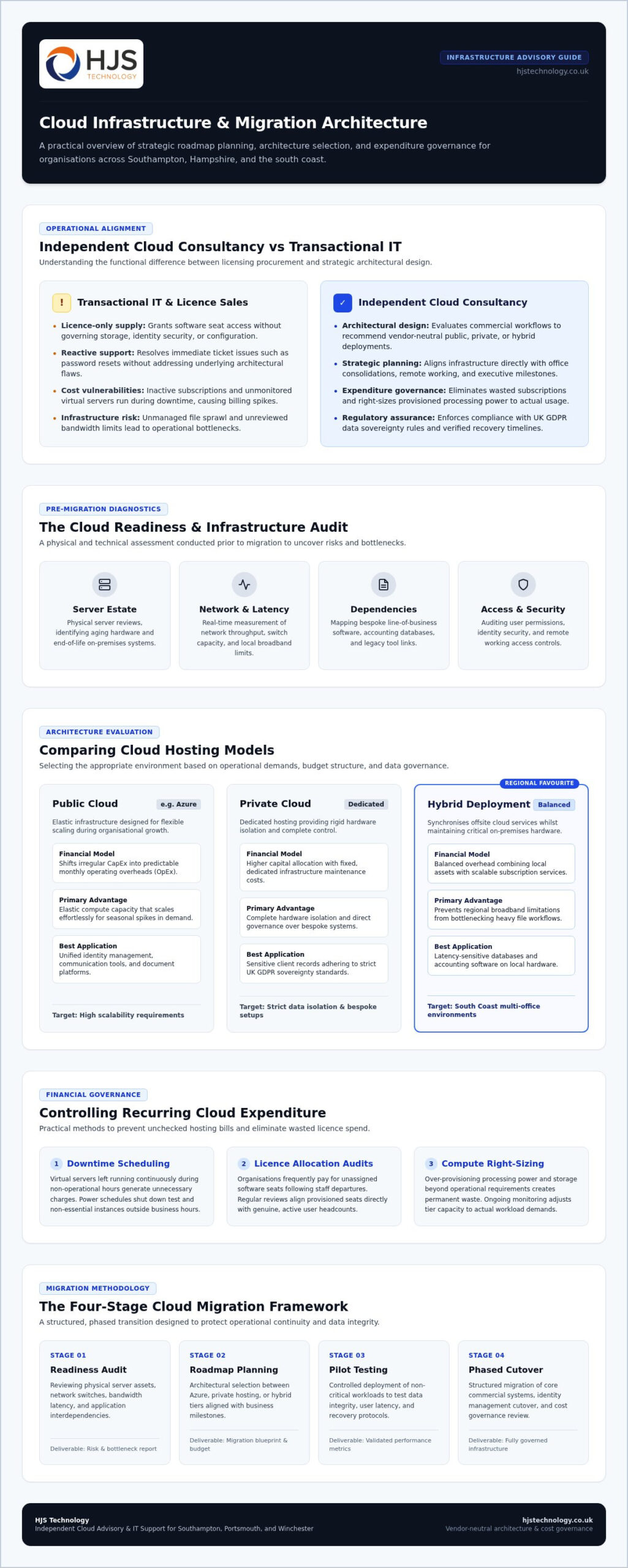
The four-stage cloud migration process for regional organisations
A structured cloud migration follows four distinct phases: discovery, architecture design, staged migration, and post-cutover support. This disciplined framework eliminates unscheduled downtime by validating system performance before decommissioning physical servers. Working with an experienced cloud consultancy Hampshire provider ensures every stage has a documented rollback plan to protect business operations.
During the pilot phase, consultants migrate non-critical data subsets to test synchronisation speeds and benchmark security configurations against the NCSC cloud security principles. Live cutovers occur outside standard working hours, meaning your staff finish on Friday and log into their cloud environment on Monday morning without disruption. Structured data backup and recovery procedures safeguard every file throughout the transfer process.
Ensuring data security and UK GDPR compliance during migration
Protecting sensitive business information requires continuous data encryption both in transit across public networks and at rest in cloud repositories. Access controls enforce Multi-Factor Authentication (MFA) and conditional access policies before employees log in from remote locations. Detailed audit logs maintain complete compliance with statutory UK GDPR guidelines and satisfy cyber insurance underwriting standards.
Managing user adoption and secure file access across remote teams
User adoption depends on keeping file management straightforward for non-technical employees. Mirroring familiar drive mappings through Microsoft 365 tools like SharePoint Online preserves daily workflows without confusing staff. Granular permission tiers prevent accidental folder sharing and ensure commercial data remains restricted to authorised personnel.
How to select the right cloud consultancy partner in Hampshire
Selecting the right provider requires verifying formal security certifications, proven architectural experience, and genuine local accountability. An independent consultant prioritises commercial objectives over aggressive software licensing, ensuring your digital infrastructure remains scalable and financially predictable. Partnering with a specialist within easy reach of your offices guarantees rapid on-site assistance whenever physical hardware, structured cabling, or network routing issues arise.
Key operational criteria to evaluate before signing an advisory contract include:
- Objective recommendations focused on eliminating cloud waste rather than inflating monthly licence counts.
- Established regional presence across Southampton, Portsmouth, and Winchester for direct engineering support.
- Documented migration methodologies backed by audited rollback and disaster recovery testing.
Choosing an experienced cloud consultancy Hampshire specialist protects your organisation from restrictive vendor lock-in. It ensures your infrastructure strategy reflects your commercial ambitions rather than third-party sales targets.
Essential security accreditations and technical credentials to verify
Prioritise providers maintaining rigorous governance certifications, particularly ISO 27001 for comprehensive information security management and Cyber Essentials accreditation. These independently audited standards prove that client databases, migration scripts, and administrative accounts remain protected under documented risk management frameworks. You should also confirm direct access to qualified technical consultants rather than having critical design decisions handled solely by account managers.
Establishing your cloud modernise roadmap
A trusted adviser determines whether your organisation requires an immediate server replacement or a phased, multi-year cloud modernisation roadmap. They assess your operational tolerance for change, defining precise service levels for both day-to-day helpdesk assistance and strategic system reviews. To review your current infrastructure and explore practical migration strategies, book a consultation via the HJS Technology contact page today.
Modernise your regional IT infrastructure with strategic confidence
Migrating your commercial infrastructure to the cloud shouldn’t mean facing unpredictable hosting bills or operational downtime. By combining disciplined architectural planning with staged rollout schedules, your organisation protects critical data assets whilst eliminating unnecessary licence expenditure. Engaging an independent cloud consultancy Hampshire specialist provides the strategic clarity needed to modernise systems effectively.
Based in Southampton since 2007, HJS Technology maintains ISO 27001 certification to deliver dependable architectural guidance across Hampshire, Dorset, and Wiltshire. Our dedicated engineers evaluate your current systems and align each cloud service with your commercial priorities, ensuring your staff work securely without interruption.
Taking control of your cloud strategy today eliminates unexpected IT overheads, protects your commercial continuity, and prepares your business for sustainable long-term success.
Frequently Asked Questions
How much does cloud consultancy cost for a Hampshire SME?
Cloud consultancy fees typically depend on the total scale of your IT estate, user counts, and architectural complexity. Most projects are scoped either as fixed-price discovery and migration packages or through monthly retained advisory agreements. A structured audit provides an accurate, transparent proposal tailored to your specific commercial requirements without unexpected licence charges.
What is the difference between a cloud reseller and an independent cloud consultant?
A cloud reseller primarily focuses on selling software licences and consumption tiers, whereas an independent consultant designs bespoke architectures aligned with your commercial objectives. Transactional resellers often encourage higher subscription volumes to boost vendor commissions. In contrast, an accredited cloud consultancy Hampshire specialist analyses workflows objectively, working to reduce cloud waste and configure environments around genuine operational demand.
How long does a typical business cloud migration take to complete?
A standard SME cloud migration typically takes between four and twelve weeks from initial audit to final decommissioning. The duration depends heavily on total data volume, line-of-business software compatibility, and whether legacy databases require rearchitecting. Phased migrations allow non-critical services to transition first, ensuring full user validation before core commercial applications move across to the production cloud environment.
Will our staff experience downtime during a cloud migration?
Your staff should experience no disruption to daily operations when a migration is properly planned and executed. Technical cutovers are scheduled outside normal business hours, usually over a weekend, after exhaustive pilot tests confirm data integrity. Employees simply log out of their local network on Friday afternoon and reconnect to their modernised cloud workspace on Monday morning without missing work.
Do we need to replace all our on-premises servers to use cloud services?
You do not need to replace every on-premises server to benefit from cloud technology. Many businesses adopt a hybrid model that keeps heavy local processing or proprietary tools on existing hardware whilst moving file shares and emails to platforms like Microsoft 365. Engaging a reliable cloud consultancy Hampshire partner helps you identify which servers can be decommissioned immediately and which remain commercially viable onsite.