

Many businesses in Hampshire are still relying on traditional landline phone systems. These systems often feel disconnected from the modern way of working, lacking the flexibility for remote staff and carrying high, unpredictable costs. A modern phone system should support your team wherever they are, integrate with your other business tools, and provide a professional experience for your clients without needing bulky hardware in the office.
Deciding to modernise is the first step, but understanding the options is crucial. For organisations across the south coast, moving to a cloud-based system is not just a technical upgrade; it’s a strategic decision that affects productivity, security, and your monthly budget. With the right planning, you can get a more effective and secure system by choosing the right business telephone solutions that fit your specific needs.
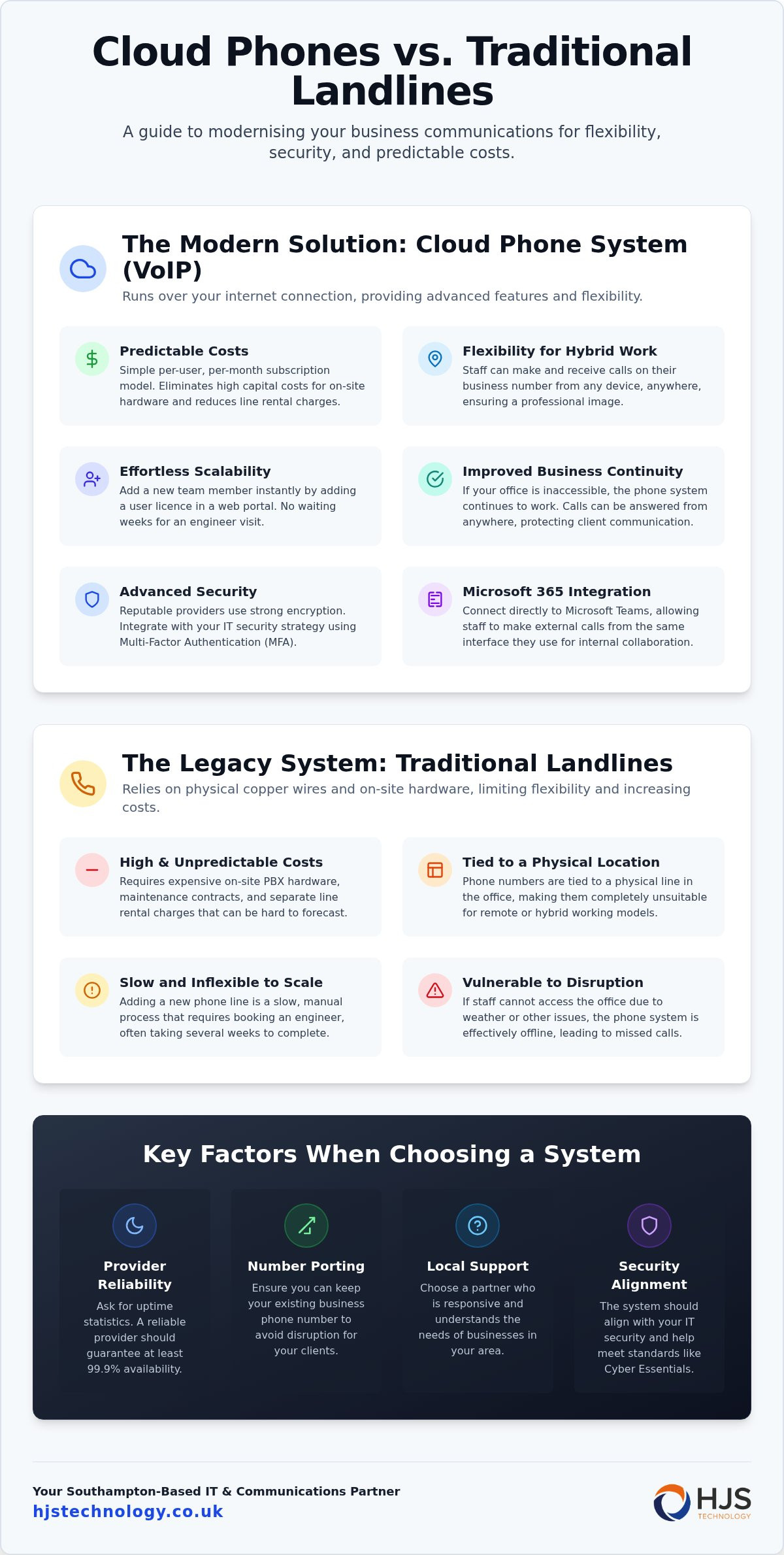
In short: A cloud phone system, or VoIP, uses your internet connection to make and receive calls, replacing traditional landlines. For most UK businesses, it offers lower costs, greater flexibility for remote working, and advanced features. Landlines are reliable but are becoming obsolete, less flexible, and often more expensive to maintain.
What is a cloud phone system and how does it work?
A cloud phone system is a modern telephone service that runs over the internet instead of traditional copper wires. It converts your voice into digital data, allowing you to make and receive calls from a desk phone, computer, or mobile app, anywhere with an internet connection. This technology is often called VoIP, which stands for Voice over Internet Protocol.
Unlike a traditional landline which relies on a physical box in your office, known as a Private Branch Exchange (PBX), a cloud system is hosted securely online. This eliminates the need for expensive on-site hardware and maintenance. All the complex technology is managed by the provider, giving you a simple, software-based way to manage your organisation’s calls.
This approach means your business phone number is no longer tied to a specific physical line or location. Your team in Southampton can work just as effectively as a team member working from home elsewhere, all appearing as part of the same professional phone system.
What are the business benefits of switching from a landline to VoIP?
The main benefits of switching to a VoIP system are significant cost savings, improved flexibility for staff, and the ability to scale your communications effortlessly. You remove the high capital cost of on-site hardware and often reduce your monthly outgoings by eliminating traditional line rental charges.
For a growing business, the advantages are particularly clear:
- Predictable costs: Cloud systems typically operate on a per-user, per-month subscription. This makes your communication costs predictable and directly tied to your headcount, so you only pay for what you use.
- Support for hybrid work: Staff can make and receive calls on their business number from any location using a mobile or desktop app. This ensures a consistent and professional image, whether they are in the office or working remotely.
- Effortless scalability: Adding a new team member is as simple as adding a new user licence in a web portal. There is no need to wait for an engineer to install a new physical phone line, which could take weeks.
- Improved business continuity: If you cannot get to the office due to bad weather or travel disruption, your phone system continues to work. Calls can be answered from anywhere, ensuring you never miss an important client call.
Are cloud phone systems secure?
Yes, modern cloud phone systems are highly secure, often more so than traditional landlines which can be physically intercepted. Reputable providers use strong encryption to protect your voice traffic, making conversations unreadable to anyone trying to listen in. This security is a critical part of protecting sensitive commercial information discussed over the phone.
However, because the system is connected to the internet, it must be treated as part of your overall IT infrastructure. Your phone system is a potential entry point for cyber threats if not managed correctly. Security is not just about the provider; it also depends on how you manage access and usage within your organisation.
How does a cloud phone system fit with our IT and security?
A cloud phone system should be integrated into your wider IT and security strategy, not treated as a separate utility. This means applying the same security principles you use for your computers and data. For example, users should be required to use Multi-Factor Authentication (MFA) to log into their softphone apps, just as they would for their email.
As an ISO 27001 certified company, we ensure that any communications system we provide aligns with recognised security standards. Integrating your phones with your IT helps you meet compliance goals like those required for Cyber Essentials certification. This unified approach ensures all parts of your technology are working together securely.
Can cloud phones connect with Microsoft 365?
A key advantage of a modern phone system is its ability to connect with the other tools you use every day. Many cloud systems can be linked directly to Microsoft Teams, turning it into your primary business phone. This allows your staff to make and receive external calls from the same Teams interface they use for internal chats and video meetings.
This creates a truly unified communications experience. When your team can manage calls, video, and messaging from a single application, it reduces complexity and improves efficiency. You can even manage and store call recordings securely within your own Microsoft 365 environment, giving you full control over your data.
How do we choose the right cloud phone system?
Choosing the right system involves looking beyond features and focusing on reliability, support, and how the system will fit with your existing infrastructure. The best system is one that meets your specific business needs and is backed by a provider you can trust. A cheap, off-the-shelf solution might seem appealing but can cause major problems if the call quality is poor or the support is unresponsive.
Here are key factors to consider for your organisation:
- Provider reliability: Ask for their uptime statistics. A reliable provider should guarantee at least 99.9% availability to ensure your phones are always working.
- Number porting: Confirm that you can keep your existing business phone numbers. The process of moving numbers, known as porting, should be managed for you to ensure a smooth transition.
- Quality of support: When you have a problem, you need to speak to an expert quickly. Check that the provider offers UK-based technical support and has a responsive helpdesk.
- Network readiness: A cloud phone system relies on a stable internet connection. Before you switch, your IT provider should check that your business broadband and Wi-Fi can handle the extra traffic without affecting call quality.
What is the process for switching to a cloud phone system?
A well-managed transition from a landline to a cloud system should involve minimal disruption to your business. A managed service provider will handle the technical details, but the process generally follows a clear plan to ensure everything goes smoothly.
The key steps usually include:
- Audit and discovery: An initial assessment of your current phone usage, costs, and network infrastructure to identify the best solution.
- System design: Creating a plan for call routing, user setup, and any special features you need, such as an automated attendant to direct calls.
- Phased rollout: The system is often rolled out to a small group of users first. This allows for testing and training, ensuring everyone is comfortable before the whole company switches over.
- Number porting: Your existing phone numbers are scheduled to be moved to the new system on an agreed date, which is managed carefully to avoid any loss of service.
- Ongoing support: After the switch, you should have access to ongoing support to help with any questions and to make changes as your business evolves.
Why work with a local IT partner for your phone system?
Working with a single, trusted IT partner for both your technology and your telecoms provides significant advantages. It ensures that your phone system is not an isolated element but a fully integrated part of a secure and efficient IT environment. When one team understands your entire setup, from your firewall to your phone handsets, troubleshooting is faster and strategic planning is more effective.
An IT partner based in Southampton can provide a more personal and accountable service. We focus on your long-term business goals, not just the technical specifications of a phone system. This partnership approach means we align your communication tools with your operational needs, helping you improve productivity and customer service.
Your next steps
If your current phone system is holding your business back, it is time to explore the benefits of a modern, cloud-based solution. The first step is to understand how your organisation works and what it needs from its communications technology.
We can help by providing a clear, no-obligation audit of your current setup and costs. To discuss a migration plan tailored to your business, please contact the HJS Technology team for an initial consultation.
Frequently Asked Questions
Can I keep my existing business phone numbers?
Yes, in almost all cases you can keep your existing phone numbers. The process is called ‘number porting’ and it is a standard procedure managed by your new provider to ensure you retain your business identity.
Do I need a special type of internet connection?
You do not need a special type, but you do need a business-grade internet connection that is stable and has sufficient bandwidth. Your IT provider can test your connection to ensure it is suitable for high-quality voice calls.
How secure are cloud telephone systems?
They are very secure. Calls are protected by encryption, which scrambles the data to prevent unauthorised listening. When managed as part of a wider IT security strategy, they are often more secure than older, analogue phone lines.
Can I use a cloud phone system on my mobile?
Yes. Most cloud phone systems come with a mobile app that allows you to make and receive calls from your business number on your personal smartphone. This is ideal for remote and hybrid workers.
What happens if the office internet goes down?
One of the major benefits of a cloud system is business continuity. If your office internet fails, you can automatically redirect calls to mobile numbers or to staff using the app at home, so you never miss a call.
Is a cloud phone system compatible with Microsoft Teams?
Yes, many cloud phone systems can integrate directly with Microsoft Teams. This allows you to make and receive external calls from within the Teams application, creating a single platform for all your business communications.