

Running a growing company requires dependable technology that stays operational beyond traditional office hours. Modern operations depend on cloud platforms, remote staff, and automated workflows that function day and night. Choosing reliable business IT support in Southampton ensures your critical systems receive immediate attention whenever problems arise.
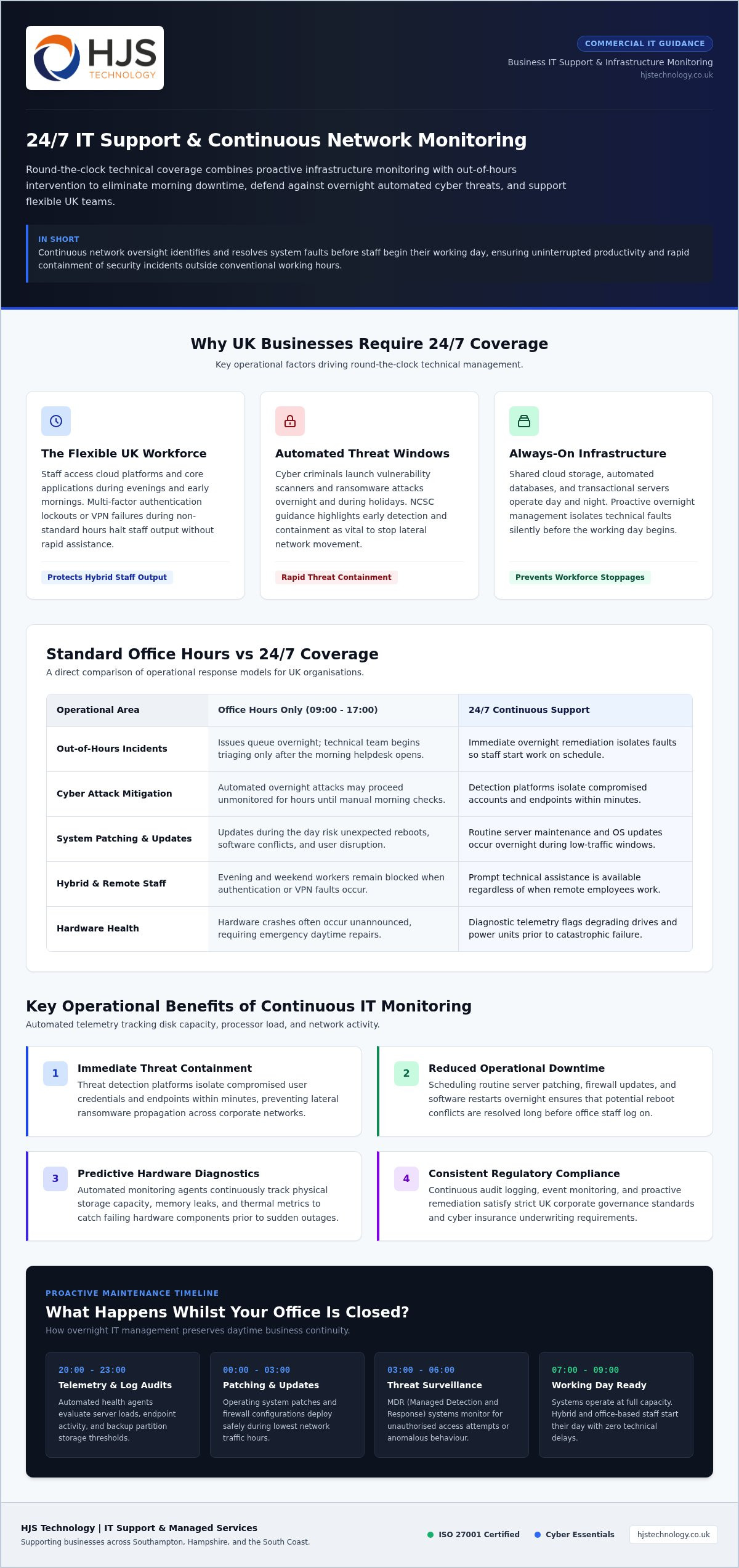
In short: 24/7 IT support for business UK combines continuous network monitoring with out-of-hours technical assistance to protect organisations from unexpected downtime and automated cyber attacks. This proactive approach identifies and resolves infrastructure faults before employees start their working day, ensuring uninterrupted productivity across standard and flexible working schedules.
Why does your UK business need 24/7 IT support?
Round-the-clock technical coverage prevents operational stoppages and protects systems from security incidents that occur outside conventional working hours. Continuous support guarantees that system updates, security patches, and hardware alerts are addressed instantly rather than waiting for the morning helpdesk to open.
Traditional operating models assumed that technical systems rested when the office doors closed at five o’clock. Modern organisations now share data continuously across cloud environments, communicate across international time zones, and support hybrid workers who start early or finish late. Unresolved network failures occurring overnight can stall an entire workforce the following morning, resulting in substantial financial loss and missed client deadlines.
Technical dependency has made uninterrupted availability a baseline requirement for commercial survival. When critical servers, databases, or cloud access tokens fail at midnight, immediate remediation preserves business continuity. Proactive management isolates technical faults silently, allowing standard commercial operations to proceed without interruption.
The rise of the flexible UK workforce
Flexible and hybrid working patterns mean employees access core business applications during evenings, weekends, and early mornings. When a team member encounters a multi-factor authentication lockout or a lost VPN connection during non-standard hours, their productivity stops without immediate technical support. Providing round-the-clock assistance ensures that remote staff receive prompt help whenever they choose to complete their duties.
Remote working arrangements also expand the surface area of potential technical friction across diverse home networks and mobile hardware. Having support available at all hours prevents minor configuration issues from escalating into major operational bottlenecks. Businesses that accommodate flexible working schedules retain staff more effectively by eliminating technical frustrations that hamper out-of-hours productivity.
Continuous security in an active threat landscape
Automated cyber attacks and malicious threat actors do not restrict their activities to regular business hours. Cyber criminals routinely deploy automated vulnerability scanners and ransomware payloads during holiday periods and early morning hours to avoid detection by internal staff. Continuous security oversight ensures that malicious network activity triggers immediate intervention, containing intrusions before data exfiltration can occur.
Guidance from the National Cyber Security Centre (NCSC) emphasises the importance of early detection and rapid containment in mitigating serious security breaches. Automated threat alerts require human verification and decisive technical countermeasures regardless of the hour. Immediate intervention limits lateral movement across corporate networks, preserving sensitive commercial records and preventing operational paralysis.
What are the main benefits of 24/7 IT monitoring?
Continuous IT monitoring identifies emerging network issues and system degradation before they cause widespread user downtime. Automated monitoring agents track disk capacity, processor temperature, memory usage, and suspicious endpoint activity continuously to prevent severe operational failures.
The following primary benefits demonstrate why round-the-clock supervision provides commercial advantages for modern organisations:
- Immediate threat containment: Threat detection platforms isolate compromised user accounts and endpoints within minutes to stop ransomware spreading.
- Reduced operational downtime: Routine server maintenance and operating system updates take place overnight without interrupting core office operations.
- Predictive hardware failure prevention: Diagnostic alerts flag failing hard drives or degrading power supplies prior to catastrophic hardware crashes.
- Consistent regulatory compliance: Ongoing audit logging and active oversight satisfy corporate governance and cyber insurance underwriting mandates.
Deploying dedicated managed detection and response services allows businesses to pair automated telemetry with specialist human analysis. This proactive combination ensures anomalies receive immediate evaluation, preventing minor system alerts from developing into damaging outages.
Reducing downtime through proactive maintenance
Routine software patching, driver updates, and firewall configuration changes present an operational risk when carried out during normal working hours. Scheduling regular updates during low-traffic periods overnight ensures that unexpected reboot loops or software conflicts are resolved long before staff log in. Proactive maintenance conducted out of hours safeguards daily productivity and keeps business infrastructure running reliably.
Continuous telemetry also tracks physical and virtual resource thresholds, such as storage volume depletion or memory leaks in database software. When a system administrator receives an alert that a primary backup partition is nearing full capacity, corrective action can be taken overnight. Addressing these hardware and software constraints preemptively avoids abrupt application crashes during peak commercial periods.
Rapid incident response and containment
When an endpoint encounters malicious code, the difference between a minor incident and a company-wide breach comes down to response speed. Round-the-clock monitoring allows support engineers to disconnect affected machines from the local network remotely within seconds of detection. This immediate containment halts the spread of malware and safeguards shared company file stores.
Following initial containment, engineers initiate structured remediation workflows to clean infected endpoints and review authentication logs. Rapid intervention preserves critical digital forensics, allowing your business to determine the precise point of entry. Prompt action ensures that compromised systems are restored securely, allowing normal operations to resume without prolonged delay.
Comparing standard office hours support with 24/7 coverage
Selecting the appropriate IT support framework requires evaluating your exposure to out-of-hours disruption against operating overheads. Traditional 9-to-5 IT support leaves significant coverage gaps overnight and during weekends, exposing businesses to undetected security breaches and prolonged morning downtime.
The table below highlights the operational differences between traditional helpdesk coverage and comprehensive 24/7 support:
| Operational Metric | Standard Office Hours Support | 24/7 Managed IT Support |
|---|---|---|
| Coverage Window | Monday to Friday, 09:00 to 17:00 | 24 hours a day, 365 days a year |
| Security Threat Detection | Alerts queue until the next working morning | Immediate triage and automated containment |
| Software Patching & Updates | Often applied during the day, causing interruptions | Deployed overnight to eliminate staff disruption |
| Out-of-Hours User Support | Unavailable; tickets sit pending | Helpdesk engineers available around the clock |
| Downtime Risk Level | High risk of unresolved morning outages | Low risk due to continuous proactive monitoring |
Standard office hours support creates a structural lag where technical problems compound during the evening. If an email exchange server or core cloud directory fails on a Friday evening, an unmonitored organisation remains unaware until Monday morning. A round-the-clock model identifies the disruption immediately, enabling resolution over the weekend so trading begins smoothly.
Organisations operating under stringent data protection standards also benefit substantially from uninterrupted supervision. Guidance published by the Information Commissioner’s Office (ICO) mandates reporting certain data breaches within 72 hours of discovery. Continuous oversight ensures that unauthorized data access triggers immediate notifications, ensuring full regulatory adherence.
How should you choose a 24/7 IT support provider in the UK?
Selecting a 24/7 IT partner requires assessing technical credentials, support team locations, and service level commitments. You must ensure the provider maintains an onshore, skilled engineering team rather than redirecting out-of-hours calls to unverified third-party answering services.
Follow these four practical steps when evaluating potential IT support providers:
- Confirm physical desk locations: Ensure that 1st, 2nd, and 3rd line technical engineers handle your out-of-hours tickets from qualified UK operating centres.
- Review contractual response times: Check that your Service Level Agreement (SLA) specifies rapid response guarantees for critical overnight incidents, not just standard business hours.
- Verify security accreditations: Look for validated quality standards, such as ISO 27001, to ensure the provider handles sensitive commercial data securely.
- Inspect user training provisions: Determine whether the support package includes comprehensive cyber security employee training to address human risk factors.
Evaluating these elements protects your organisation from entering into agreements that promise continuous support but rely on outsourced call handlers. Authentic 24/7 IT support delivers direct access to qualified technical personnel who hold the authority and knowledge to fix problems immediately.
Assessing certifications and standards
Technical credentials provide objective confirmation of an IT provider’s operational discipline and security posture. Partnering with an ISO 27001 certified organisation ensures that your technology partner adheres to internationally audited information security frameworks. This certification verifies that internal data handling, risk assessment methods, and access control policies meet exacting standards.
Formal accreditations demonstrate that the provider understands modern compliance obligations and risk mitigation strategies. When service providers invest in external audits, their operational workflows reflect established industry best practices. This operational rigour provides confidence that your confidential business information and customer records remain secure.
The importance of local accountability
While remote software tools resolve the vast majority of daily tickets, physical hardware issues still demand rapid hands-on attention. Businesses based across the South Coast region benefit enormously from choosing a support partner with regional offices and mobile engineers. A local provider can dispatch hardware replacements or send engineers on-site quickly when network equipment suffers a physical fault.
Regional proximity also fosters stronger working relationships and clear commercial accountability. Regular strategy meetings and roadmapping sessions are far more productive when conducted alongside advisers who understand your local trading conditions. Choosing a regional partner blends round-the-clock digital oversight with direct, personal service from real engineers.
How does HJS Technology deliver 24/7 support for South Coast businesses?
HJS Technology provides continuous monitoring and technical support designed to keep commercial organisations secure, efficient, and resilient. Established in 2007, the company combines structured cybersecurity methodologies with responsive helpdesk engineers to maintain high system availability for small and medium-sized enterprises.
The company delivers support through a structured five-step cybersecurity framework: Identify, Protect, Detect, Respond, and Recover. This lifecycle approach ensures that network infrastructure is catalogued accurately, defended with firewalls and endpoint controls, monitored continuously, and backed by robust disaster recovery workflows. Clients receive proactive technical management that aligns their digital systems directly with broader commercial growth objectives.
A partnership-focused approach to IT
HJS Technology serves as a trusted technical adviser for businesses employing between 5 and 200 users across the South Coast. Rather than viewing support as a series of isolated repair tickets, the team maintains regular client reviews to plan system upgrades and technology roadmaps. This collaborative relationship ensures that your technology infrastructure scales predictably alongside your business development.
Clear communication forms the foundation of every client interaction. Support engineers explain technical issues in plain English, avoiding confusing industry acronyms and overly complicated technical explanations. Decision-makers receive direct, practical guidance that allows them to allocate technology investments efficiently and make informed choices.
Organisations looking to identify hidden network weaknesses can also deploy automated network penetration tests to uncover configuration gaps. Regular diagnostic assessments verify external firewalls and internal access boundaries, identifying technical vulnerabilities before hostile threat actors can exploit them.
Comprehensive protection and recovery
Defending modern business environments requires layered security software alongside continuous behavioural oversight. HJS Technology deploys enterprise-grade endpoint tools like Blackpoint Cyber Protect and Microsoft Defender to monitor user devices and cloud environments for abnormal activity. When an anomaly surfaces, automated containment tools isolate the asset immediately while engineers evaluate the incident.
Every resilient IT infrastructure must be underpinned by secure, immutable backup platforms. Integrating managed data backup and recovery ensures that clean snapshots of essential files and databases remain available if hardware fails or accidental deletion occurs. Rapid restoration capabilities minimise downtime and allow your team to resume work without severe commercial disruption.
Frequently asked questions
What is the difference between 24/7 IT support and a standard helpdesk?
A standard helpdesk operates solely during conventional office hours, typically between 09:00 and 17:00 on weekdays. In contrast, 24/7 IT support delivers continuous system monitoring and direct engineering assistance every hour of the year. Issues occurring overnight are resolved before staff arrive, eliminating morning productivity loss.
Does a small business with 10 employees really need 24/7 monitoring?
Yes, smaller firms are primary targets for automated cyber attacks because their out-of-hours defences are often minimal. Overnight monitoring ensures that ransomware incursions are stopped immediately before encrypting network storage. Additionally, flexible staff working evening hours receive immediate help without having to wait for normal working hours.
Will 24/7 IT support help my business meet UK GDPR requirements?
Continuous monitoring assists UK General Data Protection Regulation (UK GDPR) compliance by detecting unauthorized system access and personal data breaches promptly. Immediate threat isolation ensures that breaches are contained before extensive data loss can take place. Round-the-clock audit logs provide the necessary documentation required when reporting incidents to the ICO within mandatory reporting timeframes.
How much does 24/7 managed IT support cost for a UK business?
Costs generally follow a predictable per-user or per-device monthly subscription model based on the complexity of your IT environment. Exact pricing depends on your total seat count, software licencing requirements, and whether you need round-the-clock helpdesk access or out-of-hours monitoring alone. This fixed-fee structure allows business owners to budget IT expenses accurately without fearing unexpected bills.
Can 24/7 IT support prevent all cyber attacks?
No technical solution can provide a total guarantee against every conceivable cyber threat. However, continuous monitoring combined with multi-factor authentication and proactive patching drastically reduces your exposure to automated exploits. If an intrusion attempt takes place, rapid containment stops lateral movement, ensuring that isolated incidents do not become catastrophic breaches.
Next steps for securing your organisation
Ensuring your technology infrastructure remains operational and protected requires a structured approach to IT support. Unresolved technical faults and automated cyber threats can strike at any moment, creating costly downtime and harming client relationships. Choosing an experienced partner delivers continuous protection, allowing your workforce to perform productively without technical friction.
Taking control of your digital infrastructure begins with an objective assessment of your current security posture and support coverage. Evaluating your out-of-hours vulnerabilities helps identify hidden gaps in your backup systems, device configurations, and endpoint monitoring workflows. To discover how our tailored coverage models safeguard your core operations, contact the HJS Technology team today on 02380 386 586.