

An external IT team should add capacity, not take the IT manager out of the driving seat. Co-managed IT support for companies with an IT manager can help cover day-to-day demand or specialist gaps, while strategic priorities and key decisions stay in-house. HJS Technology Ltd provides business IT support and consultancy. Discuss the proposed scope with the team before committing to an arrangement.
If your team is stretched, tickets are being duplicated, or requests are going unresolved, simply handing over more work may not solve the problem. First identify where work is getting stuck, then agree who will own each task, how updates will be shared and when an issue should be escalated. HJS Technology Ltd is based in Southampton and provides managed IT support.
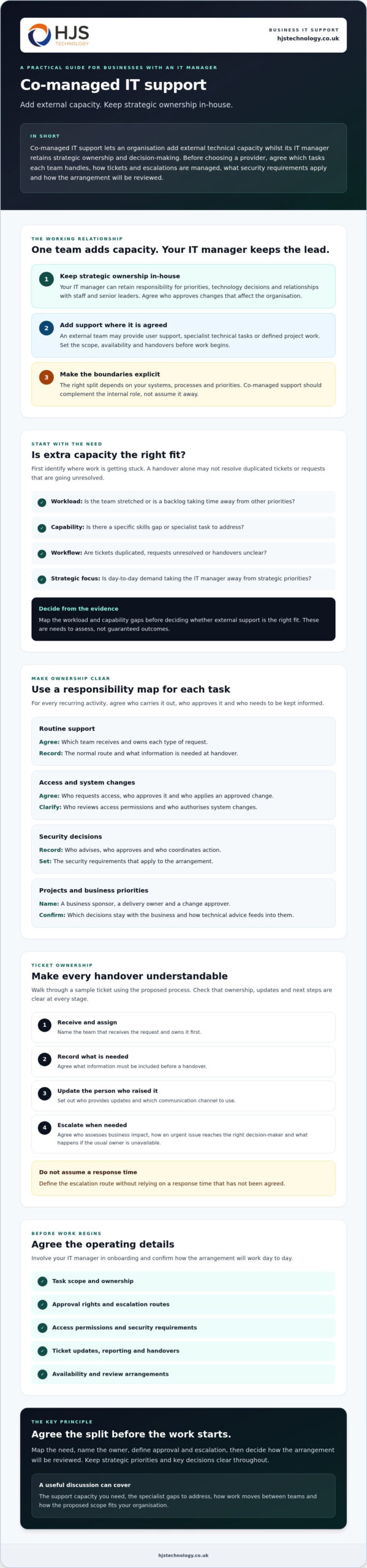
In short: Co-managed IT support lets an organisation add external technical capacity while its IT manager retains strategic ownership and decision-making. Before choosing a provider, agree which tasks each team handles, how tickets and escalations are managed, what security requirements apply and how the arrangement will be reviewed.
Key Takeaways
- Co-managed IT support for companies with an IT manager can add agreed capacity while keeping strategic ownership in-house.
- Use a responsibility table to clarify who owns each task, who approves decisions and how issues are escalated.
- Map workload and capability gaps before deciding whether external support is the right fit for your team.
- Confirm scope, access, reporting and review arrangements before work begins, and involve your IT manager in onboarding.
What does co-managed IT support mean when you already have an IT manager?
Co-managed IT support means your internal IT leadership keeps ownership of technology priorities and decisions, while an external provider supplies support capacity for responsibilities you agree together. It can help address a workload or skills gap without automatically transferring control of the IT function.
That differs from fully outsourced IT, where an external provider takes on a broader share of day-to-day responsibility. Neither arrangement suits every organisation. The practical question is which tasks your internal team should retain and where additional capacity would make a difference.
For an organisation in Hampshire, a potential gap might be a backlog of user support requests, specialist input for a defined project, or work that is taking the IT manager away from strategic priorities. These are needs to assess, not a standard package or guaranteed outcome. For example, cyber security support in Southampton may be relevant if security expertise is one of the gaps you are considering.
What stays with the internal IT manager?
The IT manager may retain responsibility for setting business priorities, making or recommending technology decisions, and managing relationships with staff and senior leaders. They may also remain responsible for approving changes that affect the organisation.
These are boundaries to agree, not fixed rules. Record who owns each decision and task so internal knowledge informs the work and responsibility stays clear. For each activity, distinguish between the person who carries it out, the person who approves it and the person who needs to be kept informed.
What might an external IT partner add?
An external partner might take on agreed user support, specialist technical tasks or defined project work. HJS Technology Ltd’s managed IT support includes first-, second- and third-line helpdesk, giving you a basis for discussing the types of support capacity your organisation needs.
The right split depends on your systems, processes and priorities. Confirm the precise scope, availability and handovers before work begins. Co-managed IT support for companies with an IT manager should complement the internal role, not assume it away.
How should an IT manager divide responsibilities with an external provider?
Agree task ownership, approval rights and handovers before the provider starts work. A responsibility matrix can record who owns, approves and escalates each task, as well as the communication channel to use.
Keep the matrix practical. For each recurring task, note the normal route, what information is needed at handover and what happens if the usual owner is unavailable. Both parties should also agree how the provider’s work fits your existing processes and who remains accountable for decisions.
Which decisions should remain with the business?
Set out who approves system changes, spending, access to business information and priorities that could affect staff or customers. For example, a provider might carry out an approved change, while the internal manager or another named business decision-maker authorises it.
There is no universal split. Decision rights should reflect your organisation’s governance and the agreed contract, so everyone knows where technical advice ends and business approval begins. Be especially clear about access permissions: who requests access, who approves it, who applies the change and who reviews it.
How should tickets and escalations move between teams?
Document who owns a ticket at each stage, what information must be recorded before a handover and who updates the person who raised it. Ask the provider to walk through a sample ticket using your proposed process. Check that ownership, updates and next steps are clear at every handover.
Agree how urgent issues reach the appropriate decision-maker, including who assesses the business impact and how that person is contacted. Define the escalation route without assuming a response time that has not been agreed.
- Routine support: name the team that receives and owns each type of request.
- Access: identify who authorises access and who carries out the approved change.
- Security decisions: record who advises, approves and coordinates action.
- Projects: agree a business sponsor, delivery owner and change approver.
Use these questions to compare business IT support options, then discuss your support requirements with HJS Technology Ltd.
How can you assess whether co-managed IT support is the right fit?
Start by tracing the work your team needs help with, then test how an external provider would work alongside your IT manager. This makes it easier to identify gaps before they turn into duplicated effort, missed handovers or unclear ownership when evaluating co-managed IT support for companies with an IT manager.
Work through these steps:
- Map workload: list recurring tickets, planned projects and tasks competing for your IT manager’s time. Note where work builds up and what is being delayed.
- Identify capability gaps: separate the need for extra capacity on routine support from the need for specialist knowledge.
- Define boundaries: document which work the provider may take on and which decisions stay internal.
- Test workflows: walk through a sample ticket, handover and approval using your existing tools and processes.
- Review fit: check whether communication, documentation and security coordination work in practice.
Ask each prospective provider for a written scope, named responsibilities and an example report. Check how they will work with your IT manager, manage permissions, keep documentation current and provide ticket updates. For security work, clarify how the provider will coordinate with your existing security owner. HJS Technology Ltd outlines its cyber security services in Southampton, but any shared responsibilities should be agreed directly.
What should you ask a prospective provider?
Ask which responsibilities they can accept, how they will share knowledge with your internal team and what happens when a request falls outside the agreed scope. Request examples of how they document work and report on open tickets or recurring issues. If certification matters to your organisation, confirm what it covers and how it relates to your requirements. HJS Technology Ltd identifies ISO 27001 certification, which may be relevant when assessing security practices.
How can you check that the arrangement is working?
Agree measures that reflect your priorities, such as ticket status, recurring issues and changes in workload. Set the review frequency and process for changing the scope in writing. Use reviews to discuss what is working, where handovers are causing friction and whether the division of responsibilities still matches your needs.
From provider shortlist to workable partnership
A workable co-managed arrangement starts with agreed responsibilities, access, escalation routes, reporting and review arrangements. Keep your internal IT manager involved from initial discussions through onboarding, so existing knowledge shapes how the provider works with your systems and people.
Before work begins, put the proposed scope in writing and distinguish confirmed commitments from anything still to be agreed. This helps prevent assumptions about support availability, access permissions or ownership from becoming part of the working relationship by default. Where a task depends on an internal approval or another supplier, document that dependency too.
What should an initial transition plan cover?
Use a transition plan to give both teams a shared picture of the environment and how work should flow. Include prompts such as:
- Systems and services within the agreed scope.
- Existing documentation, known issues and work already in progress.
- Who approves access, and how permissions are requested and reviewed.
- Internal stakeholders, provider contacts and agreed escalation routes.
- How tickets, updates, reports and review meetings will be handled.
Mark each item as confirmed, awaiting agreement or out of scope. This simple distinction helps your IT manager identify decisions to resolve before the provider takes on work. It also gives both teams a useful reference when a request does not fit the agreed scope.
When should you contact a potential partner?
Start a conversation once your team has identified the workload gaps and boundaries it wants to address. Bring a short outline of current pressures and the responsibilities you may want to share. Then ask whether the provider can support that model and what needs to be agreed before onboarding.
For organisations in Southampton and across the South Coast, check practical local coverage as part of those discussions. Clarify whether the working arrangement includes any on-site support, where it applies and how it fits the agreed scope, rather than assuming this from a provider’s location.
HJS Technology is based in Southampton, but any co-managed responsibilities and availability should be confirmed directly. If you are considering co-managed IT support for companies with an IT manager, contact HJS Technology to discuss your organisation’s needs and confirm whether the requested model is a fit.
Make extra IT capacity work for your team
Co-managed IT support for companies with an IT manager works best when it adds clearly defined capacity without blurring who owns decisions. Map the workload you need help with, agree task ownership and approvals, then document how tickets, escalations and reviews will work.
Keep your IT manager involved in selecting and onboarding a partner. Their knowledge of your systems, people and priorities can help shape a practical arrangement, while a written scope makes clear what is confirmed and what still needs agreement.
HJS Technology is based in Southampton and was established in 2007. Its managed IT support includes first-, second- and third-line helpdesk. Whether HJS can support your preferred co-managed model, and which responsibilities it can take on, should be confirmed directly.
A well-defined partnership can give your team useful additional capacity while keeping business priorities and strategic ownership in-house.
Frequently Asked Questions
Can a company use co-managed IT support if it already has an IT manager?
Yes. A company can use co-managed IT support alongside an in-house IT manager by agreeing which tasks need extra capacity and which responsibilities stay internal. For example, an external team might handle a defined share of support requests, while the manager sets priorities and oversees technology decisions. The arrangement should reflect your actual workload, skills gaps and business requirements.
What is the difference between co-managed and fully outsourced IT support?
Co-managed support combines an internal IT function with external help for agreed tasks or skills gaps. Fully outsourced support gives an external provider a broader role in delivering IT services, although the exact scope depends on the agreement. Neither model is automatically better. The right choice depends on the capacity you need, the responsibilities you want to retain and the internal expertise available.
Will an external IT support provider take control away from our IT manager?
Not if decision rights and task boundaries are clearly agreed. Your IT manager can retain responsibility for setting priorities, advising on technology decisions and working with internal stakeholders, while a provider handles specific support tasks. Document who approves changes, access and spending, and who owns each ticket. The final arrangement should reflect your organisation’s governance and the contract.
What should we ask a co-managed IT support provider?
Ask which responsibilities they can accept and how they will work with your internal IT manager. Request a written scope, named task owners, an example report and clear processes for ticket handovers, access approvals, documentation and escalation. Also discuss how the provider will coordinate with your existing security owner and tools, and how changes to the agreed scope will be reviewed.
Can HJS Technology work alongside an in-house IT manager?
HJS Technology provides managed IT support with first-, second- and third-line helpdesk, which may be relevant when assessing additional support capacity. The company is based in Southampton and was established in 2007. Whether it can take on your specific co-managed responsibilities, and what availability and working arrangements would apply, should be confirmed directly. HJS Technology serves organisations in Southampton, Portsmouth, Winchester, Eastleigh, Fareham, Dorset, Poole, Hampshire, Salisbury, Wiltshire and Bournemouth. To discuss your requirements, contact HJS Technology.