

Few operational disruptions frustrate a management team faster than having an internet provider and a phone supplier blame each other for dropped client calls. When evaluating the business telecoms Hampshire organisations depend on, you shouldn’t have to arbitrate disputes between separate technical helpdesks. You simply need reliable voice and data connectivity that keeps staff reachable across office desks, home workstations, and mobile devices without unexpected downtime.
This guide explains how to select a dependable communications setup by consolidating cloud telephony, business mobile plans, and high-speed broadband under a single regional support partner. We examine practical steps to retire legacy copper lines before the UK copper telephone switch-off, whilst integrating modern collaboration tools directly with Microsoft 365 and customer databases. A unified approach eliminates supplier finger-pointing, protects against hidden fees, and keeps your workforce connected from Southampton to rural trading estates.
In short: Dependable business telecoms in Hampshire require unifying cloud VoIP phone systems, business mobile plans, and high-speed broadband under a single regional support partner. This approach eliminates multi-supplier finger-pointing, secures lines before the national copper network switch-off, and ensures call quality across office and remote workstations.
Key Takeaways
- Understand the core building blocks of dependable business telecoms Hampshire organisations rely on, from hosted VoIP systems to multi-network mobile packages.
- Discover whether Microsoft Teams Phone or dedicated cloud platforms like Gamma Horizon offer the right call routing tools for your operational workflows.
- Learn how local connectivity variations across Hampshire trading estates affect call stability ahead of the national copper telephone switch-off deadline.
- See why uniting telephony and IT support under a single regional helpdesk removes supplier finger-pointing and speeds up fault resolution.
What services make up modern business telecoms in Hampshire?
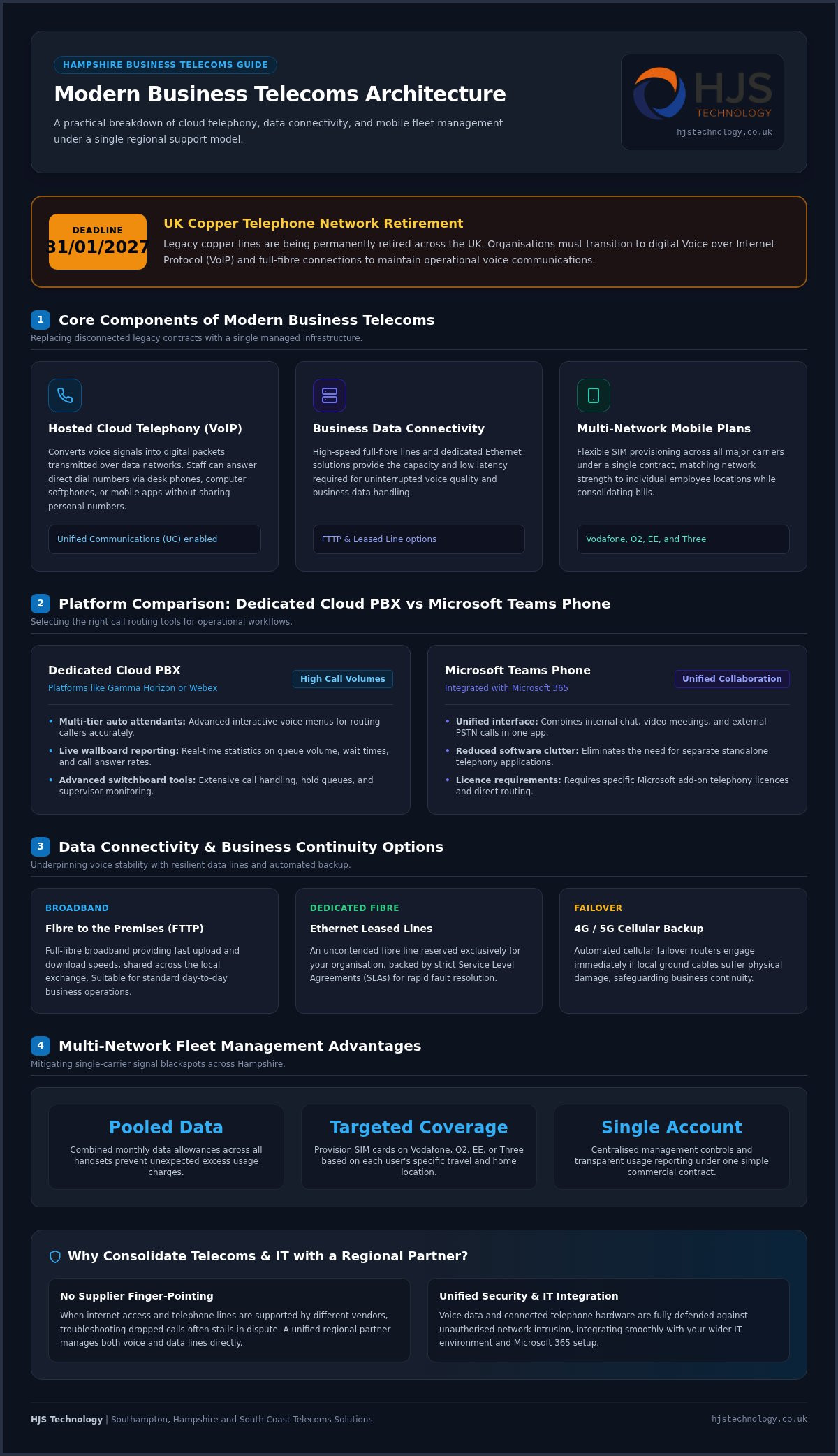
Modern business telecoms Hampshire packages combine hosted cloud telephony, business-grade broadband, and flexible business mobile plans into one managed architecture. Rather than treating calls, internet connectivity, and mobile SIM cards as disconnected contracts, a unified setup connects them across a single managed infrastructure.
Cloud phone systems and business VoIP explained
Voice over Internet Protocol (VoIP) converts traditional voice signals into digital data packets, transmitting calls over reliable data networks instead of ageing copper wiring. Transitioning to modern business telephone solutions ensures your organisation remains operational following the national copper telephone network retirement scheduled for 31/01/2027. Through Unified Communications (UC) systems, team members can answer direct dial numbers using desk phones, computer softphones, or mobile apps without giving out personal numbers.
Business data connectivity and local broadband options
Stable voice calling depends entirely on the resilience and capacity of your primary data connection. Organisations generally select between two main broadband and leased line options, depending on location and daily data traffic:
- Fibre to the Premises (FTTP): Full-fibre broadband that provides fast upload and download speeds, shared across the local exchange.
- Dedicated Ethernet leased lines: An uncontended fibre line reserved exclusively for your company, backed by strict Service Level Agreements (SLAs) for rapid fault resolution.
To prevent costly downtime, resilient setups also incorporate automated cellular 4G or 5G backup routers that engage immediately if local ground cables suffer physical damage. Pairing these communication links with professional cyber security services in Southampton and Hampshire ensures all voice data and connected hardware remain fully defended against unauthorised network intrusion.
How do you choose between VoIP, Microsoft Teams, and mobile systems?
Choosing between hosted telephony platforms depends on your call handling complexity, existing software licences, and workforce mobility. Organisations handling high call volumes typically benefit from dedicated cloud PBX (Private Branch Exchange) systems, whilst teams already working in Microsoft 365 often consolidate calling directly within Microsoft Teams Phone. Evaluating these options carefully ensures your business telecoms Hampshire deployment supports operational goals without unnecessary licensing costs.
Evaluating hosted VoIP against Microsoft Teams calling
Dedicated platforms such as Gamma Horizon or Webex excel at high-volume call handling, live wallboard reporting, and multi-tier auto attendants. In contrast, Microsoft Teams Phone unites internal chat, video conferencing, and external calling into one interface, reducing software clutter. Connecting external lines to Teams requires specific add-on licensing and direct routing, making it sensible to assess whether your staff require advanced switchboard features or simple desk-to-desk collaboration.
Managing multi-network business mobile fleets
Placing an entire workforce on a single mobile carrier creates operational vulnerabilities across varied regional coverage areas. Tailored business mobile phones address this risk by letting organisations provision SIM (Subscriber Identity Module) cards across Vodafone, O2, EE, and Three under a single contract. This flexible approach provides several key operational advantages:
- Pooled monthly data allowances that eliminate unexpected excess usage fees
- Network assignment matched to each employee’s home and travel coverage
- Centralised account management with transparent usage controls
Uniting these distinct tools prevents communication silos between office workers, remote staff, and mobile field teams. To explore which telephony architecture best matches your organisation’s daily call patterns, speak with our local telecoms team for practical advice.
What local connectivity factors affect Hampshire businesses?
Local connectivity across Hampshire varies significantly between urban commercial centres and outlying business parks. Whilst city centre offices benefit from direct gigabit fibre, trading estates across Romsey, the New Forest, and rural areas frequently encounter physical infrastructure constraints that dictate which business telecoms Hampshire providers can practically deliver.
Addressing broadband availability across Hampshire commercial parks
Full-fibre availability is not uniform across regional business parks and converted agricultural premises. Installing new services often triggers physical site surveys to inspect existing Openreach ducting, which can identify blocked conduits or lead to excess construction charges when civil engineering is necessary. Partnering with a specialist for business-grade broadband and Wi-Fi solutions early in an office relocation prevents unexpected road-digging delays from stalling company operations.
Preparing for the UK analogue telephone line retirement
National copper lines are reaching compulsory decommissioning, requiring every operational service to transition to digital data links. According to guidance from Ofcom, business lines will experience a definitive cut-off without automatic safety nets. Beyond desk phones, organisations must urgently audit and upgrade connected non-voice hardware:
- Monitored security and Redcare fire alarm signalling units
- Emergency lift breakdown telephone lines
- Electronic door entry access systems and physical gate intercoms
- Analogue franking machines and standalone credit card terminals
Identifying these ancillary services prevents critical building security and compliance systems from failing unexpectedly when copper exchanges disconnect.
Why combine business telecoms and IT support with a local partner?
Combining your communications and IT support under a single regional provider prevents the common dispute where broadband carriers and phone vendors blame each other for dropped calls. For organisations investing in business telecoms Hampshire wide, having one helpdesk manage local network switches, firewalls, and voice circuits resolves technical faults without delays.
Eliminating multi-supplier blame during communications faults
When call jitter or audio dropouts occur, separate suppliers often point fingers rather than diagnosing the network path. A unified Southampton helpdesk oversees your entire technical environment, troubleshooting local routers, internal data cabling, and Session Initiation Protocol (SIP) trunking under one ticket. Having local field engineers available across Hampshire also means physical hardware replacements happen swiftly on-site without waiting days for distant contractors.
Selecting the right telecoms partner for your organisation
Choosing the right communications partner requires verifying both technical accreditations and commercial contract flexibility. As an ISO 27001 certified organisation established in Southampton in 2007, HJS Technology maintains tier-one access across leading voice and mobile carriers. Before signing an agreement, evaluate prospective suppliers using these critical operational checks:
- Do they provide 1st, 2nd, and 3rd line technical support directly from a regional helpdesk?
- Are call recording archives and customer databases stored securely in compliance with UK data protection laws?
- Can company telephone numbers port smoothly without prolonged downtime or restrictive lock-ins?
To discuss your communications setup with an established south coast provider, contact the HJS Technology team today.
Taking control of your Hampshire communications setup
Selecting modern business telecoms Hampshire organisations can rely on comes down to infrastructure readiness and supplier accountability. Auditing legacy copper lines now prevents sudden operational disruption ahead of the national PSTN switch-off, whilst matching cloud platforms to your exact workflow protects your licensing budget. Most importantly, consolidating voice, multi-network mobile packages, and internet connectivity under one provider removes multi-supplier finger-pointing.
Established in Southampton in 2007, HJS Technology maintains an ISO 27001 certified environment to protect your data and deliver dependable business communications. Our local engineers support businesses across the region, providing practical guidance on call routing, hardware upgrades, and broadband resilience. You can call our team on 02380 386 586 or submit an enquiry online.
Upgrading your telecoms infrastructure early keeps your staff connected, protects operational continuity, and sets your organisation up for long-term growth.
Frequently Asked Questions
What is the difference between residential broadband and business broadband in Hampshire?
Business broadband includes committed Service Level Agreements (SLAs), prioritised data traffic, and fixed IP addresses, whereas residential broadband shares local bandwidth with surrounding households. For organisations operating across Southampton and Winchester, business-grade connections provide guaranteed fix times during outages and lower contention ratios. This prevents domestic streaming traffic in neighbouring properties from slowing down your daily cloud applications and voice calls.
Can our business keep its existing Hampshire telephone numbers when switching to VoIP?
Yes, your organisation can port existing geographic landline numbers, including 023 Southampton or 01962 Winchester prefixes, directly into a hosted VoIP platform. The number porting process occurs digitally in the background without physical engineering work at your premises. Maintaining your established local numbers protects client familiarity and avoids the expense of reprinting marketing stationery when updating your business telecoms Hampshire infrastructure.
How will the UK copper telephone switch-off affect my office in Hampshire?
Analogue copper lines are being retired permanently across the UK on 31/01/2027, cutting off services that still rely on the legacy Public Switched Telephone Network (PSTN). Unlike domestic connections, commercial lines face a hard disconnection without an automatic safety net. Any analogue equipment, including fax machines, Redcare alarms, lift diallers, and older payment terminals, must migrate to digital IP or cellular connections to avoid sudden service failure.
Do we need new physical desk phones to use a cloud phone system?
No, modern cloud telephony does not require traditional hardware handsets at every desk. Staff can make and receive calls using softphone applications installed on laptops, desktops, or smartphones with standard headsets. However, organisations that prefer physical desktop devices can retain compatible IP handsets or deploy pre-configured handsets that plug straight into existing computer network switches for immediate calling.
Why is an independent multi-network mobile plan better than dealing with a single mobile network?
Single-network mobile contracts leave field staff vulnerable to regional signal blackspots across Hampshire, especially around rural trading estates or the New Forest. Independent providers supply pooled SIM plans spanning EE, Vodafone, Three, and O2 under one monthly bill. This approach optimises business telecoms Hampshire companies deploy by pairing each team member’s handset with the carrier providing the strongest mobile coverage in their specific operational area.