

Cyber security statistics from 2025 to 2026 can help UK business leaders set priorities, provided they read the figures in context. For organisations in Southampton, automated penetration testing can form part of a wider security review, alongside staff awareness, monitoring and recovery planning.
In short: The UK government’s 2025 and 2026 surveys both found that 43% of businesses had experienced a breach or attack in the previous 12 months. Treat this as national context, not a prediction for your organisation. Check what each figure measures, compare like with like, then assign owners and review dates to practical security actions.
This guide explains what the 2025-2026 evidence can and cannot tell you, and how to use relevant findings to shape your security priorities during Cyber Security Awareness Month.
Key Takeaways
- Distinguish survey estimates from reported incidents and personal data breaches before comparing figures.
- Check the survey period, sample and definitions behind any cyber security statistic.
- Use relevant evidence to prioritise protections, staff training and incident response, rather than reacting to headlines alone.
- Build a proportionate security review for your Southampton or Hampshire organisation, with a clear owner for each action.
What do 2025-2026 cyber security statistics tell UK businesses?
UK government survey data offers a view of reported business experiences, but each figure needs to be understood on its own terms. The Department for Science, Innovation and Technology’s Cyber Security Breaches Survey 2026, published on 30/04/2026, found that 43% of UK businesses had experienced a breach or attack in the previous 12 months. That was unchanged from the previous year’s survey.
This comparison covers UK businesses and the reporting periods stated in government surveys published in 2025 and 2026. It does not measure Southampton businesses alone. During Cyber Security Awareness Month, use the findings to understand wider patterns and choose proportionate priorities for your own organisation.
Which UK sources can businesses use for cyber security statistics?
The government’s Cyber Security Breaches Survey estimates how many businesses report particular experiences. The National Cyber Security Centre (NCSC) publishes UK threat guidance and incident information, while the Information Commissioner’s Office (ICO) provides information about personal data breaches reported to the regulator. These sources measure different things, so their figures are not interchangeable.
What does a business cyber security statistic measure?
A survey estimate reflects responses from a defined sample; it is not a count of every incident across UK businesses. A reported breach or attack describes an organisation’s experience during the survey’s stated period, and one organisation may experience multiple events. An ICO report concerns a personal data breach reported to the regulator, not every cyber incident.
Before comparing percentages, check the survey year, fieldwork and business-size categories. The 2026 survey’s 43% figure is the share of businesses reporting a breach or attack during the previous 12 months, not the number of attacks. Southampton organisations can use this national context alongside a review of their own risks and business IT support in Southampton, rather than treating a UK-wide estimate as a local prediction.
How did UK business cyber security figures change from 2025 to 2026?
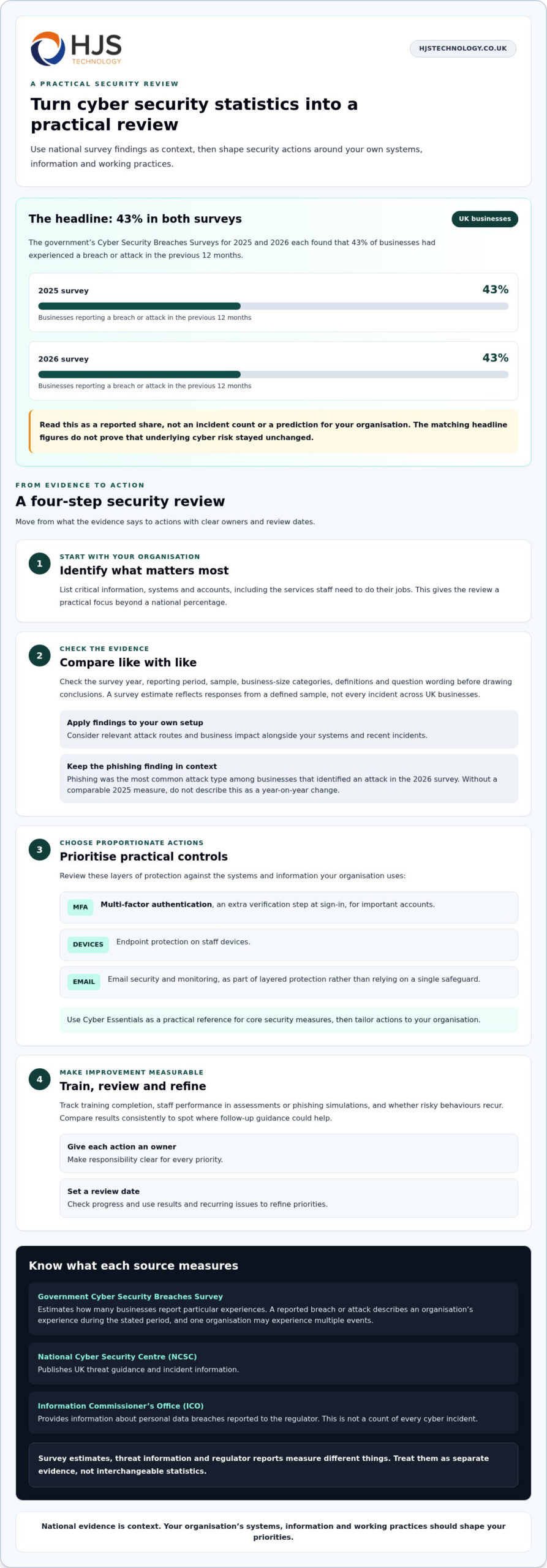
The headline estimate was unchanged. The Department for Science, Innovation and Technology (DSIT) reported that 43% of UK businesses had experienced a breach or attack in the previous 12 months in both the 2025 and 2026 surveys. This indicates no change in that measure, but does not show that every type of cyber incident stayed level.
| Metric | 2025 value | 2026 value | Source | Fieldwork period | Interpretation |
|---|---|---|---|---|---|
| Businesses experiencing a breach or attack | 43% | 43% | Cyber Security Breaches Survey 2025 and Cyber Security Breaches Survey 2026, DSIT | Previous 12 months for each survey; exact fieldwork dates aren’t stated in the figures cited here. | No change in the reported share. This is not an incident count or a business-specific prediction. |
Are the 2025 and 2026 survey results directly comparable?
The headline estimates are comparable in that both surveys report 43%, but this alone cannot establish that underlying cyber risk was unchanged. Published on 30/04/2026, the 2026 survey describes the preceding 12 months, not activity during calendar year 2026. Publication year and reporting period are different. Check each report’s methods and question wording before drawing firmer conclusions about trends.
Other 2026 findings, including phishing being the most common attack type among businesses that identified an attack, should not be described as a year-on-year change without a comparable 2025 measure.
Which figures matter most to smaller organisations?
Use prevalence figures as context, then focus on evidence connected to your own exposure, such as attack routes and business impact. A national percentage does not give a Southampton or Hampshire organisation its individual likelihood of attack. For a review of your controls and priorities, discuss your organisation’s cyber security priorities.
What should businesses do with cyber security statistics?
Use statistics to guide a practical review, not to copy another organisation’s security plan. Identify what matters to your business, check which findings apply, then prioritise controls, staff training and regular reviews.
National figures offer context, but your own systems, information and working practices should shape your response. Turn relevant findings into specific actions, give each one an owner and set a date to check progress.
- Identify critical information, systems and accounts, including the services staff need to do their jobs.
- Assess relevant evidence, such as common attack routes, against your organisation’s setup and recent incidents.
- Prioritise practical controls, assign an owner to each action and set a review date.
- Train and review staff, then use results and recurring issues to refine your priorities.
How can a business measure whether security awareness is improving?
Track training completion, staff performance in assessments or phishing simulations, and whether risky behaviours recur over time. Compare results consistently to see where follow-up guidance could help. Do not treat training figures as expected outcomes unless you have verified the original study and its methods. Staff awareness training is one part of an ongoing security review.
Which controls should statistics prompt a business to review?
Check that multi-factor authentication (MFA), which adds an extra verification step at sign-in, protects important accounts. Review endpoint protection on staff devices, email security and monitoring as well. These controls provide layers of protection, rather than relying on a single safeguard.
Use Cyber Essentials as a practical reference for reviewing core security measures, then tailor actions to the systems and information your organisation relies on.
How can Southampton and Hampshire businesses turn the data into a security plan?
Turn national statistics into a short action plan based on your organisation’s systems, information and ability to recover. For small and medium-sized businesses in Southampton and Hampshire, this means addressing relevant gaps without treating every headline as a prediction of what will happen locally.
Start by naming an owner for each action and setting a review date. A proportionate review should cover:
- Users and access: check who can reach important accounts and systems, and whether their access remains appropriate.
- Devices and cloud services: keep an accurate record of the equipment and services staff rely on, and review how they are protected.
- Staff awareness: provide relevant guidance and revisit recurring issues through training.
- Monitoring and response: decide how suspicious activity will be noticed, who will assess it and what steps follow.
- Recovery: review backups and test whether the organisation can restore essential information and services.
What belongs in a practical business cyber security review?
Use a simple record that lists the risk, planned action, accountable owner and next review date. This makes progress easier to track and helps explain why a control was prioritised. Reviewing business cyber security services can help connect protection, monitoring and response planning to the systems your organisation depends on.
When should a business seek specialist support?
Consider support if nobody is clear about who owns cyber security risks, monitoring is limited, or incident response and recovery arrangements have not been tested. HJS Technology is a Cyber Essentials Certification Body and supports organisations working towards Cyber Essentials certification as part of a practical security programme.
Choose one priority, assign an owner and agree when to review it. If your organisation would benefit from help shaping its next steps, speak with HJS Technology about your cyber security plan.
Make your next cyber security decision count
UK cyber security statistics are most useful when you understand what they measure and compare like with like. Survey estimates offer national context, not a prediction for an individual business. Use them to guide a review of your systems, staff practices and readiness to respond and recover.
For organisations marking Cyber Security Awareness Month, the practical takeaway from the 2025-2026 figures is to turn relevant evidence into clear priorities, assign owners and review progress. Focus on improvements that apply to your business instead of trying to respond to every headline at once.
HJS Technology is based in Southampton and supports organisations across Southampton, Portsmouth, Winchester, Eastleigh, Fareham, Dorset, Poole, Hampshire, Salisbury, Wiltshire and Bournemouth. Its cyber security services include staff awareness training, monitoring and recovery planning, helping businesses address people, protection and preparedness together.
A manageable plan can start with one well-chosen action. Give it a clear owner and review progress regularly to strengthen your organisation’s approach at a sensible pace.
Frequently Asked Questions
What are the most important UK cyber security statistics for businesses in 2025 and 2026?
The Department for Science, Innovation and Technology’s Cyber Security Breaches Survey 2026 found that 43% of UK businesses experienced a breach or attack in the previous 12 months, the same headline share as in the previous survey. It also reported that phishing affected 38% of businesses that identified an attack. These are survey findings, not a count of every incident or a prediction for an individual organisation.
Have cyber attacks on UK businesses increased from 2025 to 2026?
The comparable headline survey estimate did not increase: 43% of businesses reported a breach or attack in both surveys. This does not mean the number of attacks was unchanged, because the statistic measures businesses reporting an experience during each survey’s previous 12 months. Publication dates also differ from the periods covered, so check the reporting period before interpreting the figures as a calendar-year trend.
Which types of UK businesses are most affected by cyber incidents?
The 2026 Department for Science, Innovation and Technology survey reported higher breach or attack prevalence among larger businesses: 69% for large businesses with 250 or more employees and 65% for medium businesses with 50-249 employees. It reported 46% for small businesses with 10-49 employees and 42% for micro businesses with 1-9 employees. These national results do not determine any one organisation’s risk.
Does cyber security awareness training reduce business risk?
Training can help staff recognise suspicious messages and follow safer working practices, but the figures cited here do not establish a verified, quantified reduction in business risk from training. Measure participation, assessment results and recurring behaviours over time, then use the findings to plan follow-up guidance or phishing simulations. Treat awareness as one part of a wider approach that includes technical controls, monitoring and incident readiness.
What should a small business do after reviewing cyber security statistics?
Choose a practical next step based on your systems and responsibilities: identify important accounts and information, review access controls, check staff awareness, and make sure someone owns incident response and recovery actions. Set a review date and track progress. For a Southampton business, the value of cyber security statistics from 2025 to 2026 lies in turning relevant evidence into specific, owned improvements.