

A message that looks like a routine invoice update can still prompt hesitation: is the request genuine, or should it be reported? For businesses in Southampton and across Hampshire, cyber awareness training can help employees recognise suspicious messages and risky requests, then respond in a way that supports your organisation’s security procedures.
A one-off session may cover the basics, but employees face different risks in their day-to-day roles. Practical training is more useful when it reflects those differences and gives people clear guidance they can apply to the messages and decisions they encounter at work.
This article looks at how tailored learning can address individual knowledge gaps, while giving managers a clearer view of participation, grades and risk scores. You’ll also see how progress reporting can help you keep track of training and how awareness fits alongside wider cyber security measures.
In short: Practical cyber awareness training helps employees spot common security risks and understand how to respond. Tailored learning can address different knowledge gaps, while manager reports on participation, grades and risk scores make it easier to review progress and maintain training records.
Key Takeaways
- See how everyday actions, from handling messages to sharing information, can affect your organisation’s security.
- Cyber awareness training can start with a gap analysis, then tailor learning to employees’ individual needs.
- Learn how participation, assessment results and risk scores offer different ways to review training progress.
- Use a practical starting sequence to plan training for your team in Southampton or elsewhere in Hampshire.
Why does cyber awareness training matter in everyday business?
Cyber awareness training teaches employees to recognise common security risks and respond appropriately during their everyday work. Handling an email, approving a payment request or sharing a document can all involve a security decision, even when the task feels routine.
A convincing message might appear to come from a supplier asking for updated bank details. A colleague might receive an unexpected request to share a file or confirm login information. Training helps staff pause, check whether a request is genuine and follow a clear process rather than acting under pressure.
Ongoing awareness training builds and refreshes practical security habits; a one-off presentation can introduce key ideas, but cannot provide the same continuing opportunity to learn and review.
What should employees learn to recognise?
Employees should learn to look for unusual sender addresses, unexpected attachments, urgent demands and requests that fall outside normal processes. They also need to know what to do when something feels wrong: avoid replying or opening attachments, and report the concern through the route their organisation has agreed. A straightforward reporting process helps staff raise concerns promptly without needing to decide whether a message is definitely malicious.
How does training fit into wider cyber security?
Training supports the five stages of cyber security: Identify risks, Protect systems and information, Detect suspicious activity, Respond to incidents and Recover operations. Staff awareness can help people notice and report warning signs, but it does not replace technical safeguards or a response plan.
For example, multi-factor authentication asks users to prove their identity in more than one way, helping protect accounts if a password is compromised. Training complements controls like this by helping employees understand why they matter and how to use them carefully. HJS Technology Ltd’s cyber security services in Southampton and Hampshire bring these wider measures into the security picture alongside staff learning.
How does tailored cyber awareness training work?
Tailored cyber awareness training gives employees learning that reflects their individual knowledge gaps and risk profiles. Rather than assigning everyone the same material, a business can use an initial gap-analysis questionnaire to identify where further learning would be useful.
The process can then follow a clear cycle:
- Identify learning gaps using questionnaire responses and individual risk information.
- Assign relevant training that addresses the areas each person needs to develop.
- Review participation and results to see who has taken part and where further learning may help.
- Adjust the learning in response to progress and changing needs.
Identify needs, tailor learning, review progress and adjust the next steps. This gives managers a practical way to organise learning without assuming every employee needs identical content.
How can training reflect different employee needs?
Different responsibilities can bring different security decisions. Someone who regularly handles supplier invoices may benefit from learning relevant to payment requests, whilst an employee who shares documents may need guidance suited to information handling.
These are examples, not fixed role-based modules: individual profiles help guide relevant topics. Clear, accessible language also means staff can apply the guidance without needing a technical background.
What role can phishing simulation play?
A phishing simulation presents a safe opportunity to practise recognising a deceptive message and deciding what to do next. It should support learning, not embarrass or punish someone who misses a sign. Constructive follow-up can explain the clues to notice and reinforce the reporting route, so employees know how to respond in future.
HJS Technology Ltd’s cyber awareness training and phishing simulation can help structure learning around employee needs and provide useful context for managers reviewing progress.
How can managers measure cyber awareness training progress?
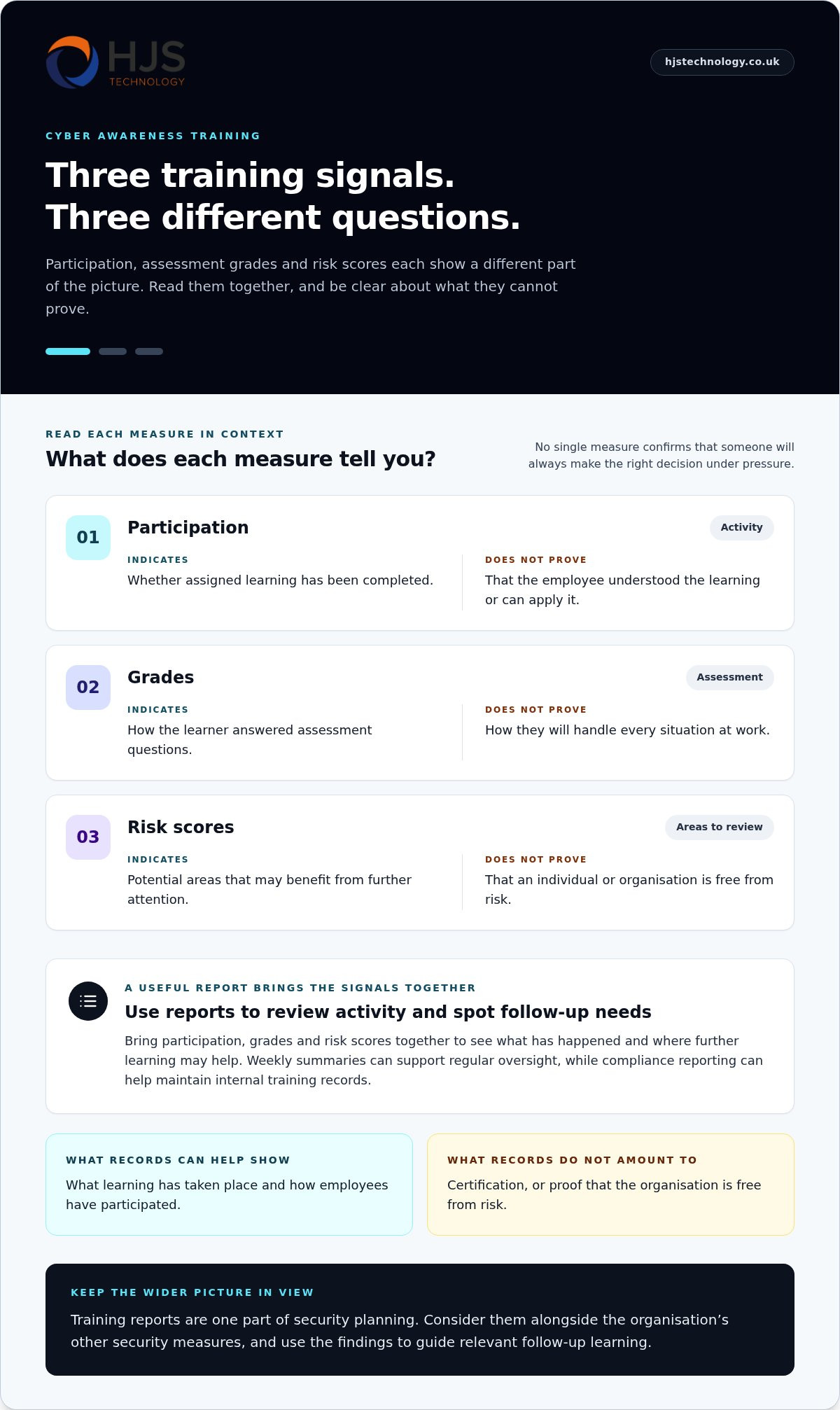
Managers can assess training progress by looking at participation, assessment results and risk scores as separate measures. Together, they provide a more useful view than a single completion figure, but they cannot confirm that someone will always make the right decision under pressure.
| Measure | What it indicates | What it cannot prove |
|---|---|---|
| Participation | Whether assigned learning has been completed. | That the employee understood or can apply it. |
| Grades | How the learner answered assessment questions. | How they will handle every situation at work. |
| Risk scores | Potential areas that may benefit from further attention. | That an individual or organisation is free from risk. |
What should a useful training report include?
A useful report can bring together participation, grades and risk scores so managers can see activity and identify areas for follow-up. Weekly summaries can support regular oversight, while compliance reporting can help maintain internal records of training activity. These records may help show what learning has taken place, but they do not amount to certification.
Training records are one part of wider security planning. Cyber Essentials certification, for example, relates to broader security controls, so training reports should be considered alongside the organisation’s other security measures.
How often should managers review progress?
Set a review rhythm that fits your organisation’s training activity and business needs. Look for patterns across reports: repeated difficulties with a topic may suggest that guidance needs clarification or additional learning. This helps managers decide where to focus attention rather than relying on an isolated result.
Use completion information as a record of participation, not as a guarantee of future behaviour. Discuss relevant themes with employees and consider whether procedures, training materials or other security measures need attention. Reviewing the information in context makes reports more useful for planning the next steps.
How can Hampshire businesses put cyber awareness training into practice?
Begin with a manageable plan that fits your organisation’s working practices. Decide which employees to include, what the programme should address and how managers will review its progress.
- Identify employee groups whose responsibilities involve different information or security decisions.
- Review current practices, including existing learning and how staff raise concerns.
- Set learning priorities and choose an approach that suits your employees’ needs.
- Review training reports to help plan any useful follow-up.
Before training begins, managers can decide which information will help them assess participation and plan future learning. Keeping those priorities clear can make it easier to use reports constructively, rather than treating them as a box-ticking exercise.
What should a business prepare before starting?
List the employee groups to include, note how training is currently handled and establish what information managers need for internal records. It can also help to agree who will review reports and how any follow-up will be managed. For wider planning context, the National Cyber Security Centre’s Cyber Security Awareness Month guidance can help prompt broader discussion about security awareness.
Training works alongside technical controls and response planning, not instead of them. Consider how staff learning fits with your organisation’s existing security arrangements and responsibilities.
Where can Southampton and Hampshire businesses get support?
HJS Technology Ltd is based in Southampton and serves businesses across Hampshire and the south coast. Its cyber security training can help organisations plan learning around staff needs and consider how managers will review progress.
Discuss your organisation’s training needs with the HJS Technology Ltd team.
Give your next training decision a clear focus
Start with one practical question: which everyday decision would you most like employees to handle with greater confidence? Choosing a clear focus can help you shape the next step around your organisation’s needs, rather than treating training as another item to complete and forget.
From there, consider how the learning will fit into normal working routines and how managers will use progress information to plan follow-up. Cyber awareness training can form part of a broader approach, with learning tailored to employee needs and reviewed alongside the security measures already in place.
You don’t need every detail settled before starting a conversation. Discuss your priorities with HJS Technology Ltd and explore an approach that suits your business.
A considered first step can help your team build security awareness into the way work gets done.
Frequently Asked Questions
Is cyber awareness training mandatory for UK employees?
There isn’t one general UK rule setting the same cyber awareness course and schedule for every employee. Requirements can depend on your sector, contracts and internal policies. If your organisation handles personal data, staff understanding can form part of its wider approach to protecting information. Review the expectations that apply to your business, and keep training records as evidence of activity, not as automatic proof of compliance.
Can cyber awareness training prevent phishing attacks?
No training can guarantee that phishing attempts will be stopped. Cyber awareness training can help employees question unusual messages, avoid acting on suspicious links and report concerns, giving your organisation an opportunity to respond. Pair this learning with measures such as email security and multi-factor authentication. If someone does interact with a suspicious message, make sure they know whom to tell and what details to share.
How often should staff receive cyber awareness training?
There’s no single training interval that suits every organisation. Consider introducing learning during induction, then refreshing it when working practices, systems or risks change. A suspected phishing email or a change to how staff access company accounts may also highlight a useful topic for follow-up. Choose a review rhythm that fits your business, and use questions from staff to spot areas that need clearer guidance.
What should cyber awareness training cover?
Cover the risks employees may meet in their actual work, such as suspicious links, unexpected attachments, unusual payment instructions and requests for sensitive information. Explain how to verify a request using a trusted route, rather than replying directly to the message. Include safe handling of passwords and work data, plus what employees should do if they think they’ve made a mistake. Keep guidance relevant to your organisation’s procedures.
How can managers tell whether cyber awareness training is working?
Look beyond course completion: invite staff to explain how they would handle a realistic scenario, and check whether they know how to report a concern. Managers can also review training results over time and use recurring knowledge gaps to shape follow-up. These signs help assess learning, but they don’t prove that every employee will respond correctly in a real incident. Consider them alongside technical controls and incident records.