

A security alert arriving at 02:00 cannot wait for the office to open. 24x7x365 managed detection and response combines round-the-clock monitoring with expert investigation and an agreed process for deciding what to do. HJS Technology’s expert-led security monitoring service brings those elements together.
This guide explains what the service covers, how experts assess suspicious activity and how to choose monitoring for your cloud accounts and devices. It also sets out what to clarify about responsibilities, so you can judge which level of coverage fits your organisation.
In short: 24x7x365 managed detection and response combines continuous security monitoring with expert investigation and agreed action on suspicious activity. Coverage can include cloud accounts, endpoints such as laptops and servers, or both. The right scope depends on your systems and how response responsibilities are arranged.
Key Takeaways
- Effective MDR involves more than round-the-clock alerts. Establish who investigates potential threats and takes agreed response actions.
- Explore 24x7x365 managed detection and response to see how expert monitoring and incident response can support your organisation.
- Compare cloud-focused monitoring with coverage that also includes endpoints, then match the scope to the systems your business relies on.
- Prepare by listing your key systems, users, devices and incident contacts, then agree responsibilities with your internal IT team.
What does 24x7x365 managed detection and response cover?
24x7x365 managed detection and response covers continuous monitoring, expert assessment of suspicious activity and an agreed response process. With HJS Technology’s 24x7x365 managed detection and response, experts assess activity in context rather than treating every software notification as a confirmed incident. This helps distinguish routine changes in behaviour from activity that may need investigation.
How is MDR different from antivirus and firewalls?
Antivirus and firewalls are important safeguards, but they do not determine whether an alert is harmless or needs a business response. A staff member signing in at an unusual time, for example, may have a legitimate reason. The key is whether other activity around that sign-in changes its significance. Expert assessment puts alerts into context, so responses can be proportionate rather than identical for every signal.
Why does cover need to extend beyond office hours?
Security concerns can arise when a business’s usual decision-makers are away from their desks. If nobody reviews activity during evenings, weekends or bank holidays, an alert may go unassessed until staff return. The term 24x7x365 means coverage is intended to continue every day of the year, including those periods. HJS Technology supports businesses across Hampshire, and its cyber security services in Southampton and Hampshire place monitoring within a wider security approach.
How does managed detection and response handle a threat?
When an alert appears, a clear sequence helps ensure it is assessed before action is taken. Experts review the signal and relevant activity, consider the business context, decide whether it needs a response, then take agreed steps to contain risk and review the outcome.
- Detect: A monitoring tool flags activity that may need attention.
- Investigate: An expert checks related activity and considers whether the alert has a legitimate explanation.
- Decide: The team determines whether to escalate and which response is appropriate.
- Contain: Agreed actions aim to limit further risk and potential impact.
- Review: The organisation considers recovery needs and what could be improved.
What happens after a security alert?
Investigation may include checking what happened before and after an alert, and whether it affects a service the business relies on. Clear escalation arrangements help the response team reach the right business contact, explain the concern and establish who can authorise actions that may disrupt work. Containment aims to reduce potential harm, but cannot guarantee that disruption or data loss will be avoided.
HJS Technology’s security framework connects Identify, Protect, Detect, Respond and Recover. It links an understanding of risks and safeguards with monitoring, incident response and recovery planning. Microsoft Defender and Blackpoint Cyber Protect support its detection approach, while expert judgement informs response decisions. Account safeguards such as multi-factor authentication also contribute to the wider security picture.
To understand how HJS’s managed detection and response service can fit your organisation’s security arrangements, discuss your systems and response responsibilities with the team.
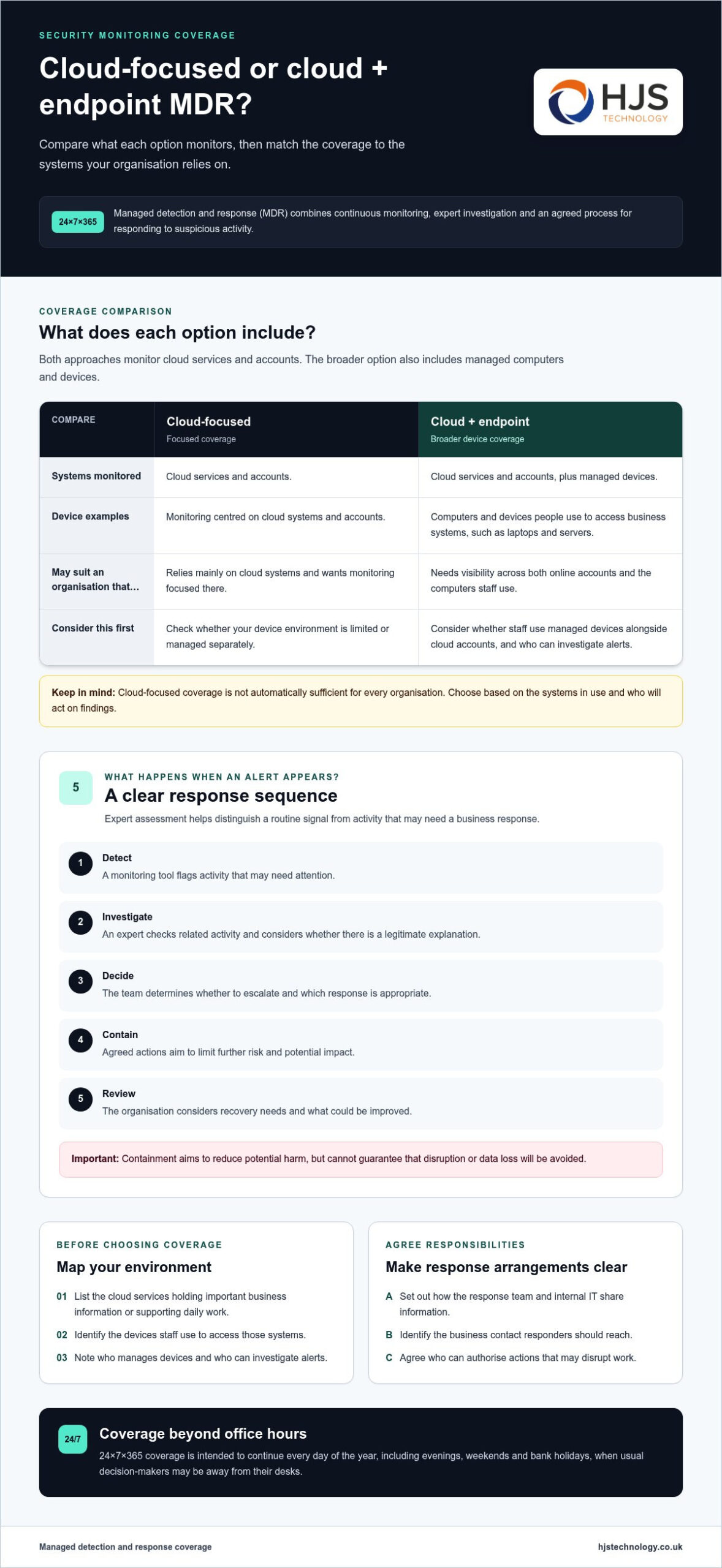
Should your business choose cloud-only or cloud and endpoint MDR?
Choose coverage by looking at where your important systems run, which devices staff use and who can act on security findings. Compare both approaches against your actual environment rather than assuming one level suits every organisation.
HJS Technology’s 24x7x365 managed detection and response includes cloud-focused and cloud-plus-endpoint coverage choices. Cloud-focused monitoring centres on cloud services and accounts, while broader coverage also includes managed computers and devices.
| Coverage | Systems monitored | May suit organisations that |
|---|---|---|
| Cloud-focused | Cloud services and accounts | Rely mainly on cloud systems and want monitoring focused there. |
| Cloud and endpoint | Cloud services and accounts, plus managed devices | Need visibility across both online accounts and the computers staff use. |
When might cloud-focused detection and response fit?
Cloud-focused coverage may suit an organisation whose essential work takes place through cloud services and accounts, particularly if its device environment is limited or managed separately. Start by mapping the services that hold important business information, support daily work or control access. Then identify who manages the devices used to reach them. Cloud-focused coverage can be a sensible fit, but it is not automatically sufficient for every organisation.
When might cloud and endpoint coverage be more appropriate?
An endpoint is a computer or device people use to access business systems, such as a laptop or server. If staff work across managed devices and cloud accounts, monitoring both can help connect activity across the environment. This may be especially relevant when your internal IT team has limited capacity to investigate alerts. HJS’s wider cyber security services can complement MDR as part of a broader approach.
Existing antivirus and other protective software still matter, but software alone does not assign responsibility for investigating alerts or coordinating a response. Base your decision on the systems in use and who will act on findings.
How can Hampshire businesses prepare for 24x7x365 MDR?
Prepare by documenting your systems, users and decision-makers, then agree how your internal IT team and the response team will share information and make decisions. This gives responders the context they need to assess alerts and route urgent concerns to the right people.
What should your organisation document before onboarding?
Create a concise reference that helps responders understand what matters to your business. Include:
- Critical services: List the cloud platforms and business systems staff rely on, such as email, file storage and finance tools.
- Users and devices: Identify key accounts, staff groups and managed computers that should be in scope.
- Business contacts: Name the people who can explain unusual activity and make operational decisions.
- Escalation routes: Set out who should be contacted, how urgent concerns are passed on and who can approve actions that may disrupt work.
For a business in Southampton, an agreed contact route can connect a technical alert with someone who understands its effect on operations. Clear responsibilities also prevent uncertainty about who investigates, who authorises a response and who updates colleagues.
How does HJS fit into a wider security plan?
HJS Technology’s security lifecycle links Identify, Protect, Detect, Respond and Recover, placing monitoring within a wider plan for managing risk and restoring operations. Its cyber security support can be shaped around your systems and existing IT arrangements. HJS holds ISO 27001 certification and Cyber Essentials accreditation.
Use these details to discuss the right scope of 24x7x365 managed detection and response for your organisation, including how it should work with your internal team. HJS is based in Southampton and supports businesses in Southampton, Portsmouth, Winchester, Eastleigh, Fareham, Dorset, Poole, Hampshire, Salisbury, Wiltshire and Bournemouth.
To discuss your organisation’s requirements with HJS, get in touch with the team.
Make your next security decision with confidence
Choose 24x7x365 managed detection and response by defining who owns each step when suspicious activity needs attention. Consider which systems matter most, how much capacity your internal team has and how an external response team should communicate with your people. Clear expectations help make the service useful in practice, not just another layer of technology.
HJS Technology has supported organisations since 2007. Its cybersecurity approach brings expert-led round-the-clock monitoring and incident response into a broader plan for identifying risks, protecting systems and supporting recovery. Start with your organisation’s priorities, not technical jargon.
A considered plan helps your team make clearer security decisions and keep attention on the work that matters.
Frequently Asked Questions
Is 24x7x365 MDR active on weekends and bank holidays?
Yes. 24x7x365 managed detection and response is intended to provide monitoring and response coverage throughout the year, including weekends and bank holidays. That describes the coverage model, not a promise that every alert receives the same action. Clarify which systems are monitored, how urgent findings are escalated, who is contacted and which decisions remain with your organisation.
Can managed detection and response replace antivirus software?
No. MDR complements protective software rather than making it unnecessary. Endpoint protection and firewalls can help block or limit threats, while monitoring and investigation add another layer of oversight. For example, software might flag a file on a work laptop, but the organisation still needs a process for assessing the alert and deciding what to do. No single tool can prevent every incident.
How is MDR different from a security information and event management system?
A security information and event management (SIEM) system collects and analyses security data, such as records of account sign-ins and device activity. MDR is a managed service that adds expert monitoring and response to security tools and information. Since providers use these terms differently, compare which systems are covered, who investigates alerts and who is responsible for action rather than relying on labels alone.
Is managed detection and response suitable for a small business?
It can be, depending on the organisation’s systems, exposure and ability to investigate concerns outside normal working hours. A small firm might rely on cloud email, online accounting and a handful of business laptops, all of which support important work. Map those services, identify who manages them and consider who can assess security alerts before deciding what coverage fits.
Does 24x7x365 MDR guarantee that a business will not suffer a cyber attack?
No. No monitoring service can guarantee that an attack will never succeed. MDR can help surface suspicious activity and support investigation, but the outcome depends on the incident and the safeguards already in place. Treat it as one part of a wider plan: review access permissions, use multi-factor authentication, help staff recognise suspicious messages and ensure recovery plans address essential business systems.