

A penetration test earns its value when it shows not only where a weakness exists, but what someone could do with it. If you’re unsure what testing includes, how disruptive it might be or whether an automated result will be useful, those are sensible questions to resolve first. HJS Technology’s penetration testing in Southampton uses on-demand internal and external network tests to simulate attack scenarios.
This guide explains how penetration testing differs from a vulnerability scan, what the scope and reporting process can cover, and how to turn findings into prioritised remediation. You’ll also see how automated testing can support security reviews and assurance needs, while helping your team decide what to address next.
In short: Penetration testing simulates attacks against agreed parts of your network to reveal weaknesses and assess their potential business impact. Automated internal and external tests can provide on-demand findings, with strategic and technical recommendations to help your team prioritise remediation and make informed security decisions.
Key Takeaways
- See how a controlled test can show which weaknesses may be exploitable and what they could mean for your business.
- Compare internal and external testing to identify which routes into your network each approach examines.
- Learn how penetration testing with vPenTest can support on-demand security reviews, while keeping scope and assurance needs in view.
- Use a practical sequence to review findings, assign remediation owners and decide when follow-up testing makes sense.
What does penetration testing reveal about a Southampton business?
A penetration test is a controlled assessment that simulates attack techniques to check whether weaknesses in your systems could be exploited. It helps an organisation understand where an unauthorised person might gain access, based on the systems and boundaries included in the agreed scope.
For a Southampton business, findings can clarify which security issues need attention and which systems they affect. HJS Technology provides penetration testing in Southampton to help organisations review network security and make practical decisions. The company also serves businesses in Portsmouth, Winchester, Eastleigh, Fareham, Dorset, Poole, Hampshire, Salisbury, Wiltshire and Bournemouth.
A useful test connects identified weaknesses to prioritised security improvements. It differs from routine monitoring, which observes activity over time, and vulnerability scanning, which identifies potential issues. These activities provide different information and can contribute to a wider security review.
What is the difference between penetration testing and vulnerability scanning?
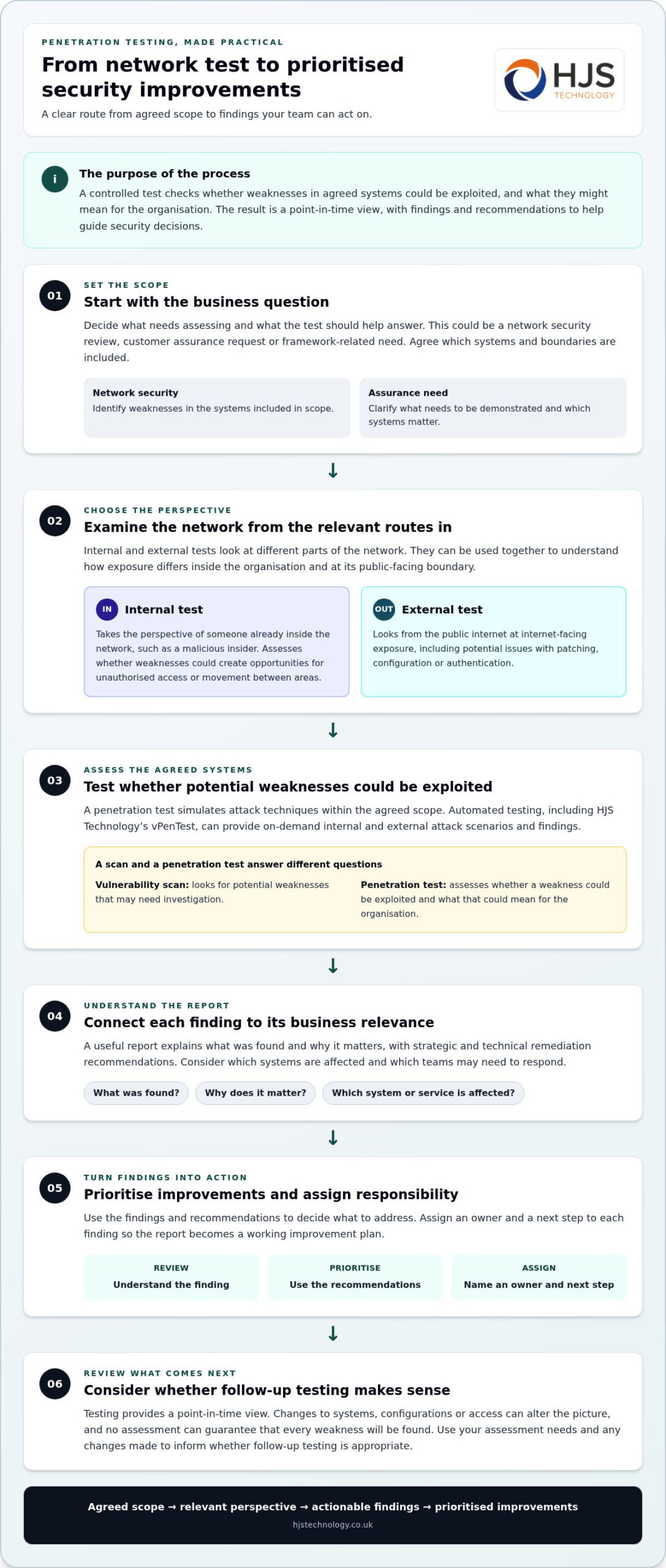
A vulnerability scan looks for potential weaknesses, such as software that may need updating or a setting that warrants review. A penetration test assesses whether a weakness could be exploited and what that could mean for the organisation. Scanning can flag areas for investigation, while testing provides further context about the risk. The right mix depends on the business question and the systems included in scope.
Which organisations may need a penetration test?
Testing may be relevant to organisations reviewing network security, responding to customer assurance requests or preparing for framework-related requirements. Examples include PCI DSS (Payment Card Industry Data Security Standard), ISO 27001 and SOC 2 (System and Organisation Controls 2). A test can contribute to an assurance review, but it does not guarantee compliance or certification.
For businesses in Southampton and across Hampshire, start by defining what needs to be demonstrated and which systems matter to that review. HJS Technology’s testing can address a specific assessment need as part of a wider security plan.
How do internal and external penetration tests work?
Internal and external penetration tests examine different routes into a network. An internal test takes the perspective of someone already inside the organisation, while an external test considers what may be exposed to someone connecting from the public internet. HJS Technology’s automated network penetration testing can cover both perspectives.
| Perspective | Broad purpose and example areas |
|---|---|
| Internal | Simulates an insider threat to identify weaknesses within the organisation’s network. |
| External | Reviews internet-facing exposure, including potential patching, configuration and authentication issues. |
What does an internal network test examine?
An internal test takes the perspective of someone already inside the organisation’s network, such as a malicious insider. It assesses whether weaknesses in that environment could create opportunities for unauthorised access or movement between areas. The aim is to understand internal exposure within the agreed scope, not to assume that a particular system will be accessed.
What does an external network test examine?
An external test looks at the organisation from the public internet. It can assess whether internet-facing parts of the network have potential weaknesses involving patching, configuration or authentication. These findings help the business identify exposed areas that may need attention, within the agreed scope.
Internal and external perspectives complement one another by showing how risks may differ inside the network and at its public-facing boundary. Discuss your testing requirements with HJS Technology to consider which systems and perspective fit your assessment needs.
Does automated penetration testing provide useful assurance?
Yes, automation can make on-demand testing practical, but its usefulness depends on the systems in scope and the assurance your organisation needs. HJS Technology uses vPenTest to simulate internal and external attack scenarios, then provides findings and remediation recommendations to guide security decisions.
Like any test, it provides a point-in-time view. Changes to systems, configurations or access after testing can alter the picture, and no assessment can guarantee that every weakness will be found. Automated testing can support regular reviews, but it should not be treated as a replacement for every manual assessment or proof that risk has been eliminated. Learn more about automated penetration testing in Southampton.
What makes a penetration-testing report actionable?
A useful report explains what was found and why it matters, then sets out strategic and technical remediation recommendations. Decision-makers need to understand the business relevance, such as whether a finding affects an important service or needs a particular team’s attention, rather than being left with technical labels alone. Assigning an owner and next step to each finding helps turn the report into a working improvement plan.
Testing provides a snapshot, while managed detection and response can help an organisation maintain security visibility between assessments.
How should a business assess testing scope?
Start with the systems you need assessed and the question the test should answer. For example, are you reviewing network security, preparing evidence for a customer or responding to a framework-related assurance need? Requirements vary, so check the current official guidance for the relevant framework rather than assuming one test meets every requirement.
Cyber Essentials is a distinct assurance activity, not a substitute for a penetration test. Keep its purpose separate when planning which evidence and checks your organisation needs.
How can Southampton businesses turn test findings into action?
Review the findings, assign an owner to each agreed action and plan follow-up according to business risk. A clear process helps your team move from a technical report to decisions that support day-to-day operations.
HJS Technology’s concise reports bring together strategic and technical remediation recommendations. These help decision-makers understand what needs attention without promising a particular remediation outcome. For organisations considering penetration testing in Southampton, agree in advance who will review the report and coordinate any resulting work.
What should happen after the penetration-test report arrives?
Use the report to decide what to address first, who will take responsibility and how progress will be recorded. A practical sequence is:
- Review each finding and consider its potential business impact and urgency.
- Assign an owner and record the action, any decision to defer it and the reason.
- Track progress until the agreed work is complete, then consider whether follow-up testing is appropriate for the finding and original scope.
This keeps responsibility visible and gives the business a record of decisions, including where an action needs further planning rather than an immediate change.
How can local businesses discuss their testing requirements?
For organisations in Southampton and Hampshire, effective follow-through starts with understanding which systems matter to the business and what the assessment needs to establish. Businesses across the south coast can consider how testing fits into wider cyber security planning, rather than treating the report as a standalone task.
Bring your priorities, relevant systems and assurance questions to HJS Technology’s contact page. This gives the team a practical basis for discussing a suitable scope and how findings could inform your next security decisions.
Make your next security decision with confidence
Connect testing with your organisation’s priorities: decide which systems need attention, who will act on findings and how you’ll review progress. This gives the assessment a clear purpose and helps keep security work aligned with business needs.
HJS Technology provides penetration testing through vPenTest, with on-demand internal and external network testing and concise reports containing strategic and technical recommendations. Based in Southampton, the team serves businesses across the south coast and can help you consider how testing fits your organisation’s security plans.
Bring your priorities and assurance questions to the conversation. Contact HJS Technology to discuss your testing needs and plan a suitable next step.
A considered assessment gives your team a clearer basis for action and helps you decide what to do next.
Frequently Asked Questions
What is penetration testing in simple terms?
It’s a controlled way to check whether someone could use weaknesses in your business systems to gain access they shouldn’t have. Think of it as testing a building’s locks and entry points with permission, rather than waiting for an intruder to try them. For a Southampton organisation, penetration testing can make security risks easier to discuss and plan around.
Is automated penetration testing enough for my business?
It can be suitable when the agreed scope and testing method match the security question you need answered. For example, an organisation seeking a repeatable view of its network may value on-demand automated testing, while a more specialised assessment may call for a different approach. Consider your systems, assurance needs and the evidence requested by customers or relevant frameworks before deciding what testing is appropriate.
How often should a business carry out penetration testing?
There isn’t one interval that suits every business. Review timing against your risk, customer or framework expectations, and changes that could affect your systems, such as a major network change or the introduction of a new service. A Hampshire business can plan a testing cycle with its security team and revisit it when the business or its technology changes.
Can a penetration test guarantee that our network is secure?
No. A test provides evidence about the agreed systems and scope at the time it takes place, but it cannot prove that every weakness has been found or predict every future risk. New systems, configuration changes and emerging issues can alter your security position. Treat test results as one useful input alongside routine security management, staff awareness and appropriate monitoring.
What should we do after receiving a penetration-testing report?
Make sure each finding has a clear decision, an accountable owner and a recorded next step. If a proposed change could affect an important service, coordinate it with the people responsible for that service and plan the work appropriately. Track progress, document any decision to defer action, and consider follow-up testing where it would help assess whether relevant changes have addressed the reported issue.