
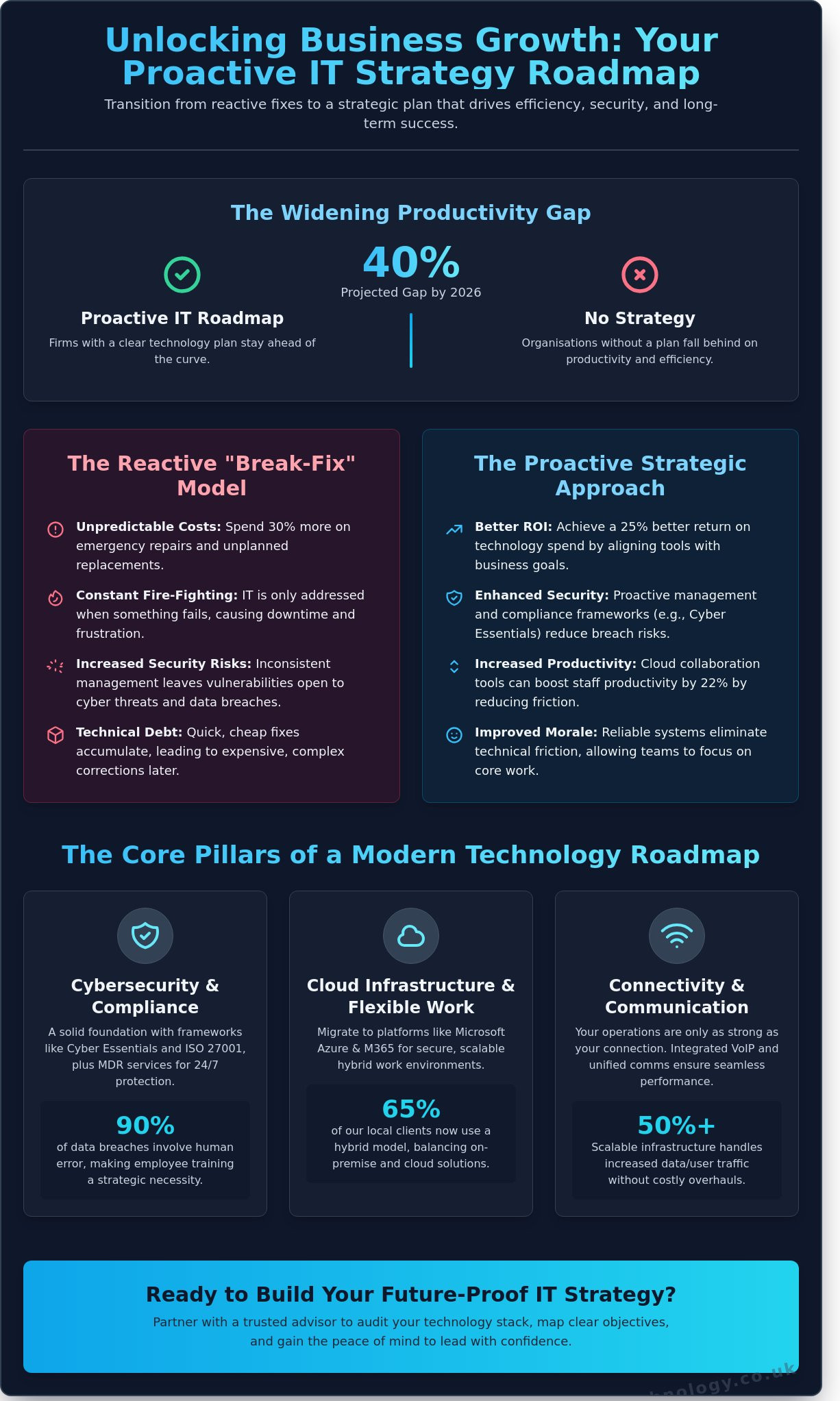
By 2026, the productivity gap between UK firms with a proactive technology roadmap and those without one is projected to widen by 40%. It’s a bold reality that your it strategy is now the primary driver of your commercial success, rather than just a background utility. You likely feel that your technology should be a seamless asset; however, unpredictable costs and the persistent worry of cyber threats can make it feel like a constant hurdle. We agree that your focus should be on growing your business, not managing technical friction.
In this guide, we’ll show you how to align your digital tools with your specific business goals to achieve a 25% better return on your technology spend. You’ll discover how to replace reactive fixes with a bespoke plan that enhances security and ensures system reliability. We’ll walk through the essential steps to build a clear roadmap that provides the long-term peace of mind you need to lead with confidence.
Key Takeaways
- Learn how to align your technology with long-term business goals to transition from a reactive ‘break-fix’ model to a proactive, strategic approach.
- Discover the essential pillars of a modern IT strategy that prioritise workforce productivity and ensure infrastructure stability.
- Understand how proactive IT management can significantly reduce downtime and improve employee morale by eliminating technical friction.
- Follow our five-step framework to audit your current technology stack and map out clear objectives for the next five years.
- Explore the benefits of partnering with a trusted advisor to access specialist expertise and ensure your organisation remains resilient and future-proof.
What is an IT Strategy and Why Does Your Business Need One?
To understand What is an IT Strategy, you must view it as a comprehensive roadmap that aligns your technology choices with your overarching business goals. It represents a fundamental shift from the reactive “break-fix” model, where IT is only addressed when something fails, to a proactive approach that anticipates future needs. While a short-term plan might focus on replacing a single laptop or updating software, an it strategy provides a long-term vision that ensures your infrastructure supports your objectives for 2026 and beyond.
This strategic foresight allows businesses to maintain a competitive edge. It moves technology from the basement to the boardroom, ensuring every investment serves a purpose. By planning three to five years ahead, you avoid the trap of making isolated technical decisions that don’t communicate with each other. This organised approach provides the peace of mind that your business is built on a stable, capable foundation.
Technology as a Catalyst for Business Growth
The right systems do more than just function; they streamline your entire operation. Implementing bespoke cloud-based collaboration tools can increase staff productivity by 22% by reducing time spent on administrative friction. When your technology is seamless, your team can focus on service delivery rather than troubleshooting hardware issues. This directly improves the customer experience, as your staff have the tools to respond quickly and accurately.
Scalable infrastructure is a vital component of this growth. A strategic plan ensures that your systems can handle a 50% increase in data or user traffic without requiring a complete, costly overhaul. By choosing scalable solutions from the start, you create a path for expansion that is both manageable and cost-effective. Your technology becomes a partner in your success, not a bottleneck that restricts your potential.
The Hidden Risks of Operating Without a Strategy
Operating without a clear it strategy leads to “Technical Debt.” This happens when businesses opt for quick, cheap fixes that eventually require expensive corrections. Research indicates that organisations lacking a strategic plan spend 30% more on emergency repairs and unplanned replacements than those with a roadmap. These financial surprises can cripple a small business’s cash flow during critical periods.
Security and compliance also suffer when technology is managed inconsistently. Without a strategy, you may leave vulnerabilities in your network that invite cyber threats. A proactive partnership ensures that all software is patched and all hardware meets current standards. This reduces the risk of data breaches and ensures you meet your legal obligations. A well-defined plan eliminates the stress of technical uncertainty, allowing you to lead your business with confidence.
The Core Pillars of a Modern Technology Roadmap
A successful it strategy isn’t a static document hidden in a drawer. It’s a proactive framework that aligns your digital tools with your commercial goals. Every investment must serve a distinct purpose. If a new piece of software doesn’t save time or increase security, it doesn’t belong in your budget. We recommend reviewing your roadmap every 90 days to ensure it stays relevant as market conditions shift. This disciplined approach ensures your technology supports your staff rather than creating hurdles for them.
Cybersecurity and Compliance as a Foundation
Building your digital house on sand leads to disaster. We integrate frameworks like Cyber Essentials and ISO 27001 to give your business a solid base. Managed detection and response (MDR) services act as a 24/7 digital guard for your brand reputation. Technology alone isn’t enough; 90% of data breaches involve human error according to 2023 ICO reports. This makes regular employee awareness training a strategic necessity for every Southampton firm. It’s about creating a culture of vigilance that protects your bottom line.
Cloud Infrastructure and the Future of Flexible Work
The shift to hybrid work requires a flexible approach. Migrating to platforms like Microsoft Azure or Microsoft 365 allows your team to work securely from any location. Approximately 65% of our local clients now use a hybrid model, balancing on-premise hardware with cloud scalability. This structure ensures your costs fluctuate with your headcount, preventing waste on unused licences. It’s about building resilience so your operations never skip a beat, regardless of where your team logs in.
Connectivity and Communication Systems
Your digital operations are only as strong as your connection. Choosing the right business internet is the first step toward seamless performance. Integrating VoIP and unified communications ensures your clients always reach a professional voice, whether the team is in the office or on the road. We provide 24/7 system monitoring to catch issues before they cause downtime. If you’re ready to refine your it strategy, feel free to get in touch with our local team for a friendly chat about your goals.
- Proactive Monitoring: Identifying hardware failures before they disrupt your day.
- Scalable Solutions: Ensuring your tech stack grows at the same pace as your revenue.
- Strategic Alignment: Mapping every £1 spent on IT to a specific business outcome.
Moving from Reactive Fixes to Proactive IT Management
Relying on a reactive model means you’re always one hardware failure away from a crisis. This “firefighting” approach creates unnecessary tension for your leadership team and stalls your growth. By contrast, a proactive it strategy involves constant monitoring and preventative maintenance. We use data-driven insights to identify a failing server or a security vulnerability before it impacts your operations. This shift ensures your technology supports your business goals rather than dictating your daily schedule. By catching issues early, we transform IT from a source of stress into a silent, reliable engine for your business.
The True Cost of the ‘Break-Fix’ Mentality
Choosing the cheapest support option often results in hidden expenses that dwarf the initial savings. A 2023 report indicated that unplanned downtime costs UK small businesses an average of £3,670 per hour in lost productivity and missed sales. Beyond the immediate financial hit, technical friction erodes staff morale. In fact, 42% of UK workers say they’ve felt frustrated by slow or unreliable technology. This frustration leads to higher staff turnover, which costs an organisation roughly £3,000 per hire in recruitment fees alone. Proactive management eliminates these “soft” costs by keeping systems running smoothly.
Achieving Seamless Integration with a Managed Partner
A managed service provider functions as a natural extension of your internal team. You gain access to a full spectrum of 1st, 2nd, and 3rd line support for a fixed, predictable monthly investment. This structure removes the worry of unexpected invoices. Our team monitors your infrastructure 24/7; we often resolve patches and system updates overnight. You won’t even notice the work happening, but you’ll certainly feel the results. This creates a state of total peace of mind, allowing you to focus entirely on your clients. Integrating this level of support into your it strategy provides several key benefits:
- Predictable Budgeting: Fixed monthly costs eliminate the “bill shock” of emergency repairs.
- Expertise on Demand: Instant access to senior engineers without the cost of a full-time internal hire.
- Reduced Friction: Systems are optimised for performance, meaning fewer “spinning wheels” for your staff.
- Strategic Alignment: Technology choices are made based on your three-year business plan, not just today’s crisis.
If you’re ready to stabilise your technology and move away from the stress of constant fixes, contact our Southampton team to discuss a bespoke plan that fits your specific needs.
How to Create Your IT Strategy: A 5-Step Framework
A robust it strategy acts as a roadmap for your business growth. It’s a fact that 32% of UK businesses still operate without a formal technology plan, which often leads to reactive, emergency spending. You can build a stronger foundation by following a structured 5-step framework. This process ensures your technology works for you, rather than against you.
- Audit your technology stack: Identify every piece of hardware and software to expose gaps or security vulnerabilities.
- Define your objectives: Set clear business goals for the next 12 months, 3 years, and 5 years to ensure IT supports your vision.
- Map solutions to goals: Choose tools that solve specific problems. If you plan to increase remote staff by 25% in three years, your strategy must include scalable cloud infrastructure.
- Budget for the future: Allocate funds for upgrades and cybersecurity enhancements to avoid unexpected costs.
- Establish KPIs: Measure success with specific metrics, such as a 15% reduction in helpdesk tickets or achieving 99.9% system uptime.
This structured approach moves your business away from chaos toward proactive stability. It allows you to treat technology as a tool for efficiency rather than a constant source of friction.
Assessing Your Current Technical Debt
Many businesses carry technical debt, which refers to the hidden costs and risks of outdated systems. We recommend conducting a free IT health check to benchmark your status. A 2023 assessment of local Hampshire firms found that 45% were running at least one piece of end-of-life hardware. Identifying these legacy systems helps you avoid security breaches. Organising your hardware and software inventory provides the clarity needed for better management and peace of mind.
Aligning IT Spend with Long-Term Goals
Your IT budget shouldn’t be a series of surprises. It’s better to prioritise investments based on their potential return on investment. A well-planned forecast balances capital expenditure (CapEx) for hardware with operational expenditure (OpEx) for cloud services. This financial clarity allows you to fund essential protections properly. For instance, ensuring your disaster recovery plan template is fully funded and tested is vital for continuity. When you ensure your it strategy aligns with your long-term vision, technology becomes a catalyst for success.
Ready to build a technology roadmap that supports your business goals? Contact our Southampton team today to discuss a bespoke plan for your business.
The Role of the Trusted Advisor in Future-Proofing Your Business
Successful SMEs in Southampton understand that an effective it strategy isn’t just about keeping the lights on; it’s about driving growth. Partnering with an external consultancy gives your business access to a depth of knowledge that’s difficult to build in-house. While a single internal IT manager might be skilled, a strategic partner provides a whole team of specialists. This collective expertise helps you navigate the shift towards AI and advanced automation. By 2025, approximately 75% of UK businesses plan to integrate AI into their daily operations. You need a partner who ensures these tools actually drive revenue rather than adding complexity.
Our “Business First” philosophy means we look at your commercial objectives before we even talk about hardware. We don’t start with a list of products. We start with your goals. This approach changes your relationship with your provider from a transactional cost to a value-driven partnership. We treat technology as a vehicle to reach your milestones. It’s a proactive stance that helps you stay ahead of competitors who are still stuck in a reactive “break-fix” cycle.
Bespoke Solutions for Unique Business Challenges
Off-the-shelf IT packages rarely fit the nuances of your specific industry. A local legal firm has different compliance needs than a Hampshire-based logistics company. We customise every solution to align with your specific workflows. Regular strategic reviews are a core part of this process. We meet quarterly to ensure your technology pivots as your market changes. This proactive stance helped our clients reduce technical debt by 30% on average over the last two years. We don’t believe in one-size-fits-all because your business isn’t like everyone else’s.
Securing Peace of Mind for 2026 and Beyond
Trust is built on standards and consistency. Choosing a partner with ISO 27001 certification ensures your data management meets international security benchmarks. Long-term relationships drive better technical outcomes because your advisor understands your history and your future trajectory. This consistency provides the stability needed to scale with confidence. We focus on the people behind the screens, making sure your team feels supported during every upgrade or migration. A robust it strategy is your best defence against future uncertainty. Ready to start? Contact our team today to discuss your strategic roadmap.
Future-Proofing Your Business Success for 2026 and Beyond
Developing a robust it strategy ensures your technology serves your commercial goals rather than dictating them. You’ve seen how shifting from reactive fixes to a proactive, five-step framework creates a seamless path to growth. Since 2007, HJS Technology Ltd has helped firms move beyond technical friction toward true operational continuity. As an ISO 27001 certified firm with 19 years of expertise, we understand that your priority is productivity, not troubleshooting hardware.
We adopt a “Business First” approach to ensure your systems remain compliant and secure. Our team acts as your trusted advisor, providing the steady hand you need to navigate the evolving digital landscape. You shouldn’t have to manage the complexities of cyber security or document solutions alone. Instead, you can enjoy total peace of mind while we handle the technical roadmap that supports your ambitions. We focus on the tools so you can focus on the results.
Ready to align your technology with your vision? Book a Strategic IT Consultation with HJS Technology Ltd today to start building a more resilient future for your team.
Frequently Asked Questions
How do I create an IT strategy for a small business?
You create an effective strategy by aligning your technology investments with your three year business objectives. Start by auditing your current hardware and software to identify gaps that hinder productivity. A successful roadmap focuses on how tools can solve specific operational challenges. We recommend prioritising projects that offer the highest return on investment for your Hampshire based team.
What should be included in a comprehensive IT strategy document?
A comprehensive document must include a current state assessment, a three year financial forecast, and a clear cybersecurity framework. It needs to detail your hardware lifecycle, cloud migration plans, and data protection protocols. Including a 36 month budget helps you avoid unexpected capital expenditure. This structured approach ensures your technology supports your commercial goals without any hidden surprises.
How often should a business review and update its IT strategy?
You should conduct a formal review of your it strategy at least once every 12 months to account for new technologies. Quarterly health checks are also vital for making smaller adjustments based on recent performance data. Since 39 percent of UK businesses identified a cyber attack in 2022, annual updates are essential to keep your security measures robust and effective.
What is the difference between an IT plan and an IT strategy?
An IT strategy defines the high level “why” and “where” of your technology, while an IT plan outlines the tactical “how” and “when”. The strategy focuses on long term outcomes, such as achieving a 15 percent increase in remote team efficiency. In contrast, the plan lists specific tasks, like the exact date you’ll upgrade your office scanners or laptops.
Why is an IT strategy important for business continuity and disaster recovery?
It provides the essential framework for maintaining operations during a crisis by defining your Recovery Time Objectives. Without this strategic foundation, your business risks prolonged downtime and significant data loss. The average cost of downtime for a UK SME is £4,227 per hour; a proactive plan reduces this risk by establishing clear, tested backup protocols.
How much does professional IT strategic consultancy cost for a UK SME?
Professional consultancy typically ranges from £800 to £1,500 per day depending on the complexity of your infrastructure. Many businesses find better value by choosing a managed service that includes strategic guidance within a fixed monthly fee. For a 25 person firm, a bespoke three year roadmap usually requires two days of initial assessment to ensure every detail is covered.
Can a managed service provider help with my long term IT strategy?
Yes, a managed service provider acts as a Virtual CTO to guide your long term it strategy and ensure your systems scale with your growth. They provide the technical foresight and local expertise needed to keep your business competitive. Currently, 75 percent of UK SMEs rely on external partners for this strategic direction rather than hiring an expensive, full time internal Director.
What are the first steps to take if my business has no formal IT strategy?
Your first step is to document every piece of hardware and software your team uses daily. Identify the primary technical “pain points” that cause frustration or slow down your workflow. Once you have this list, schedule a 60 minute discovery session with a trusted advisor. This allows you to map out your immediate risks and set clear targets for the 2024 financial year.