





For nearly 24 hours many people around the world couldn’t get into their Outlook email. Some other Microsoft services also had problems. Microsoft has published an early report explaining the cause. We’ve broken it down for you below.
The key takeaway: businesses shouldn’t assume that cloud services will always be available. Having backup arrangements and a clear business continuity plan is essential.
Who was affected?
- Email was hit hardest. Most people couldn’t open their mailbox in Outlook, on the web, or on their phone, and many emails arrived late.
- Other services had smaller problems. Teams, SharePoint, OneDrive, Copilot and others mostly stayed up, but some features that depend on email didn’t work properly. Teams chats and meetings worked for most of the outage.
- How bad it was depended on where you were and when you tried to connect. Some people had patchy access rather than none at all.
What went wrong?
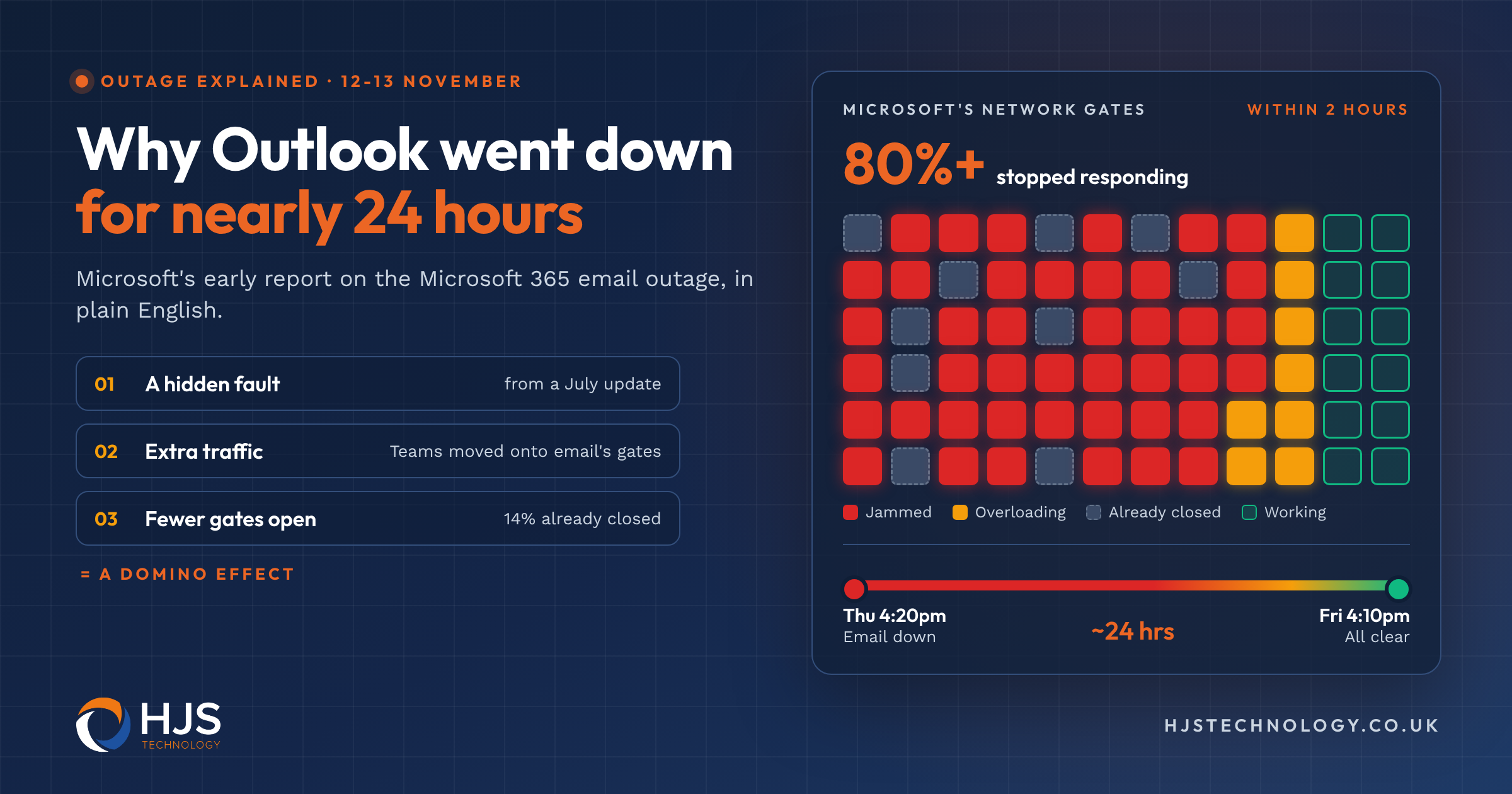
Think of Microsoft’s network like the entrance gates to a huge building. Everyone has to go through these gates to reach their email. Three things went wrong at the same time:
- A hidden fault. In July, Microsoft made a small change to the software running these gates. It worked fine for months. But it had a hidden weakness: when the gates got very busy, they could jam up completely. Microsoft’s testing didn’t catch this, because the tests ran on smaller, older machines where the problem barely shows.
- Extra visitors. Early on Thursday, Teams traffic was moved onto the same gates that email uses making those gates busier than usual.
- Fewer gates open. About 14% of the gates were already closed because of an unrelated problem from the day before.
Put those three together and some gates jammed. The system then did what it’s designed to do and sent people to other gates. Those gates got overloaded and jammed too. It spread like a domino effect. Within two hours, more than 80% of the gates had stopped responding. The barriers that normally stop a problem in one region spreading to others also failed.
Teams, OneDrive and SharePoint could switch to a different set of gates, so they recovered sooner. Email is too big to switch over, so it stayed stuck.
Why did it take so long to fix?
- Every time engineers reopened a gate, the crowd waiting outside rushed in and jammed it again.
- The faulty change was months old, so there was no quick “undo” button.
- In the end, Microsoft built a fix that put the software back to how it was before July. Engineers then took large groups of servers offline, applied the fix, restarted them and brought them back carefully.
Asia Pacific and Europe recovered first on Friday morning. Webmail was back to normal worldwide by about 2:15pm, and Microsoft confirmed the problem was over at 4:10pm.
Did I lose any emails?
According to the report, you shouldn’t have. Microsoft gave delayed emails extra time to be delivered, so messages sent during the outage were held and then delivered rather than bounced back as “undeliverable”.
What’s Microsoft doing to stop it happening again?
So far, Microsoft says it has:
- Removed the faulty change
- Added extra capacity
- Added new monitoring to spot this kind of problem earlier
- Added safeguards so one failure can’t knock over the rest like dominoes
A full report is due by 20 November 2026.
This summary is based on Microsoft’s preliminary report dated 15 November 2026. Some details may change when the final report comes out.
Do you have a Business Continuity Plan?
Get in touch to discuss what a business continuity plan would look like for your organisation.