

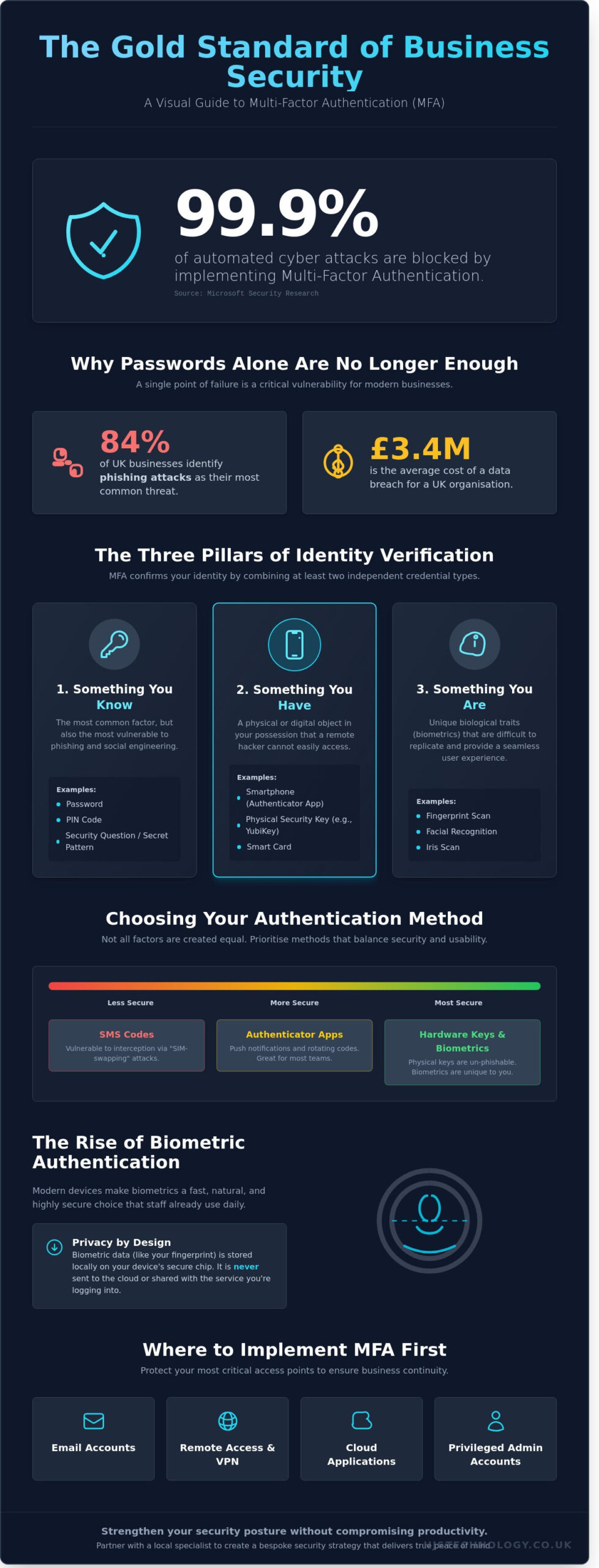
Did you know that 99.9% of automated cyber attacks are blocked by implementing just one specific security measure? It’s a staggering figure from Microsoft’s recent security research that highlights why multi-factor authentication has become the gold standard for protecting UK businesses. We understand that as a business owner, you want your systems to be secure; however, you don’t want to bury your staff under piles of technical jargon or complex login processes that hinder their daily work.
It’s completely natural to feel concerned that more security means more friction for your employees. We agree that technology should always support your business goals, not create new hurdles for your team. This guide will show you how this proactive tool actually simplifies your path to Cyber Essentials compliance and provides the long-term peace of mind your organisation deserves. We’ll explain exactly how multi-factor authentication works in plain English and help you build a security strategy that feels seamless rather than stressful.
Key Takeaways
- Learn how multi-factor authentication acts as a robust shield, neutralising up to 99% of common cyber attacks against your organisation.
- Understand the three essential pillars of identity verification and why using independent credentials is vital for modern business security.
- Discover how to implement high-level protection without compromising employee productivity or creating unnecessary friction in your daily operations.
- Identify the critical areas of your business, such as email and remote access, that require immediate protection to ensure long-term continuity.
- Explore the strategic advantages of partnering with a local specialist to create a bespoke security posture that offers true peace of mind.
Understanding Multi-Factor Authentication and Its Role in Modern Business
Multi-factor authentication (MFA) acts as a sophisticated, multi-layered security system designed to protect your sensitive business data. At its core, the concept is simple yet incredibly effective. It requires users to provide two or more independent credentials before they’re granted access to a network or application. This shift from simple, static passwords to identity-based security reflects the modern reality of cyber threats. By implementing multi-factor authentication, you’re adopting the single most effective method for preventing unauthorised access to your company’s digital assets.
HJS Technology views this technology as a fundamental pillar of a healthy IT strategy. It isn’t just an extra step for your employees; it’s a strategic barrier that ensures only the right people access your systems. We focus on making these transitions seamless so that your team remains productive while staying secure.
Why Passwords Alone Are No Longer Sufficient
The UK government’s Cyber Security Breaches Survey 2024 found that 84% of businesses identified phishing as their most common threat. Credential harvesting through these phishing attacks means that once a hacker has your password, your entire business network is at risk. If an employee uses the same password for a personal account that gets leaked in a data breach, your corporate security is instantly compromised. “In 2026, a password is no longer a wall; it is merely a gate that requires a second lock.” Relying on a single string of characters is a vulnerability that modern businesses can’t afford to ignore.
The Business Value of Enhanced Identity Verification
Securing your identity isn’t just about IT; it’s about business continuity and protecting the brand reputation you’ve spent years building. According to IBM’s 2023 Cost of a Data Breach Report, the average cost of a breach for UK organisations reached £3.4 million. By using multi-factor authentication, you significantly reduce the risk of costly downtime and the operational paralysis that follows a cyber incident. This proactive approach provides genuine peace of mind for your stakeholders and clients. They need to know their data is safe in your hands. A secure infrastructure allows your team to focus on growth rather than disaster recovery. If you’re looking to strengthen your perimeter, you can contact our Hampshire-based team to discuss a bespoke solution.
The Three Pillars of MFA: How Identity is Verified
To protect your business effectively, multi-factor authentication relies on a simple but powerful logic. It requires users to provide evidence from at least two distinct categories before granting access to sensitive data. If a criminal steals a password, they still lack the other physical or biological markers needed to breach your systems. This layered approach creates a proactive barrier that’s far more robust than a traditional password alone.
- Something you know: This is the most familiar layer. It includes passwords, PIN codes, or secret patterns. While simple to use, these are the most vulnerable to social engineering.
- Something you have: This involves a physical or digital object in the user’s possession. Common examples include a smartphone, a physical security key, or a smart card.
- Something you are: These are biological traits, known as biometrics. Fingerprints and facial recognition are the most frequent examples used in modern UK workplaces.
Physical vs. Virtual Factors
Your business can choose between physical hardware, like YubiKeys, or software-based authenticator apps. Hardware tokens offer excellent security because they can’t be intercepted by remote hackers; however, software apps provide a seamless experience for hybrid teams. While SMS codes were standard in 2022, many organisations have moved away from them. Research from 2023 suggests that push notifications are significantly more secure than SMS, which can be intercepted through SIM-swapping. The right choice depends on your specific environment and how your staff access their tools.
The Rise of Biometric Authentication
Modern laptops and mobiles have made biological checks incredibly fast. Most employees already use facial recognition to unlock their phones, so adopting this for multi-factor authentication feels natural and avoids password fatigue. Privacy is often a concern for staff, but modern hardware stores biometric data locally on the device’s secure chip. The data isn’t sent to the cloud. This ensures the user’s identity is verified locally, providing peace of mind for both the employer and the employee. If you want to find the most efficient balance for your staff, you can contact our Hampshire-based team for a bespoke recommendation.
Common Misconceptions and Barriers to Implementing MFA
Many business owners hesitate to adopt multi-factor authentication because they fear it will hinder staff productivity. They worry that constant login prompts will frustrate employees and slow down the workday. Modern security systems are designed to be unobtrusive. When implemented correctly, these tools provide a seamless experience that protects your data without creating unnecessary friction. Security shouldn’t be a hurdle; it’s the foundation that allows your team to work with total peace of mind.
A frequent myth we hear is that small businesses are too small to be targeted. Data from the UK Government’s Cyber Security Breaches Survey 2024 reveals that 33% of small businesses identified a cyber attack in the last 12 months. Hackers often use automated scripts to find any vulnerability, regardless of company size. Thinking your business has nothing worth stealing is a dangerous mindset. Even a simple list of client email addresses or access to your payroll system provides enough leverage for a criminal to cause significant financial and reputational damage.
The perceived cost of implementation often stops firms from acting. However, the price of a proactive multi-factor authentication strategy is a fraction of the cost of a recovery. While a basic setup might cost a few pounds per user, the average cost of a data breach for UK businesses has risen to over £3,000 for even the smallest firms, with some losses reaching much higher when factoring in downtime and lost contracts.
Overcoming Employee Resistance
Clear communication is the most effective way to launch new security measures. Explain to your team that these steps protect their own digital identity as much as the company’s assets. You can significantly reduce login friction by using “Remember this device” settings. This feature ensures staff only need to provide a second factor once every 30 days on their trusted office hardware. If you’re unsure how to manage this transition, our team provides bespoke training advice to help your staff embrace these changes confidently.
MFA and Business Insurance Requirements
The UK insurance market has shifted its stance on cybersecurity. Many leading insurers now mandate multi-factor authentication as a non-negotiable requirement for professional indemnity or cyber insurance policies. By demonstrating that you’ve implemented robust security, you’re often seen as a lower risk, which can potentially lead to lower annual premiums. Failing to implement MFA could result in a total loss of insurance coverage in the event of a breach. This makes the technology a vital component of your business continuity and compliance strategy.
Best Practices for Deploying MFA Across Your Organisation
Implementing multi-factor authentication requires a strategic approach to ensure security doesn’t hinder your team’s daily workflow. Start with a comprehensive audit of all business-critical systems and applications. You need to know exactly where your data lives before you can lock the doors. According to the 2023 Cyber Security Breaches Survey, 32% of UK businesses identified an attack in the last year. This makes a proactive audit your first line of defence.
Prioritise protection for email accounts and remote access tools like VPNs or cloud desktops. These are the primary targets for modern cyber criminals. Once these are secure, choose authentication methods based on your team’s technical ability. While mobile push notifications are efficient, some staff may require hardware tokens. A bespoke approach ensures everyone stays productive without feeling overwhelmed by new technology.
Develop a clear policy for lost devices or forgotten credentials. If an employee loses their phone on a business trip, your IT protocol should allow for a swift, secure reset. It’s vital to continuously monitor and update your multi-factor authentication settings. Cyber threats change rapidly. Microsoft data from 2022 suggests that MFA blocks 99.9% of account compromise attacks, but only if the configuration remains robust against new tactics like MFA fatigue.
Integrating MFA with Microsoft 365
Most UK small businesses already rely on the Microsoft 365 ecosystem. Enabling multi-factor authentication within this environment is straightforward and highly effective. We use “Conditional Access” to make security smarter. This means your team isn’t constantly pestered for codes while in your secure office, but the system triggers a challenge if they log in from a new location. HJS Technology manages these settings to ensure a seamless experience that balances high security with user convenience.
MFA and the Cyber Essentials Certification
MFA is now a core requirement for achieving the UK government-backed Cyber Essentials certification. This badge of honour is often vital for winning local authority contracts or working with large-scale organisations. To meet the current criteria, you must demonstrate that MFA is active for all cloud services and administrative accounts. Use this checklist to ensure you’re compliant:
- Enable MFA for all users accessing cloud-based applications.
- Apply secondary verification to all administrative and privileged accounts.
- Ensure remote access points, such as VPNs, require more than just a password.
- Document your recovery processes for lost authentication factors.
Protecting your business shouldn’t be a source of stress. Contact HJS Technology today to discover how our local team can secure your systems and provide lasting peace of mind.
Strategic Security: Why Partnering with an Expert Delivers Peace of Mind
Implementing security in-house often leads to fragmented systems that frustrate employees and leave doors open for intruders. A 2023 study by the UK Department for Science, Innovation and Technology found that 32% of UK businesses identified a cyber attack in the last 12 months. Attempting a DIY approach to multi-factor authentication can create hidden gaps where hackers find easy entry points. These vulnerabilities often arise from misconfigured settings or overlooked user accounts. We act as your steady hand, organising your security posture so it remains robust without becoming a burden. Our team ensures that your protection is layered, logical, and effective.
Partnering with a Managed Service Provider (MSP) ensures your business benefits from ongoing threat monitoring. We don’t just set up a password; we manage the entire ecosystem. This proactive stance means we often stop threats before they impact your daily operations. A single hour of downtime can cost a UK SME upwards of £3,500 in lost productivity and recovery fees. We prevent these losses by maintaining a steady, watchful eye on your network. It’s about stability. We handle the technical heavy lifting, allowing you to focus on scaling your business and serving your customers. Our “Business First” philosophy ensures that technology serves your goals rather than dictating them.
The HJS Approach to Proactive Cybersecurity
Our ISO 27001 certification serves as a mark of trust for our clients. It proves we follow rigorous international standards for information security management. We don’t believe in one-size-fits-all packages. Whether you have 10 employees or 250, we customise every security solution to your specific user count and operational needs. By implementing multi-factor authentication as part of a bespoke strategy, we directly reduce the risk of downtime. This provides absolute peace of mind that your data is protected by a local Hampshire-based team of experts.
Next Steps for Your Business Security
Start by reviewing your current login procedures today. If you rely solely on passwords, your business is at risk. We invite you to reach out for a professional consultation with our dedicated team. We’ll help you audit your systems and implement a seamless security strategy that supports your growth. Security is a journey, not a destination; let us be your guide.
Strengthen Your Business Defences Today
Protecting your company in today’s digital landscape requires more than just a complex password. Implementing multi-factor authentication is a strategic step that ensures your sensitive data remains accessible only to those you trust. By verifying identity through multiple independent layers, you’re building a resilient environment where productivity and security coexist seamlessly. You’ll find that the right security framework doesn’t hinder your staff; it empowers them to work with total confidence from any location.
HJS Technology has provided steady guidance to UK SMEs since 2007, bringing 17 years of technical expertise to every partnership. As an ISO 27001 Certified firm, we deliver bespoke cybersecurity solutions that meet the highest international standards for data protection. We don’t believe in generic approaches. Instead, we focus on your specific business goals to ensure your technology supports your long-term success. You deserve a local partner who values your continuity as much as you do.
Secure your business and gain peace of mind; contact HJS Technology today
We look forward to helping you build a more secure and prosperous future for your organisation.
Frequently Asked Questions
Is multi-factor authentication the same as two-factor authentication (2FA)?
Multi-factor authentication is the broad category that encompasses two-factor authentication. While 2FA requires exactly two forms of verification, MFA can involve two, three, or more layers of security. Most UK businesses use these terms interchangeably to describe the process of adding a second check after a password. It’s a straightforward way to ensure your data stays protected even if a password is leaked or stolen.
Can multi-factor authentication be bypassed or hacked?
No security measure is entirely infallible, but multi-factor authentication stops 99.9% of account compromise attacks according to Microsoft research. Sophisticated criminals might use “MFA fatigue” or phishing to trick staff, but these instances are rare compared to standard password theft. We focus on training your team to recognise these attempts, providing a proactive layer of defence that keeps your business continuity intact and your mind at ease.
What happens if an employee loses the phone they use for MFA?
We can quickly reset access or use pre-generated backup codes if a staff member loses their device. This recovery process typically takes less than 15 minutes when managed by a dedicated IT partner. It’s a common scenario that doesn’t need to cause panic or significant downtime. We ensure your business operations remain seamless by having a clear recovery plan in place before any hardware goes missing.
Is SMS-based MFA secure enough for a business environment?
SMS-based verification is significantly better than using passwords alone, though the National Cyber Security Centre (NCSC) now recommends authenticator apps or hardware tokens. Criminals can occasionally intercept text messages through “SIM swapping” techniques. We usually suggest a move towards app-based codes because they’re more secure and don’t rely on a mobile signal. This improves your overall productivity and ensures your security remains robust and reliable.
Does MFA really help with Cyber Essentials certification?
Multi-factor authentication is a mandatory requirement for all cloud services under the Cyber Essentials scheme as of April 2023. You won’t achieve this government-backed certification without it being active for your entire team. By implementing these controls, you demonstrate to clients and partners that you take data protection seriously. It’s a strategic move that helps you win new contracts while securing your internal systems against common threats.
Will MFA make it take much longer for my staff to log in every day?
Most employees find that MFA adds less than 10 seconds to their initial login process. Modern systems allow staff to “remember” a trusted device for 30 days, so they don’t have to verify every single time they open their laptop. This balanced approach ensures your security doesn’t hinder daily output or frustrate your team. We prioritise a seamless experience that protects your business without getting in the way of work.
How much does it typically cost to implement MFA for a small business?
Implementation often costs £0 in additional licence fees if you already use Microsoft 365 or Google Workspace. You might invest £50 to £100 per hour for professional setup to ensure the configuration is correct across your whole organisation. This small initial investment provides long-term peace of mind. It’s a cost-effective way to prevent the average £11,000 cost associated with a successful UK data breach or ransomware attack.
Is MFA mandatory for business insurance in the UK?
Most UK insurers now require MFA as a condition for cyber liability insurance policies. In a 2023 industry survey, 85% of providers stated they might refuse cover or significantly increase premiums if these security measures aren’t active. Having these protections in place makes your business more insurable and often leads to more competitive rates. It’s a practical step that protects your financial interests and your hard-earned reputation.