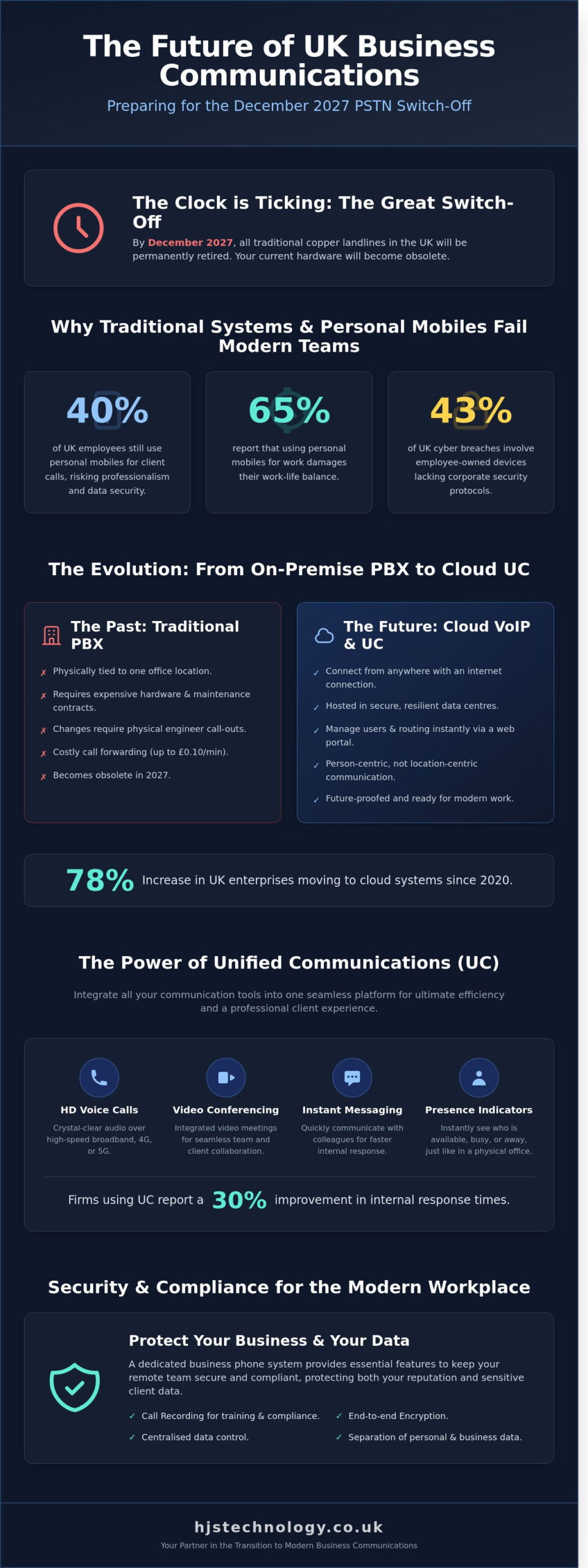
By December 2027, every traditional copper landline in Britain will be permanently retired, making your current hardware obsolete. If your staff are among the 40% of UK employees still relying on personal mobiles for client calls, you’re likely feeling the pressure of this looming deadline. You know that maintaining a professional image requires more than just a mobile number; it requires a system that works wherever your team happens to be. It’s frustrating when technology hinders productivity instead of helping your business grow.
We understand that you want communication to be a strategic asset rather than a source of daily friction. In this guide, we’ll show you how to deploy remote worker phone systems uk that provide the security and clarity your business deserves. You’ll discover how to transition seamlessly to a cloud-based setup that improves team visibility and protects your professional reputation. We’ll walk through the practical steps to ensure your business stays connected, productive, and fully prepared for the digital future, giving you the peace of mind to focus on your core goals.
Key Takeaways
- Understand the transition from traditional hardware to cloud-based Unified Communications to provide your team with a flexible and modern workspace.
- Discover how to leverage high-speed broadband and 5G to ensure your communications remain crystal clear and professional, regardless of where your staff are based.
- Identify the essential features, such as call recording and encryption, that prioritise business productivity and compliance while securing your data on home networks.
- Prepare your business for the 2027 PSTN switch-off by adopting resilient remote worker phone systems uk that guarantee long-term continuity.
- Learn how a strategic “Business First” approach to technology can simplify your transition and provide the peace of mind needed to focus on your core goals.
The Evolution of Remote Worker Phone Systems in the UK
Modern business communication has moved far beyond the copper wires and heavy hardware of the past. Today, remote worker phone systems uk businesses utilise are sophisticated, cloud-based Unified Communications (UC) platforms. These systems don’t live in a cupboard in your office. They exist in secure, resilient data centres, allowing your team to stay connected from any location with an internet connection. Since the 2020 shift in working patterns, we’ve seen a 78% increase in UK enterprises moving away from traditional setups to embrace this flexibility.
The transition from a traditional on-premise PBX (Private Branch Exchange) to a hosted Voice over Internet Protocol (VoIP) solution represents a strategic leap forward. Old systems required expensive maintenance contracts and physical engineers to make simple changes. Modern VoIP allows for proactive management through a simple web portal. You can add new users or change call routing in seconds, ensuring your business remains agile. By 2026, the UK market will have moved entirely to person-centric communication, where a phone number belongs to an individual rather than a physical desk or a specific building.
Relying on personal mobile phones for business calls presents a documented risk to your professional brand and data security. When staff use their own numbers, you lose control over the client experience and sensitive company data. Statistics show that 43% of UK cyber breaches involve employee-owned devices that lack corporate security protocols. Providing a dedicated virtual system ensures that your business maintains its professional identity while keeping your data compliant with current UK regulations. It offers the peace of mind that comes from knowing your business assets are protected and your team is supported.
Why Traditional Landlines Fail the Modern Hybrid Team
Traditional landlines are physically tied to a specific UK postcode, which creates a significant bottleneck for hybrid teams. If your staff aren’t at their desks, you’re often forced to use call forwarding. This practice can cost businesses up to £0.10 per minute in hidden fees and often results in poor call handling. Furthermore, 65% of UK employees report that using personal mobiles for work damages their work-life balance. A bespoke VoIP system solves this by providing a dedicated app that keeps work and life separate.
The Business Case for Unified Communications (UC)
Unified Communications is the integration of multiple communication methods into a single, seamless professional interface. It moves your business beyond simple voice calls by integrating video conferencing, instant messaging, and file sharing into one platform. This creates a consistent experience for your clients, regardless of where your staff are working. Whether your team is in a Hampshire office or working from home, they have access to the same strategic tools. This integration has been shown to improve internal response times by 30% in professional service firms across the UK.
How Cloud-Based Telephony Empowers Hybrid Teams
VoIP technology works by slicing your voice into small digital data packets. These packets travel across the internet to reach the recipient, where they’re reassembled into clear audio. It’s a fundamental shift from the physical copper wires of the past. This transition is no longer optional; the 2027 PSTN Switch-Off marks the date when traditional landlines will cease to function across the United Kingdom. To ensure business continuity, adopting remote worker phone systems uk wide is a proactive step that protects your operations. The success of this system relies on the robust infrastructure of high-speed business broadband or the 100Mbps+ speeds often found with 4G and 5G connectivity. These connections provide the stability needed for high-definition voice calls without the jitter or lag associated with older tech.
Managers often worry about losing oversight when teams work from home. Cloud telephony introduces “Presence” indicators that act as a virtual office map. You’ll see instantly if a team member is available, busy, or away from their desk. It removes the guesswork and allows for smoother internal collaboration without constant messages to check if someone is free. This visibility creates a sense of unity, even when your staff are scattered across different postcodes. It’s about maintaining that office-style awareness without the need for a shared physical space.
Seamless Connectivity Across Devices
Flexibility is the core of a modern hybrid strategy. Your team can choose to use a traditional desk phone, a laptop-based softphone, or a mobile app. Softphones are particularly powerful; they turn any computer into a comprehensive business extension with a full keypad and directory. This ensures a “single number” reach. Whether a staff member is in a Southampton office or a home study in Winchester, they present one professional identity. You can also customise routing rules based on the clock. For instance, calls can automatically divert to an on-call mobile after 5:30 PM. This ensures no client is left waiting, providing peace of mind for business owners who value responsiveness.
Improving Client Experience with Intelligent Call Handling
First impressions matter, and a cloud system ensures they stay professional regardless of where your staff are sitting. Auto-Attendants act as a digital receptionist, directing callers to the correct department without a manual transfer. You can also implement bespoke hold music or professional greetings that reflect your brand’s personality. Integration with tools like Microsoft 365 means that when a client calls, their record can pop up on the screen immediately. This allows your team to provide a personal, informed service that feels like everyone is in the same room. Using remote worker phone systems uk businesses can rely on means your customers never need to know your team is working remotely. If you’re looking to refine your setup, our team can help you find the right communication solutions for your specific business goals. This strategic approach to technology ensures your client experience remains consistent, professional, and reliable.
Essential Features for a Professional Remote Setup
Selecting the right technology for a distributed team requires a focus on tools that drive measurable results. While many providers offer flashy extras, HJS Technology Ltd prioritises features that enhance your team’s daily efficiency. High-quality remote worker phone systems uk provide more than just a dial tone; they offer a strategic advantage for growing businesses. For example, call recording is no longer optional for the 82% of UK firms that prioritise compliance and quality control. It provides a clear audit trail for dispute resolution and serves as a bespoke training tool for new staff members, ensuring your service standards never slip.
Efficiency stems from reducing friction in daily tasks. Features like instant messaging and “click-to-call” can reduce time spent on internal admin by up to 25%. This seamless integration allows your staff to initiate a call directly from their CRM with one click, removing the need for manual dialling and reducing errors. To ensure your business is prepared for the nationwide digital transition, we recommend reviewing the official PSTN switch-off guidance. This transition makes digital-first systems a necessity rather than a luxury well before the December 2025 milestones and the final 2027 deadline.
Managing a remote team effectively requires visibility that traditional hardware cannot provide. Detailed reporting and Akixi-style analytics provide real-time data on call volumes, wait times, and missed opportunities. These insights allow business owners to make informed decisions about staffing levels. By tracking over 200 different metrics, you can identify peak call times and allocate resources strategically, which typically reduces “abandoned call” rates by an average of 15% for our clients.
Collaboration Tools: Video and Screen Sharing
Integrated video conferencing creates a unified communication experience that separate apps cannot match. Juggling different platforms for calls and meetings often leads to technical friction and lost productivity. By using a single platform integrated with Webex or Microsoft Teams, your staff can transition from a voice call to a screen share in seconds. This capability is vital for technical support or client demonstrations, where visual clarity prevents misunderstandings and builds trust. It simplifies your remote stack, reducing the number of licences you need to manage and pay for each month.
Mobile Applications for the Work-from-Anywhere Era
A professional mobile app ensures your team stays connected without sacrificing their personal privacy. These applications mirror desk phone functionality, allowing staff to make and receive calls using their business number. This maintains a professional boundary and protects personal mobile numbers from being shared with clients. Modern apps are optimised for 4G and 5G networks, using advanced codecs to maintain call quality even when bandwidth fluctuates. This proactive approach to connectivity provides the peace of mind that your business remains reachable, whether your team is in a home office in Hampshire or travelling to a client site.
Security, Compliance, and the 2027 PSTN Switch-Off
Security is the most common concern we hear from business owners transitioning to a flexible work model. Home Wi-Fi networks are often the weakest link in a company’s digital perimeter, as they rarely feature the enterprise-grade firewalls found in a central office. However, modern remote worker phone systems uk are designed specifically to bridge this gap. They don’t rely on the inherent security of a home router; instead, they build a secure tunnel for every conversation.
Your voice traffic is protected through advanced encryption protocols. This process scrambles the data as it travels across the internet, ensuring that even if a packet is intercepted, it remains completely unreadable. We prioritise systems from providers with ISO 27001 certification. This international standard proves that the provider follows rigorous data protection practices, which is essential when you consider that 32% of UK businesses reported a cyber breach or attack in 2023. It provides the peace of mind you need to focus on growth rather than technical vulnerabilities.
The shift to digital is no longer a choice for forward-thinking leaders. By January 2027, the UK will have fully decommissioned the traditional analogue network, making IP-based systems a mandatory requirement for all businesses. If your team still relies on traditional PSTN or ISDN lines, those services will simply cease to function. Acting now isn’t just about modernising; it’s about ensuring your business remains operational during this nationwide transition.
Protecting Remote Voice Traffic
We implement Multi-Factor Authentication (MFA) as a standard safeguard for all phone accounts. This adds a vital layer of security, requiring a secondary code before anyone can access the system. Unlike consumer-grade apps, business VoIP includes proactive monitoring to detect toll fraud and “vishing” attempts. Toll fraud costs businesses globally over £20 billion annually, but our strategic approach identifies unusual calling patterns instantly to prevent financial loss. This professional-grade protection keeps your remote team safe from sophisticated social engineering tactics.
Meeting UK Regulatory Requirements
Compliance is often a complex hurdle for regulated sectors like finance or legal services. Cloud-based remote worker phone systems uk simplify this by automating the way call recordings are handled. These systems ensure that recordings are encrypted and stored in UK-based data centres, meeting strict GDPR and MiFID II standards. You won’t have to worry about manual filing or accidental deletions. Instead, you get a bespoke solution that handles data retention policies automatically, making audits a seamless part of your workflow rather than a stressful event.
If you want to ensure your business is ready for the future of UK communications, we are here to help. Speak with our Hampshire-based experts to find a secure, compliant solution that fits your specific needs.
Implementing Your Remote Strategy with HJS Technology
Choosing a partner to manage your communication infrastructure is a strategic decision that affects every layer of your business. As a Managed Service Provider (MSP), HJS Technology offers a level of continuity that standard telecoms retailers cannot match. We operate on a “Business First, Technology Second” principle. This means we don’t just sell you a handset or a software licence; we examine your specific workflows and commercial goals before recommending a solution. We believe technology should serve your staff, not create additional hurdles for them to clear.
Our approach integrates industry-leading platforms like Gamma, Webex, and Microsoft 365 into a bespoke ecosystem. By combining Gamma’s robust UK network, which maintains a 99.9% uptime record, with the collaborative power of Webex, we provide remote worker phone systems uk businesses can rely on for crystal-clear audio and reliable video conferencing. Because we are a local team based in Hampshire, we offer a level of accountability and peace of mind that national call centres lack. You’ll always speak to a dedicated expert who understands your setup and values your time.
Working with an MSP ensures your technology remains an asset rather than a liability. We take a proactive stance, looking for ways to improve your efficiency before you even realise there’s a bottleneck. This partnership model allows us to grow alongside you, adjusting your communication tools as your headcount or service offerings change. It’s a supportive, long-term relationship designed to remove the stress of IT management from your daily to-do list.
A Seamless Transition to the Cloud
Migrating your communications can feel daunting, but our structured process eliminates the friction. We manage the porting of your existing numbers with precision, ensuring your business stays reachable throughout the switch. Our team provides remote training sessions for your staff to ensure they feel confident using new features from day one. We also maintain proactive monitoring on every line. If a connection issue arises, our systems often detect and flag it before your employees even notice a drop in quality.
Beyond Telephony: The Holistic IT Partnership
Your phone system is a critical component of your wider cybersecurity and cloud strategy. In a remote environment, an unsecured VoIP line can become a vulnerability. HJS Technology ensures your communications are encrypted and integrated with your Microsoft 365 security protocols. We specialise in remote worker phone systems uk wide, ensuring that every endpoint is as secure as your main office. Working with us gives you a single point of contact for all IT, telecoms, and document solutions. This streamlined approach reduces administrative burden and ensures all your systems work in harmony. It’s about creating a stable foundation so you can focus on growth.
Ready to modernise your remote setup? Contact HJS Technology today for a bespoke consultation.
Secure Your Hybrid Future Before the 2027 PSTN Switch-Off
Adopting modern remote worker phone systems uk is no longer an optional upgrade; it’s a vital step for any business looking to survive the 2027 PSTN switch-off. By moving to cloud telephony, you’re choosing a path that prioritises seamless connectivity and robust security. This transition ensures your team stays productive whether they’re in a Hampshire office or working from home. It’s about building a foundation that supports your growth without the friction of outdated hardware.
HJS Technology has spent over 15 years helping local firms master their digital environment. As an ISO 27001 Certified Provider, we deliver the security and reliability your clients expect. Our strategic partnerships with Gamma, Webex, and Microsoft allow us to design bespoke setups that work for your specific business needs. We’re here to act as your trusted advisor, providing the steady hand you need to navigate technical changes with absolute peace of mind.
Ready to upgrade your setup? Get a professional remote phone system quote from HJS Technology today. We’ll help you turn your communication tools into a genuine competitive advantage.
Frequently Asked Questions
Can my staff use their existing mobile phones with a remote phone system?
Yes, your team can use their personal or business mobiles by installing a dedicated application that acts as a professional extension. These apps allow staff to make and receive calls using your business number, ensuring they don’t have to share private contact details with clients. It’s a practical way to integrate remote worker phone systems uk into your existing workflow while maintaining a professional image.
Will the call quality be as good as a traditional office landline?
Modern VoIP systems deliver high-definition audio that often exceeds the clarity of traditional copper landlines. You only need a stable internet connection with roughly 100kbps of bandwidth per call to maintain crystal clear communication. We focus on your network stability to ensure every conversation remains professional and free from the crackles or dropouts associated with ageing analogue infrastructure.
What happens to our business phone system if the home internet goes down?
Your business stays reachable because calls automatically divert to a mobile app or an alternative backup number if a connection fails. Most cloud platforms guarantee 99.9% uptime and allow you to pre-configure these failover rules in a few clicks. This proactive approach ensures your clients never hear a busy signal, as your team can instantly switch to 4G or 5G mobile data.
Is it difficult to move our existing UK business numbers to a cloud system?
Transferring your established UK numbers is a standard process called “porting” that usually takes between 7 and 14 working days. We handle the technical coordination with your current provider to ensure a seamless transition with zero downtime for your business. You keep the identity your customers recognise while gaining the flexibility of remote worker phone systems uk.
How does the 2027 PSTN switch-off affect my current remote working setup?
The UK’s traditional analogue network will be fully retired by 31 January 2027, making older phone systems and basic broadband lines obsolete. If your remote setup still relies on these old-fashioned services, you must transition to an IP-based system to keep your business running. Moving now provides peace of mind and prevents a last-minute rush as the deadline approaches.
Do I need to buy new hardware for every remote employee?
You don’t need to purchase expensive desk phones for every member of your team. Most remote staff prefer using a professional USB headset paired with their laptop or simply using the app on their existing smartphone. This choice can reduce your initial hardware costs by 100% for many employees while still providing all the features of a high-end office system.
Is a remote phone system more expensive than a traditional one?
Cloud-based systems are typically 30% to 50% cheaper than maintaining traditional on-site hardware and multiple physical lines. You replace unpredictable maintenance bills and line rentals with a fixed, per-user monthly fee that often includes UK call packages. This strategic shift helps you manage your budget more effectively while providing a bespoke solution for your growing team.
How can I monitor the productivity of my remote team on the phones?
You can access real-time dashboards that show exactly how many calls your team handles, average wait times, and any missed enquiries. These metrics provide a clear view of your operations without needing to be in the same physical office. By reviewing these live statistics, you can ensure your customer service standards remain high and support your staff where they need it most.