

The 2026 deadline for the UK’s digital switchover is fast approaching, and for many business owners, it brings a wave of uncertainty. Concerns about business disruption, confusing acronyms like VoIP, and the potential costs for updating essential systems like alarms or lift phones are completely understandable. The nationwide pstn switch off is more than just a technical change; it’s a strategic moment that will redefine how your business communicates, moving away from traditional copper lines towards a more flexible and efficient future.
Navigating this transition doesn’t have to be complex. This comprehensive guide is designed to provide you with a clear, jargon-free roadmap for the final stages of the migration. We will demystify the technology, outline the tangible benefits for your operations, and provide the practical steps needed to ensure your business continuity is protected. Our goal is to deliver a seamless, proactive plan, giving you complete peace of mind and confidence in your future communications strategy.
Key Takeaways
- Understand why the January 2027 deadline is fixed and how this national digital upgrade will affect more than just your voice calls.
- Learn how to conduct a simple site audit to uncover hidden analogue connections in systems like alarms, CCTV, and payment terminals before they fail.
- Compare the modern, internet-based alternatives to find a solution that improves your business efficiency and future-proofs your communications.
- Access a straightforward migration plan to ensure your organisation navigates the pstn switch off smoothly, starting with a full inventory of your devices.
The State of the PSTN Switch Off in 2026: Why the Deadline Matters
For decades, the Public Switched Telephone Network (PSTN) has been the backbone of UK business communications. This is the traditional copper wire network that has reliably carried our voice calls for generations. However, this analogue infrastructure is now being retired in favour of a fully digital, fibre-based network. The reason is simple: the ageing copper lines are no longer fit for the demands of a modern, data-driven business world.
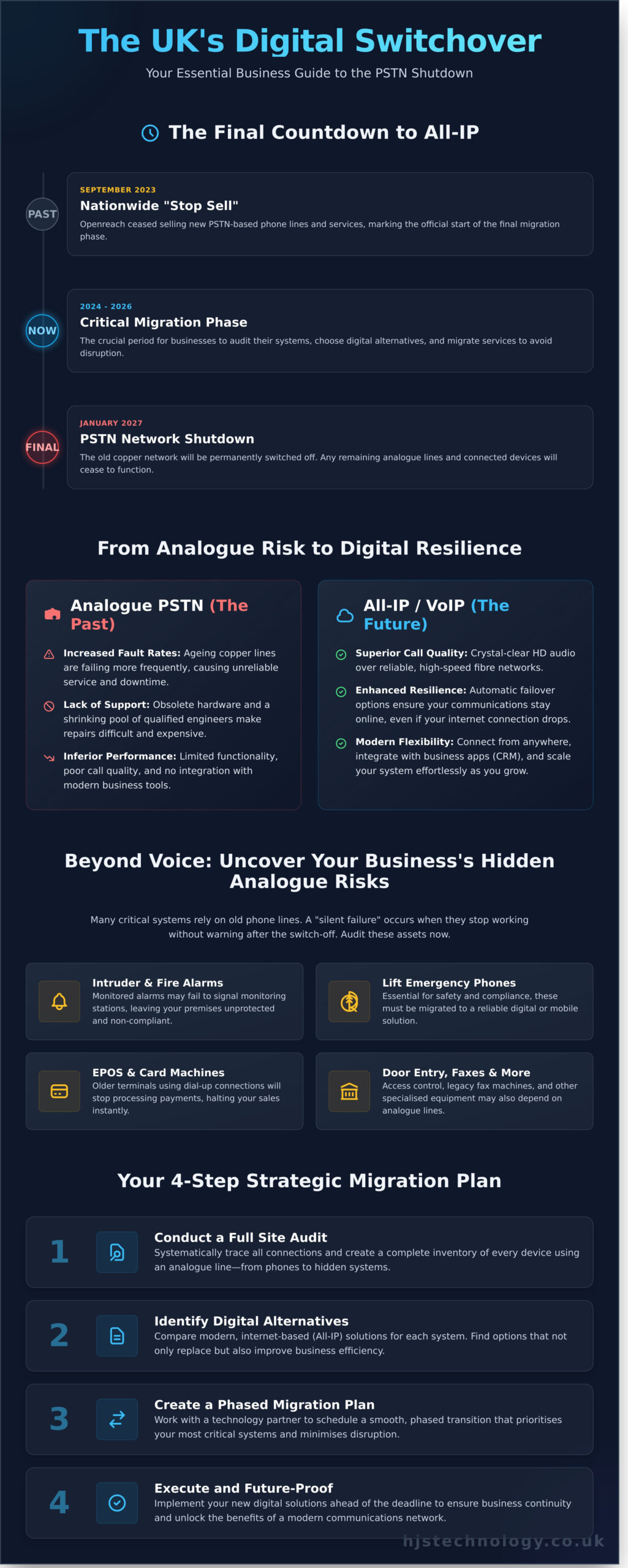
With the final switch-off scheduled for completion by January 2027, we are now in the critical final phase of this national upgrade. This isn’t a distant deadline; it’s an imminent reality that requires proactive planning. It’s crucial to understand the difference between the two main stages of the pstn switch off. The “Stop Sell” phase, which has been active since September 2023, prevents the sale of new PSTN-based services. The final withdrawal is the complete shutdown of the old network, rendering any remaining analogue lines obsolete.
The Timeline to January 2027
Openreach, the organisation managing the UK’s physical network, has been methodically phasing out the old system. The national “Stop Sell” in 2023 was a major milestone in the UK’s copper network retirement, signalling the beginning of the end. As we move through 2026, the focus shifts entirely to migrating the remaining businesses. Waiting until the final months could expose your business to significant risks, including installation delays and a shortage of engineer availability as demand peaks. A strategic, early migration ensures a seamless transition and protects your business continuity.
Why Analogue Technology is Failing
The move away from the PSTN is not just about adopting new technology; it’s about leaving behind a system that is actively deteriorating. The limitations of the legacy network present clear operational risks:
- Increased Fault Rates: As maintenance on the copper network ceases, the frequency of faults and line failures is steadily increasing, leading to unreliable service.
- Lack of Support: The hardware is a product of the 20th century. Finding spare parts and engineers with the expertise to fix these outdated systems is becoming difficult and costly.
- Inferior Performance: Digital networks, such as Voice over IP (VoIP), offer demonstrably superior call quality, enhanced resilience with failover options, and the flexibility modern businesses need to thrive.
Beyond Voice: Identifying Your Business’s Hidden Analogue Risks
The upcoming PSTN switch off is often viewed as a simple telephone upgrade, but its impact reaches far deeper into the operational fabric of your business. Many critical systems, often installed years ago and now forgotten, rely on the same analogue lines scheduled for decommissioning. The greatest risk is “silent failure”-where a system stops working without any immediate alert, only revealing itself when it’s needed most.
A proactive site audit is the first step towards securing your business continuity. This process uncovers every device connected to the old network, allowing you to create a strategic migration plan that leaves nothing to chance. This industry-wide upgrade is detailed in the official government guidance on the digital transition, making it essential for businesses to act now to prevent disruption.
Common Non-Voice Assets Using PSTN
Before the switch-off date, it’s vital to identify which of your essential systems use an analogue line. These often include:
- Intruder and fire alarms: Many monitored alarm systems use a phone line to send signals to a monitoring station. A digital upgrade is required to ensure your premises remain protected and compliant.
- Lift emergency phones: For safety and regulatory compliance, lift emergency lines must have a constant, reliable connection. These will need migrating to a compatible digital or mobile solution.
- EPOS and card machines: Older payment terminals often rely on a dial-up connection to authorise transactions. Failure here means an immediate halt to your ability to take customer payments.
- Door entry systems and fax machines: Access control systems and legacy fax machines will cease to function without a compatible digital line, impacting security and communications.
The “Business First” Audit Checklist
To ensure a seamless transition, we recommend a simple, methodical audit of your premises. This puts your business needs first, ensuring technology serves your operational goals.
- Trace your connections: Systematically walk through your premises and identify every device plugged into a wall-mounted phone socket. Check everything, from the main office to store rooms and server cupboards.
- Consult your partners: Speak with your third-party providers for services like security, alarm monitoring, and lift maintenance. Ask them about their migration path and the compatibility of your current equipment.
- Document your hardware: Create a simple inventory of all identified analogue devices, noting their make, model, and provider. This list will be invaluable when planning your migration.
Finally, remember that moving services to a digital, internet-based platform increases reliance on your broadband. The PSTN switch off is the perfect opportunity to assess your current connectivity, ensuring it has the speed and resilience to support your business both now and in the future.
This period of mandatory technological review is also an ideal time to assess other operational efficiencies. As businesses upgrade their digital infrastructure, many are also implementing smart energy management systems to reduce costs and support sustainability goals. For larger organizations, platforms like Intelli-EMS, which align with ISO 50001 standards, can integrate seamlessly into a broader strategy of modernization.
From Analogue to All-IP: Comparing Your Digital Alternatives
The upcoming pstn switch off is not just a technical deadline; it’s a strategic opportunity to modernise your business communications. Moving from an analogue system to an All-IP (Internet Protocol) network empowers your team with greater flexibility and functionality. This transition, detailed in the official government PSTN guidance, centres on Voice over Internet Protocol (VoIP) as the primary successor to traditional landlines.
VoIP vs. Traditional Landlines: A Clear Upgrade
Digital voice solutions deliver immediate and tangible business benefits. By replacing outdated analogue lines, you can:
- Reduce Costs: Eliminate expensive analogue line rental fees, which can often exceed £20 per line per month, and benefit from significantly lower call charges, especially for international calls.
- Enhance Flexibility: Empower your team to work from anywhere. VoIP allows employees to make and receive calls from their business number on a laptop, mobile app, or desk phone, seamlessly supporting hybrid and remote working models.
- Access Advanced Features: Unlock powerful tools that were once exclusive to large enterprises. Features like auto-attendants, intelligent call routing, voicemail-to-email, and CRM integration boost productivity and elevate your customer service.
Connectivity Requirements for a Digital Network
A successful transition to VoIP depends entirely on the quality of your internet connection. Your voice communications will now run over your broadband, making a business-grade service essential. Modern connectivity options like SoGEA (a dedicated broadband line without a traditional phone service) and full FTTP (Fibre to the Premises) provide the necessary speed and reliability. Relying on residential-grade broadband is a significant risk, as it often lacks the guaranteed bandwidth and service level agreements your business needs. We ensure your network is configured with Quality of Service (QoS) settings, which prioritise voice traffic to guarantee crystal-clear calls, even when your team is using the internet for other tasks.
For businesses with existing on-premise PBX hardware, SIP Trunking offers a cost-effective migration path. It connects your current system to the IP network, allowing you to retain your investment while benefiting from digital call routing and lower costs. Whether a fully cloud-based system or a hybrid approach with SIP is right for you, planning your connectivity is the first step in a successful migration away from the PSTN.
A Strategic Migration Plan for Your Organisation
Transitioning your business communications ahead of the 2026 deadline requires a proactive and organised approach. A strategic plan ensures the entire process is seamless, minimises disruption, and positions your organisation for future growth. Following a structured migration path is the key to navigating the pstn switch off with confidence and achieving peace of mind.
Our five-step process provides a clear and logical framework for a successful migration:
- Step 1: Complete a full inventory. We help you audit every device connected to your old phone lines. This includes not just your telephone system but also less obvious assets like security alarms, CCTV systems, and EPOS payment terminals.
- Step 2: Evaluate your internet connection. Your new digital voice system will rely on your broadband. We’ll assess your current internet speed and reliability to ensure it can support crystal-clear, high-quality calls without interruption.
- Step 3: Choose a future-ready solution. This is an opportunity to upgrade. We work with you to select a digital communications system that aligns with your three-year growth plan, supporting remote working and enhanced collaboration.
- Step 4: Organise a phased rollout. To maintain business continuity, we implement a phased migration. This involves moving teams or departments over to the new system in manageable stages, preventing operational downtime.
- Step 5: Train your team. We ensure your staff are comfortable and proficient with the new system’s features, enabling them to maximise productivity from day one.
Of course, a truly strategic plan considers more than just technology. Aligning this investment with your company’s financial forecasts is key to maximizing its long-term value. For businesses seeking expert guidance on the financial implications of such upgrades, it can be helpful to explore Fractional CFO Services.
Minimising Downtime During the Switch
We prioritise a smooth transition by employing a “dual running” strategy, keeping your old system active until the new digital solution is fully tested and operational. Our managed number porting process guarantees you keep your existing business numbers without any service interruption. Crucially, we also test all non-voice assets, like alarm systems, on the new line to confirm complete functionality before the final switch.
Future-Proofing Your Technology
The move to digital telephony is more than a simple replacement; it’s a strategic upgrade. Modern systems seamlessly integrate with mobile devices, allowing your team to stay connected anywhere. Scalability is effortless, enabling you to add or remove users with a few clicks as your business evolves. Furthermore, we ensure your new voice network is secure, with end-to-end encryption to protect your conversations and help you meet compliance standards.
Peace of Mind with HJS Technology: Your Trusted Advisor
Navigating the upcoming pstn switch off can feel like a significant challenge, but for Hampshire businesses, it represents a strategic opportunity. At HJS Technology Ltd, we simplify this entire transition, acting as your dedicated local partner to ensure a smooth, secure, and beneficial move to a modern, internet-based phone system. We provide the steady hand and technical expertise needed to turn a mandatory change into a genuine business advantage.
Our approach is guided by a core philosophy: Business First, Technology Second. We don’t start by talking about hardware; we start by understanding your organisation’s unique communication needs, operational workflows, and growth ambitions. As a local partner, we can conduct on-site audits to gain a true picture of your requirements, ensuring your new phone system not only replaces your old one but seamlessly integrates with your wider Managed IT Support for enhanced productivity.
Why Partner with a Local Managed Service Provider?
Choosing a single, trusted partner for your technology streamlines everything. Instead of juggling separate suppliers for IT, cybersecurity, and telecoms, you gain one team that understands your entire infrastructure. This unified approach delivers significant benefits:
- A Single Point of Contact: One call to our Hampshire-based team resolves any issue, ensuring clear communication and swift, accountable support.
- ISO 27001 Certified Security: Our commitment to this global standard for information security management means your data and communications are protected by rigorous, audited processes.
- Proactive System Monitoring: We identify and resolve potential issues with your network and systems often before you are even aware of them, maximising uptime and business continuity.
Get Started Today
The first step towards a seamless transition is understanding exactly where your business stands. We offer a bespoke PSTN readiness audit for businesses across Hampshire, including in and around Southampton. Our experts will assess your current setup, identify any dependent technology like alarms or payment terminals, and map out a clear, cost-effective migration plan.
We handle all the technical heavy lifting, from planning and procurement to installation and ongoing support, allowing you to focus on running and growing your business with complete peace of mind. Secure your company’s future communications by taking proactive steps today. Book your PSTN Readiness Audit with HJS Technology Ltd and let us guide you through the process.
Partner with HJS Technology for a Seamless Digital Transition
The upcoming pstn switch off is more than a technical deadline; it is a strategic opportunity to modernise your communications and uncover hidden analogue dependencies, from security alarms to payment terminals. A proactive migration plan is the key to ensuring this transition is seamless, secure, and beneficial for your long-term business goals.
As your Southampton-based, ISO 27001 Certified partner, HJS Technology provides the expertise and peace of mind you need. Leveraging our strong partnerships with industry leaders like Gamma, Webex, and Microsoft, our expert team designs bespoke, future-proof solutions that put your business objectives first.
Don’t let the deadline become a disruption. Secure your business continuity-contact HJS Technology for a PSTN migration plan and step confidently into the future of digital communications.
Frequently Asked Questions About the PSTN Switch Off
What exactly is the PSTN switch off and when does it happen?
The PSTN (Public Switched Telephone Network) is the traditional copper wire telephone network that has served the UK for decades. The PSTN switch off is the nationwide project to upgrade this ageing infrastructure to a modern, digital IP (Internet Protocol) network. Openreach stopped selling new PSTN lines in September 2023, with the process culminating in a complete shutdown by the end of January 2027. This change will affect all voice calls and special services that use the old lines.
Will my current business phone number stay the same after the switch?
Yes, absolutely. You can retain your established business telephone numbers. The process of moving your number from the old analogue line to a new digital service is called ‘porting’. As part of a managed migration plan, we handle this process seamlessly on your behalf. This ensures complete business continuity, meaning your clients and partners can continue to reach you on the number they already know, without any disruption or confusion during the transition.
Do I need to buy all new hardware for my office?
Not necessarily. While the switch is an excellent opportunity to upgrade to modern IP handsets with enhanced features, it is not always a requirement. In many cases, existing analogue equipment can be connected to the new digital system using a device called an Analogue Telephone Adaptor (ATA). We can conduct a full audit of your current hardware to provide a bespoke recommendation that balances your budget with your business objectives, ensuring a cost-effective migration.
What happens if I do nothing before the January 2027 deadline?
Taking a passive approach is not recommended. If you do not migrate your services before the final deadline, any device connected to your PSTN line will simply stop working. This includes your phone system, alarms, EPOS machines, and any other connected technology. This would result in a sudden loss of communication and significant business disruption. A proactive, planned migration ensures a smooth transition and gives you complete control over the process, providing peace of mind.
Will my alarm system still work after the PSTN switch off?
Many older intruder and fire alarm systems use the PSTN line to automatically contact a monitoring centre, so these will be affected. It is crucial to check with your alarm provider to confirm if your system is compatible with a digital IP line or if it requires an upgrade. Addressing this early is a key step in your migration plan, ensuring that the PSTN switch off does not compromise your business’s security and compliance obligations.
Is VoIP reliable enough for a busy professional services firm?
Modern VoIP (Voice over Internet Protocol) telephony is exceptionally reliable and offers superior call quality compared to the old copper network. Business-grade VoIP systems provide robust continuity features, such as automatic call rerouting to mobile numbers if your office internet connection fails. For a busy firm, this means enhanced resilience and the assurance that you will never miss a critical client call, providing a more professional and dependable service than ever before.
How much does it cost to migrate from PSTN to a digital system?
The cost of migration is tailored to your specific business needs, including the number of users, desired features, and existing hardware. Many modern VoIP solutions operate on a flexible per-user, per-month subscription model, which minimises upfront capital expenditure. This investment often results in lower overall call costs and increased productivity, delivering a strong return. We provide clear, transparent proposals outlining all costs involved for a bespoke solution that fits your budget.
Can I still use my analogue fax machine or franking machine?
Yes, in most instances you can continue using legacy analogue devices. Equipment such as fax machines, franking machines, and door entry systems can be connected to the new digital network using an Analogue Telephone Adaptor (ATA). However, this transition also presents an ideal opportunity to review your processes. You may find that modern alternatives, like a fax-to-email service, offer a more efficient and integrated solution for your business operations.