

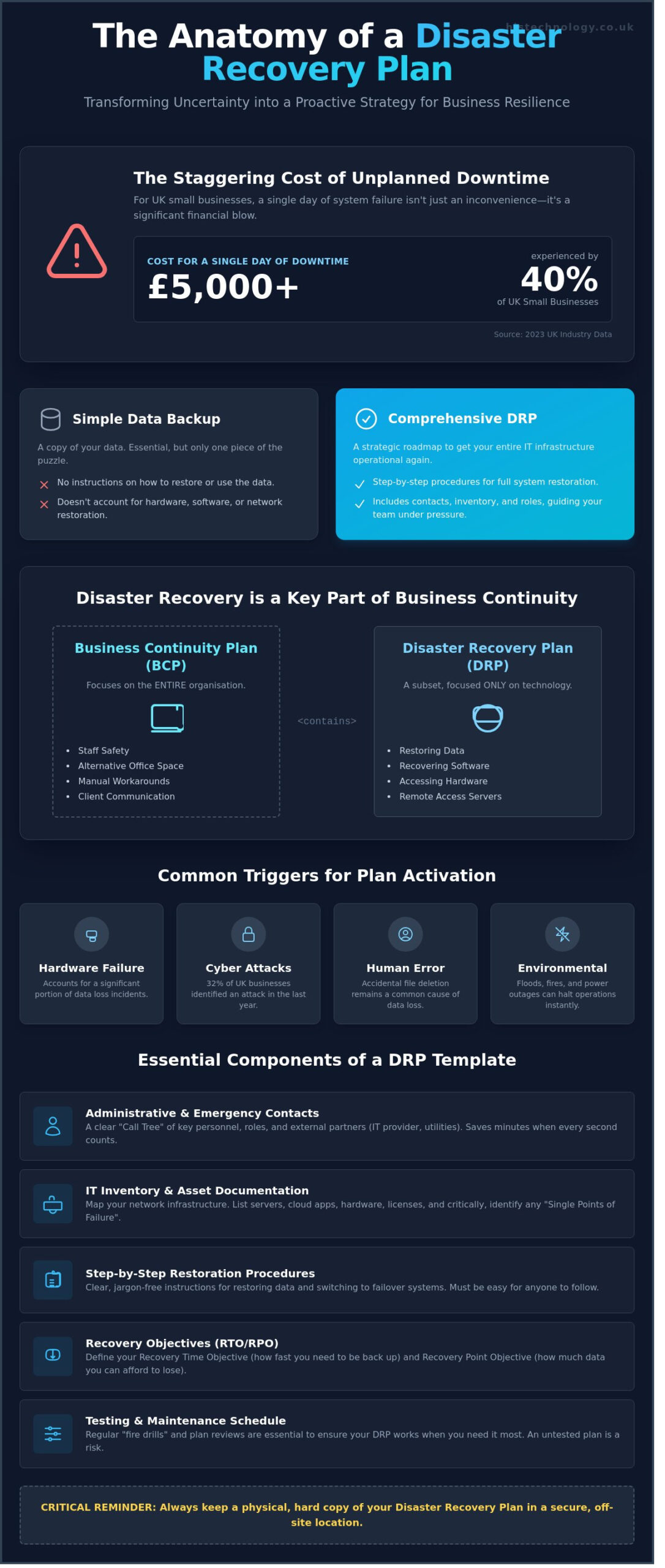
Imagine arriving at your office on a Tuesday morning to find your entire server network unresponsive following a localised hardware failure. According to 2023 industry data, 40% of small businesses in the UK find that a single day of unexpected downtime results in costs exceeding £5,000 in lost revenue and staff productivity. You probably already feel that every minute your systems are offline is a minute where your reputation is at risk and your team’s momentum stalls. It’s challenging to maintain focus when you lack a structured disaster recovery plan template to manage complex technical recovery steps under pressure. Preparation is key.
We’ve designed this guide to transform that uncertainty into a proactive strategy for resilience. You’ll learn how to build a robust framework that protects your daily operations and ensures your business can restore its vital IT services rapidly after any disruption. We’ll explore the essential components of a successful plan, including a practical checklist and advice on aligning your continuity goals with ISO 22301 standards to give you total peace of mind. Our goal is to ensure you stay in control, no matter what challenges arise.
Key Takeaways
- Understand the vital distinction between simple data backups and a comprehensive strategy designed to maintain business continuity.
- Discover how to utilise a disaster recovery plan template to create a structured, accessible document that guides your team through high-stress situations.
- Learn how to quantify the potential cost of downtime for your organisation by setting clear recovery time and point objectives.
- Recognise why regular testing and “fire drills” are essential to ensure your systems can be restored quickly without disrupting daily operations.
- Explore how a strategic partnership with an expert provider offers the professional resilience and peace of mind needed to protect your business.
What is a Disaster Recovery Plan (DRP) and Why Does Your Business Need One?
A Disaster Recovery Plan (DRP) is a documented, structured approach to restoring your IT systems after an unexpected disruption. It’s far more than a simple list of emergency contacts. This plan acts as a strategic roadmap that outlines exactly how to regain access to your data, software, and hardware. Many business owners mistakenly believe that a daily backup is enough. While backups are essential, they’re only one piece of the puzzle. A disaster recovery plan template bridges the gap between having a copy of your data and actually making that data usable for your staff again.
The 2023 Cyber Security Breaches Survey revealed that 32% of UK businesses identified a cyber attack in the previous 12 months. For those without a plan, the financial impact is immediate. Research suggests the average cost of downtime for a UK small business can exceed £3,000 per day in lost productivity and missed opportunities. Beyond the finances, a DRP protects your reputation. It ensures you can meet UK GDPR obligations and maintain the trust of your clients by showing you’ve taken proactive steps to safeguard their information. If you’re unsure where to start with your strategy, you can contact our team for expert guidance.
Disaster Recovery vs. Business Continuity
It’s vital to understand that Disaster Recovery is a subset of Business Continuity. Your Business Continuity Plan (BCP) focuses on the entire organisation, including office space, staff safety, and manual workarounds. Disaster Recovery focuses specifically on the technology that powers those processes. You must align both strategies. If your BCP tells staff to work from home, but your DR plan hasn’t prioritised the remote access servers, your operations will stall. We help you synchronise these elements for a seamless response.
Common Triggers for Activating Your Plan
Cyber attacks like ransomware are the most common modern threat, but they aren’t the only ones. Statistics from the UK insurance industry show that hardware failure and accidental file deletion by employees account for roughly 20% of data loss incidents. Local environmental issues also play a role. For example, flash flooding in Hampshire during early 2023 caused significant power outages for local firms. A well-prepared disaster recovery plan template ensures your business stays operational whether the threat is a digital virus or a physical flood.
The Essential Sections of a Disaster Recovery Plan Template
A disaster recovery plan template serves as your business’s emergency handbook. It transforms a chaotic situation into a managed process by organising information for immediate access during high-stress moments. Your primary goal is to restore the most critical business functions first. Always keep a physical, hard copy of the plan off-site. If your office is inaccessible or your local servers are encrypted, a digital-only file won’t help your team get back to work. This document must be clear enough for any staff member to follow, ensuring continuity even if your lead IT person is unavailable.
Administrative Details and Emergency Contacts
Your plan starts with people. You need an up-to-date list of key personnel and their specific roles during a crisis. This includes a clear “Call Tree” to ensure information flows logically from senior management down to every department. Don’t forget external partners. Include direct lines for your IT provider, utility companies, and insurance brokers. Having these numbers ready saves precious minutes when every second of downtime costs a UK SME an average of £4,231 per hour, according to 2023 industry benchmarks.
IT Inventory and Asset Documentation
You cannot fix what you haven’t documented. Mapping your network infrastructure is a proactive step that provides total visibility for your recovery team. List every server, cloud application, and hardware asset. Include software licences, serial numbers, and vendor support details. Crucially, identify “Single Points of Failure” within your stack. If 75% of your operations rely on one ageing on-site server, that’s a strategic risk that needs addressing before a disaster strikes.
Step-by-Step Restoration Procedures
Complexity is the enemy of recovery. This section provides clear, jargon-free instructions for restoring data from cloud or off-site backups. It details how to switch to failover systems or hosted desktops so your team stays productive. Before going live, include verification steps to check data integrity. This ensures your systems are clean and accurate. If you feel unsure about these technical steps, speaking with a strategic IT partner can provide the professional guidance you need to secure your operations.
Setting Your Recovery Objectives: Understanding RTO and RPO
Effective disaster recovery starts with clear, measurable goals. You can’t build a robust disaster recovery plan template without defining exactly what success looks like for your business operations. These objectives aren’t just technical benchmarks; they’re commercial decisions that dictate how quickly you can return to serving your customers after an incident.
Quantifying the cost of downtime is the first step in this process. A 2023 study by Beaming revealed that UK businesses lost £3.7 billion due to internet downtime alone. To calculate your specific risk, you should aggregate lost revenue, staff wages during idle periods, and potential regulatory fines from bodies like the ICO. For many Hampshire-based SMEs, even a single hour of total system failure can cost upwards of £500 in lost productivity and missed opportunities.
There’s a direct relationship between recovery speed and the total investment required. A “zero-downtime” solution provides ultimate peace of mind, but it requires significant investment in redundant hardware and real-time data replication. Most organisations find their ideal balance by categorising systems based on their impact on the bottom line. This strategic approach ensures you aren’t overspending on low-priority archives while leaving your mission-critical payment systems vulnerable.
Recovery Time Objective (RTO)
Recovery Time Objective is the duration of the outage goal. It represents the maximum amount of time your business can survive without a specific system before the damage becomes irreversible. When filling out your disaster recovery plan template, you should categorise your infrastructure into tiers:
- Tier 1 (Critical): Systems like your primary database or customer-facing portals that need to be back online within 0 to 4 hours.
- Tier 2 (Essential): Tools like internal file shares or bespoke line-of-business applications that can be down for 4 to 24 hours.
- Tier 3 (Supportive): Non-essential systems, such as historical marketing archives, where a recovery time of 48 hours or more is acceptable.
Recovery Point Objective (RPO)
Recovery Point Objective is the age of the files you recover. This metric determines how much data loss your business can tolerate. If you back up your data once every 24 hours at midnight and a server fails at 4:00 PM, you’ve lost 16 hours of work. For a law firm or an accounting practice, that loss could be catastrophic. We help you determine backup frequency based on how often your data changes, ensuring your RPO aligns with your compliance obligations and operational needs. If you’re unsure where your current strategy stands, you can contact our team for a professional assessment of your recovery readiness.
Testing and Maintaining Your Disaster Recovery Plan
A disaster recovery plan template only provides true value when you’ve proven it works through rigorous testing. Without regular validation, your strategy remains a collection of assumptions that might fail during a genuine crisis. We view testing as a proactive investment in your company’s resilience rather than a box-ticking exercise. It’s the difference between hoping for the best and knowing you’re prepared.
Scheduling regular fire drills for your IT systems doesn’t have to disrupt your daily operations. By running these tests after hours or in a dedicated sandbox environment, you can identify bottlenecks without affecting your team’s productivity. A 2023 report by Datto indicated that 40% of small businesses only test their DR plans once a year, which often leaves them vulnerable to recent software updates or hardware changes. Regular testing builds a culture of calm confidence. Your team will act with precision because they’ve already practised the steps required to restore continuity. This proactive approach removes the panic from the equation.
Types of Disaster Recovery Testing
- Tabletop exercises: This involves gathering your key stakeholders to talk through the disaster recovery plan template and identify gaps in communication or responsibility.
- Simulation testing: Your IT partner restores a non-critical server to a separate environment to verify that the data is intact and the restoration process is functional.
- Full failover testing: This represents the gold standard of resilience. You switch your entire operation to a secondary system to ensure total business continuity and verify recovery time objectives.
Creating a Review Cycle
Your business is dynamic, so your plan must be too. We recommend a quarterly or bi-annual audit to account for new staff, updated software, or hardware upgrades. Whenever a minor incident occurs, use it as a learning opportunity to refine your documentation. Incorporating a DR briefing into your new employee onboarding process ensures every team member knows their role from day one. This structured approach transforms your disaster recovery plan template from a static file into a living, breathing safeguard for your business. It provides the peace of mind that allows you to focus on growth rather than technical friction.
Partnering with a Managed Service Provider for Total Resilience
Managing the complexities of IT infrastructure shouldn’t distract you from running your business. While a disaster recovery plan template provides the necessary framework, the actual implementation requires constant vigilance and technical expertise. Professional IT support transfers this responsibility from your shoulders to a dedicated team. This shift ensures that your recovery protocols aren’t just words on a page, but active systems ready to deploy at a moment’s notice.
Choosing an ISO 27001 certified partner adds a critical layer of security to your organisation. This certification demonstrates that your provider follows rigorous international standards for information security management. It’s about moving away from a reactive “fix-it” culture that only responds when things break. Instead, we focus on a proactive stance that prioritises business continuity. We align your technology with your long-term goals, ensuring your IT setup supports growth rather than hindering it. This strategic approach provides the peace of mind you need to focus on your core operations.
The Role of Managed Backup and Recovery
Reliable protection requires enterprise-grade tools. We utilise industry-leading solutions like Datto and Acronis to automate your data protection. These systems perform regular backups without manual intervention, removing the risk of human error. Our team provides 24/7 monitoring to identify and resolve backup failures before they escalate into true disasters. If the worst happens, we manage the restoration process directly. Having experts handle the technical recovery reduces stress and ensures your systems return to normal quickly. Data from the 2023 Cyber Security Breaches Survey shows that 32% of UK businesses identified a breach or attack in the last 12 months; professional recovery support is now a fundamental requirement.
Strategic Consultancy for Future Growth
Your technology must evolve alongside your business. Regular IT audits allow us to identify vulnerabilities in your disaster recovery plan template before they’re exploited by external threats. We don’t believe in one-size-fits-all solutions. Our team works to customise your resilience strategy as your workforce scales or your service offering expands. This bespoke planning ensures your infrastructure remains robust and compliant with UK regulations. If you’re ready to move beyond basic templates and secure your company’s future, please contact HJS Technology Ltd for a professional review of your current resilience.
Future-Proof Your Business Continuity Today
Building a resilient organisation starts with thorough preparation. A robust disaster recovery plan template provides the essential framework you need to protect your operations, yet true security requires active maintenance and expert oversight. You’ve seen how defining clear RTO and RPO benchmarks ensures your data stays accessible when it matters most. By moving beyond a static document, you transform your IT infrastructure from a potential vulnerability into a strategic asset that supports your growth.
HJS Technology brings over 15 years of proactive IT experience to your side. As an ISO 27001 Certified Provider, we specialise in Datto and Acronis recovery solutions that keep your productivity high and your risks low. We don’t just fix problems; we prevent them from disrupting your daily goals. Our local Hampshire team focuses on your business first, ensuring your technology supports your long-term success without the headache of complex jargon. We’re dedicated to providing the seamless support your team needs to thrive in any circumstances.
Secure your business today; contact HJS Technology for expert DR planning. We’re ready to provide the peace of mind you deserve so you can focus on what you do best.
Frequently Asked Questions
What is the most important part of a disaster recovery plan?
The most critical component of any disaster recovery plan template is the definition of your Recovery Time Objective (RTO) and Recovery Point Objective (RPO). These metrics dictate how quickly you must return to operation and how much data you can afford to lose. Establishing these figures ensures your continuity strategy remains focused on productivity rather than just technical restoration. Without these specific targets, your IT team cannot build a bespoke solution that aligns with your business goals.
How often should a small business update its DR plan?
You should review and update your disaster recovery plan at least once every 12 months. Small businesses often undergo rapid changes, so a quarterly review is even better if you’ve introduced new software or hardware. In fact, 40% of businesses fail to reopen after a major disaster because their plans were outdated. Regular testing ensures your strategy remains proactive and reflects your current operational reality, providing lasting peace of mind.
Can I use a free disaster recovery plan template for my business?
You can certainly use a free disaster recovery plan template as a starting point for your documentation. However, a generic document rarely covers the bespoke requirements of a UK business. While a free template provides a logical structure, you must tailor it to include your specific local vendors, UK compliance standards, and unique internal workflows. A strategic partnership with a professional provider can help bridge the gap between a basic template and a robust, reliable plan.
What is the difference between a backup plan and a recovery plan?
A backup plan focuses on creating copies of your data, whereas a recovery plan outlines the entire process of restoring business operations. Think of a backup as a spare tyre and the recovery plan as the toolkit and instructions needed to change it during a rainstorm. While 90% of UK firms have some form of backup, many lack a strategic recovery process. A comprehensive plan ensures your team knows exactly how to use those backups to maintain seamless continuity.
How much does it cost to implement a professional disaster recovery strategy?
Implementation costs vary based on your infrastructure, but small UK businesses typically invest between £100 and £2,000 per month for managed recovery services. This investment covers proactive monitoring, secure off-site storage, and regular testing. When you consider that the average cost of downtime for a small firm is approximately £4,000 per hour, a professional strategy becomes a cost-effective way to protect your bottom line. It’s a strategic choice that prioritises long-term business health.
Do I need a disaster recovery plan if all my data is in the cloud?
Yes, you still require a dedicated plan even if you use cloud services like Microsoft 365 or Google Workspace. Cloud providers guarantee the availability of the platform, but they don’t take responsibility for your specific data integrity or user errors. Recent data shows that 70% of cloud-based data loss is caused by accidental deletion or malicious internal activity. A bespoke disaster recovery plan template ensures you have a clear path to restore your cloud environment and maintain productivity during an outage.
Who should be responsible for the disaster recovery plan in an SMB?
The responsibility for disaster recovery sits with senior management, supported by a designated IT lead or an external partner. Business owners must drive the strategy because recovery priorities are business decisions, not just technical ones. Appointing a single Plan Owner ensures accountability and clear communication during a crisis. This collaborative approach ensures your technology serves your business goals, allowing you to focus on growth while your IT partner handles the technical resilience.
What happens if we don’t have a disaster recovery plan?
Without a plan, your business faces an average of 18.5 hours of downtime following a server failure. This leads to immediate financial losses, potential regulatory fines under UK law, and a breakdown in client trust. Statistics indicate that 60% of companies that lose their data shut down within six months of the incident. Having a structured response in place transforms a potential catastrophe into a manageable hurdle, preserving your reputation and ensuring your team stays productive.