

Last Tuesday, a marketing manager in Ocean Village stared at her screen in frustration. The upload for a crucial client video was crawling, a common symptom of underpowered business internet Southampton businesses often tolerate. An hour later, her colleague was cut off mid-sentence during a vital VoIP call.
It’s a familiar story. That nagging feeling of being held back by your connection, where dropped calls and sluggish access to Microsoft 365 are just part of the working day, is a significant drain on productivity and morale. You know a better connection is out there, but the alphabet soup of terms like FTTP, SOGEA, and Leased Lines can be confusing.
This strategic guide is designed to change that. We’ll demystify the technical jargon and provide a clear framework for choosing a connectivity solution that ensures your organisation stays secure, productive, and ahead of the curve in 2026. Discover how to match the right speed to your team’s real-world needs and why having a local, responsive partner on your side provides the ultimate peace of mind.
Key Takeaways
- Discover why standard residential broadband is insufficient for modern businesses and how a dedicated connection with a Service Level Agreement (SLA) protects your productivity.
- Use our simple framework to assess your needs and select the right business internet Southampton has to offer, whether it’s a Leased Line, FTTP, or SOGEA solution.
- Avoid the common “upload speed trap” by learning why symmetrical speeds are now vital for cloud applications, video conferencing, and VoIP phone systems.
- Implement a strategic resilience plan with a failover connection, ensuring your business remains online and operational even during an internet outage.
Understanding Business Internet in Southampton: Why Your Connection Matters
Your office internet connection is far more than a simple utility; it’s the central nervous system of your entire operation. For any modern Hampshire business, choosing the right connectivity is a strategic decision that directly impacts productivity, security, and growth. Unlike residential broadband, which is a shared, “best effort” service, a true business-grade connection is a dedicated resource backed by a formal Service Level Agreement (SLA). This agreement guarantees performance, uptime, and rapid-response fix times, providing a level of assurance that consumer-grade services simply cannot offer.
For any Southampton firm with five or more employees, relying on a residential package is a significant commercial risk. The moment your team starts collaborating on cloud documents, using VoIP phones, and joining video calls, a contended home connection begins to buckle, leading to slowdowns and frustrating interruptions.
Fortunately, the local infrastructure landscape is evolving rapidly. Across Hampshire, providers like Openreach and CityFibre are expanding their full-fibre networks, bringing faster and more reliable options to the region. This progress presents a fantastic opportunity, but it also adds a layer of complexity. This is why we champion a “Business First, Technology Second” philosophy. Choosing the right business internet in Southampton isn’t about chasing the highest Mbps; it’s about matching the technology to your specific commercial goals, from supporting a hybrid workforce to ensuring seamless customer interactions.
For organisations where connectivity is absolutely mission-critical, dedicated solutions are the gold standard. These circuits, often known as leased lines, provide a private, uncontended connection directly to your premises. While the technical details of what a leased line is can be complex, the business benefit is simple: guaranteed performance and reliability that you own 100% of, 100% of the time.
The Real Cost of Downtime for Local SMBs
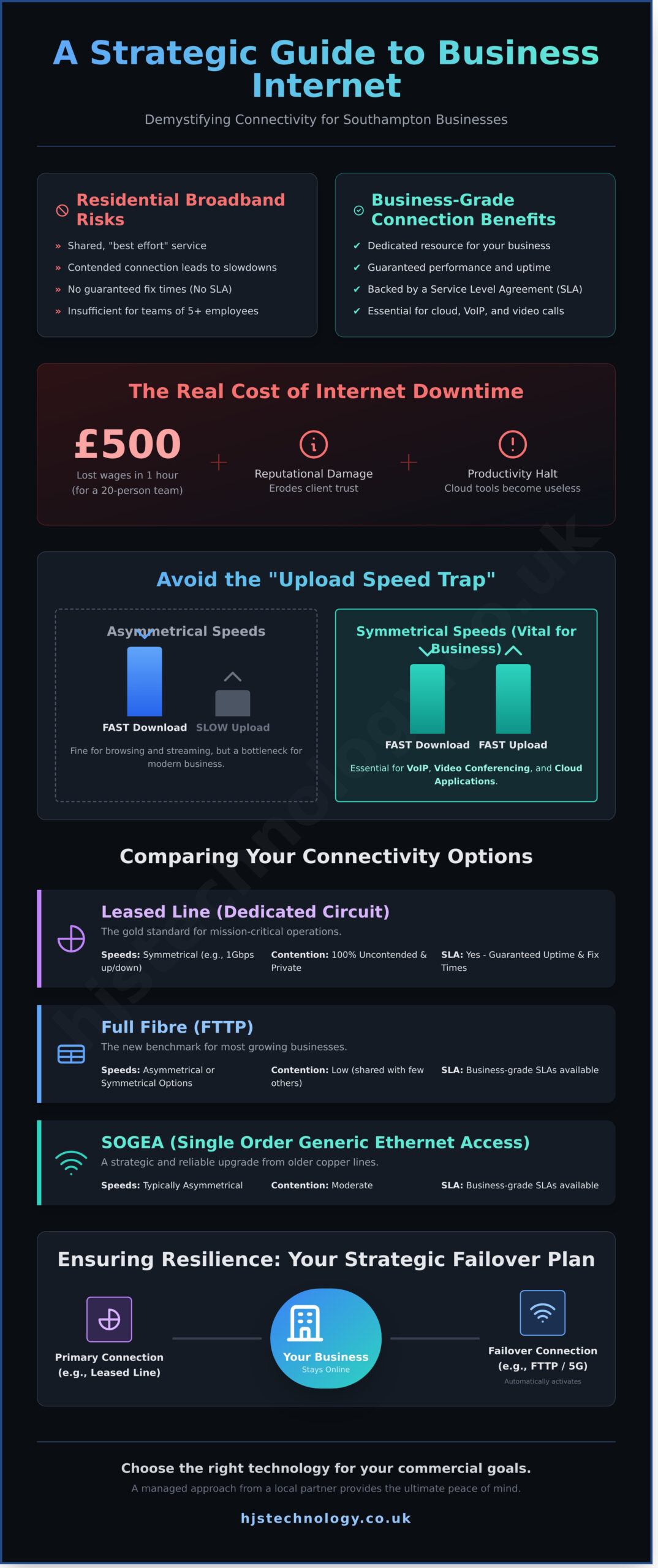
An internet outage is never just a minor inconvenience; it’s a direct financial blow. Consider a 20-person team with an average loaded hourly cost of £25 per employee. A single hour of internet downtime translates to £500 in direct wage costs with zero output. Beyond the balance sheet, the reputational damage can be severe. Dropped VoIP calls, an inaccessible customer portal, or the inability to process orders can quickly erode client trust and undermine your professional standing. Your investment in powerful cloud tools like Microsoft 365 is also rendered useless, turning productivity assets into sources of company-wide frustration.
Connectivity as the Backbone of Your Digital Strategy
A resilient internet connection is the foundation upon which your entire digital strategy is built. It directly underpins the success of your cybersecurity measures, ensuring security patches are downloaded promptly and remote staff can maintain stable VPN connections. It’s the critical link that makes modern communication tools like Microsoft Teams effective, enabling clear video conferencing and real-time collaboration. A robust plan for business internet in Southampton is the first step. This is where HJS Technology acts as your steady hand, ensuring this foundational layer is not just installed, but strategically aligned with your objectives, giving you the peace of mind to focus on what you do best.
Comparing Your Options: Leased Lines, FTTP, and SOGEA
Choosing the right internet connection for your business can feel like navigating a maze of acronyms. The reality is that the best solution depends entirely on two factors: what’s physically available at your postcode and what your business truly needs to operate efficiently. Before you get lost in the technical details, the first step is always an availability check. This simple search reveals your realistic options and prevents you from planning around a service you can’t get.
A key difference you’ll encounter is between asymmetrical and symmetrical speeds. Most home and standard business broadband connections are asymmetrical; they offer fast download speeds but much slower upload speeds. This is fine for browsing and streaming. However, modern businesses that use video conferencing, cloud storage, and VoIP phone systems rely heavily on fast uploads. Symmetrical connections, where upload and download speeds are identical, provide the performance and stability these applications demand.
Full Fibre (FTTP) and SOGEA: The Modern Standard
For the majority of growing businesses in Hampshire, these two technologies represent the new benchmark for reliable connectivity. They offer a strategic upgrade from older copper lines without the significant investment of a dedicated line.
- Full Fibre (FTTP): This stands for ‘Fibre to the Premises’. In simple terms, it’s a pure fibre optic cable running directly into your office building. It delivers incredibly fast and reliable speeds, making it a future-proof choice that can scale with your ambitions.
- SOGEA: This is ‘Single Order Generic Ethernet Access’. It’s the modern replacement for traditional broadband that required a phone line. As Openreach plans to switch off the old copper phone network by 2025, SOGEA is the default high-speed connection for businesses where FTTP isn’t yet available.
Both are considered “best-effort” services, meaning you share the local network capacity with other users. Installation is typically straightforward, often completed within 10-15 working days, with monthly costs usually ranging from £40 to £80.
Dedicated Fibre Leased Lines: The Gold Standard
When your internet connection is absolutely critical to your operations, a dedicated leased line is the ultimate solution. Think of it as your own private, uncontended motorway to the internet; there are no other users to slow you down, ever. This is the gold standard for any serious business internet Southampton requires for mission-critical tasks.
The benefits are substantial. You get symmetrical speeds, meaning if you pay for a 1Gbps connection, you receive 1Gbps for both downloads and uploads. This is transformative for businesses with 50+ staff, heavy cloud application users, or those transferring large data files. Crucially, leased lines are backed by robust Service Level Agreements (SLAs) that guarantee 99.9% or higher uptime and promise fix times within 4-6 hours, not days. A stable, dedicated line is a core part of a resilient business infrastructure, a key principle highlighted in the government’s official cyber security guidance, as it minimises disruptions that can create vulnerabilities.
This level of service requires a greater investment. Installation can take between 60-90 working days and monthly costs for a 100Mbps line typically start around the £250 mark. It’s an investment in continuity and performance, giving you complete peace of mind.
Understanding which of these options aligns with your budget and business goals is the essential first step. Our local Hampshire team can run a free availability check for your postcode and provide a clear, jargon-free comparison to help you make a confident decision.
How to Choose the Right Connection for Your Organisation
Selecting the right internet connection for your business involves looking beyond the headline download speed. A strategic assessment requires a clear understanding of your team’s size, the nature of your work, and the level of support you need to ensure business continuity. For many organisations, the hidden details, such as upload speeds, static IP addresses, and the provider’s service level agreement, are far more critical to daily operations than a low monthly price.
Sizing Your Bandwidth: A Practical Guide
A simple framework can help you match your needs to the right technology. For smaller teams of 5-20 employees primarily using email, web browsing, and occasional video calls, a standard business Fibre to the Premises (FTTP) connection often provides an excellent balance of cost and performance. The rollout of full-fibre infrastructure, supported by the government’s Project Gigabit programme, is making these connections more accessible than ever. For larger organisations of 20-100+ staff, or those heavily reliant on cloud applications, a dedicated Leased Line is the superior strategic choice, offering guaranteed, symmetrical speeds that don’t fluctuate.
It’s crucial to avoid the “upload speed trap.” While home broadband focuses on download speeds for streaming and browsing, modern businesses create and send vast amounts of data. A 30-minute team video call on Microsoft Teams or a 5GB cloud backup to your server relies heavily on your upload capacity. An asymmetric connection can quickly become a bottleneck, slowing your entire operation down. Your contention ratio is the number of other users your provider allows to share your connection’s total bandwidth; a leased line offers a 1:1 ratio, meaning the connection is exclusively yours.
Finally, insist on a static IP address. This is a fixed, permanent address for your business on the internet. It’s essential for hosting your own servers, enabling secure remote access for staff via a VPN, and operating networked CCTV systems. A dynamic IP, which changes periodically, simply isn’t suitable for a professional environment.
Evaluating the Provider, Not Just the Pipe
The company that supplies your connection is as important as the connection itself. When assessing a provider for business internet Southampton, look for a local partner with a UK-based helpdesk staffed by humans, not chatbots. Ask for their specific Service Level Agreement (SLA), which should contractually guarantee a fix time of 8 hours or less, giving you a clear recovery path if an issue occurs. Vague promises of “great support” are no substitute for a written commitment.
Look for providers who hold ISO 27001 certification. This is the international standard for information security management, demonstrating that the company has robust, audited processes in place to protect your data and their network infrastructure. It’s a powerful indicator of professionalism and a commitment to security.
For most non-technical business owners, a “managed” connection offers far greater value than an “unmanaged” one. An unmanaged service simply delivers the line to your building, leaving you to configure routers, manage security, and troubleshoot problems. A managed service is a proactive partnership. Your provider monitors the connection 24/7, manages the hardware, and takes full responsibility for resolving issues, delivering the peace of mind you need to focus on running your business.
Ensuring Resilience: Failover and Cyber Security
For any modern business, the most pressing question about connectivity is often the simplest: “What happens if the line gets cut?” In an era where operations depend on cloud applications, video calls, and VoIP telephony, even a few minutes of downtime can be costly. A 2022 Gartner report found the average cost of IT downtime can exceed £4,500 per minute for many organisations. This is why a resilient connection isn’t a luxury; it’s a fundamental component of your business continuity plan.
True resilience is about creating a robust digital foundation that protects your productivity and your data. It involves planning for disruptions before they happen and establishing a security posture that starts right at the edge of your network. This proactive approach delivers the ultimate benefit: peace of mind.
The Role of 4G and 5G Failover
A primary fibre line is powerful, but it remains a single point of failure. Automated failover provides a crucial safety net. Should your main line be disrupted by civil works or a local exchange issue, our systems can instantly switch your entire office’s connection to a high-speed 4G or 5G mobile network. This isn’t a “cold” standby that requires manual intervention. It’s a “hot,” seamless transition that happens in milliseconds, ensuring your VoIP phones keep ringing and your team stays connected without even noticing the change. At HJS Technology, we build this resilience into every bespoke connectivity proposal we design, because we believe your business can’t afford to stop.
Securing the Edge: Routers and Managed Firewalls
Your internet connection is the main gateway into your business network, making your router the first line of defence in your cyber security stack. The free router supplied by most consumer-grade internet service providers is simply not built for business-level threats. A 2023 investigation by Which? found that one in five popular home routers had significant security flaws. These devices often lack advanced security features, receive infrequent firmware updates, and can be a weak link for criminals to exploit.
Upgrading to a business-grade managed firewall provides a powerful, proactive shield. Unlike a simple router, a managed firewall from HJS Technology offers:
- Advanced Threat Protection: Actively scanning for and blocking intrusion attempts, malware, and other malicious traffic before it reaches your servers or computers.
- Proactive Management: We handle all configuration, updates, and security patches, ensuring your defences are always current against emerging threats.
- Integrated Support: The firewall becomes part of your complete IT support solution, giving us full visibility to diagnose issues and protect your network holistically.
For any company looking for a dependable business internet Southampton solution, securing this entry point is the critical first step. Proactive threat monitoring begins the moment data tries to enter your network. By managing your firewall, we ensure that your connectivity is not only fast and reliable but also fundamentally secure, protecting your most valuable digital assets.
A robust connectivity strategy is about more than just speed; it’s about building a secure and resilient foundation for your entire operation. Speak to our team about designing a connectivity plan that gives you complete peace of mind.
Why a Managed Approach to Connectivity Wins
Choosing the right internet service is about more than securing a fast connection; it’s about implementing a strategic asset that powers your business. At HJS Technology Ltd, our “Business First” philosophy dictates that technology must serve your commercial goals, not the other way around. This means we don’t just sell you a data line. We provide a fully managed connectivity solution designed to enhance productivity, ensure reliability, and support your growth.
The real advantage emerges when you consolidate your critical services. Imagine having one local partner for your IT support, telecoms, and your business internet Southampton. When an issue arises, there is no finger-pointing between your internet provider and your IT company. There is just one phone call to a team that understands your entire setup. Our unified support desk resolves over 95% of issues on the first call, eliminating the frustrating and time-consuming blame game that plagues businesses using multiple vendors.
This seamless integration is overseen by your dedicated account manager. This isn’t a call centre agent; it’s a strategic partner who invests time to understand your company’s objectives, operational challenges, and future ambitions. They ensure your connectivity solution evolves with your business, proactively recommending adjustments before you even realise you need them. It’s a partnership built on trust and a shared goal: your success.
The Advantage of a Local Southampton Partner
Working with a national, faceless provider simply can’t compare to the accountability of a local partner. With offices in Fareham and Southampton, we are part of the same business community you are. Our engineers possess intricate knowledge of the local Hampshire infrastructure, from the specific challenges of the city centre exchanges to the connectivity options in more rural business parks. This on-the-ground expertise allows us to design and implement more robust and reliable solutions. We focus on building long-term partnerships, not just selling contracts.
Ready to Upgrade Your Business Internet?
Imagine the peace of mind that comes from a professional, fully managed installation. We handle everything, from the initial site survey and liaising with network providers to the final configuration of your routers and security settings. Your team experiences minimal disruption and can start benefiting from a faster, more stable connection immediately. To discover the best options for your premises, we invite you to contact HJS Technology Ltd for an availability check. Let us take the technical burden off your shoulders, so you can focus on what you do best: running your business.
Partner with HJS Technology for Future-Ready Connectivity
Selecting the right connection is more than a technical choice; it’s a strategic decision that underpins your company’s productivity and growth. The landscape of business internet Southampton offers powerful options from dedicated Leased Lines to versatile FTTP, but the true advantage comes from a secure, managed approach. This ensures your operations remain seamless, protected, and always online.
Don’t leave your connectivity to chance. As an ISO 27001 Certified provider, we specialise in delivering bespoke, secure solutions backed by our local Southampton-based 1st, 2nd, and 3rd line helpdesk. We’re not just a supplier; we’re a dedicated partner invested in providing the expertise and support that gives you complete peace of mind.
Ready to build a resilient foundation for your business? Get a bespoke business internet quote for your Southampton office and let’s discuss your strategic needs for 2026 and beyond.
Frequently Asked Questions
What is the difference between home and business internet in Southampton?
Business internet provides superior reliability and dedicated support designed for commercial needs. Unlike home broadband, a business connection includes a Service Level Agreement (SLA) guaranteeing uptime and fix times, ensuring your operations stay online. When choosing business internet in Southampton, you also benefit from options like static IP addresses and prioritised customer support, giving you the robust, dependable connectivity your company requires to maintain productivity and serve your clients effectively.
How long does it take to install a business leased line in Hampshire?
A dedicated business leased line installation in Hampshire typically takes between 60 and 90 working days to complete. This timeframe accounts for the essential planning stages, including physical site surveys, local authority permissions for any necessary street works, and the final engineering task of laying the dedicated fibre optic cable to your premises. We manage this entire process to ensure a smooth and predictable installation, keeping you informed at every step.
Do I need a static IP address for my Southampton business?
Yes, a static IP address is crucial if your business hosts its own email server, needs secure remote access for staff, or operates a VoIP phone system. A static IP is a fixed address on the internet that never changes, unlike the dynamic IPs common with home broadband. This stability is essential for services that require a consistent point of contact, enhancing your security, reliability, and the professional functionality of your IT infrastructure.
What happens to my internet if there is a power cut or the line is damaged?
Your primary internet connection will fail during a power cut or if the physical line is damaged. To prevent costly downtime, we implement strategic business continuity solutions. A popular and effective option is an automatic 4G or 5G failover service. This backup connection activates instantly when your main line goes down, seamlessly keeping your team online and your business operational until the primary service is restored, providing you with complete peace of mind.
Can I keep my existing phone number if I switch to a new business internet provider?
Yes, you can absolutely keep your existing business phone numbers when you switch providers. This process, known as ‘number porting’, is regulated by Ofcom and is a standard procedure. As your local Hampshire partner, we handle the entire porting process on your behalf. We coordinate with your old and new providers to ensure a seamless transition with no interruption to your critical business communications, allowing you to upgrade your service without hassle.
Is full-fibre (FTTP) available everywhere in Southampton?
No, full-fibre to the premises (FTTP) is not yet available at every commercial address in Southampton, although the network is expanding rapidly. Availability is highly dependent on the specific cabinet and exchange serving your postcode. We can perform a detailed availability check for your exact location to confirm which services, from FTTP to dedicated leased lines, offer the best performance and value for your business needs, providing a truly bespoke solution.
What is a Service Level Agreement (SLA) and why does my business need one?
A Service Level Agreement (SLA) is a contractual guarantee from your provider that defines the performance and reliability of your connection. It’s vital for your business because it specifies key metrics like guaranteed uptime, such as 99.9%, and sets firm deadlines for fault resolution, often within 5-7 hours. An SLA provides the assurance that your connectivity is backed by a professional commitment, protecting your business from the financial impact of unexpected downtime.
How much bandwidth does a team of 20 people actually need for Microsoft Teams?
For a team of 20 people using Microsoft Teams for mixed activities, we recommend a minimum synchronous speed of 20 Mbps. While a single HD video call uses around 1.5 Mbps, not all staff will be on video calls simultaneously. This 20 Mbps baseline provides a reliable buffer for multiple concurrent video meetings, voice calls, and file sharing without impacting performance. A tailored analysis of your specific usage patterns will ensure your connection perfectly matches your needs.